
Transforming Cassava into High-Value Processed Commodities
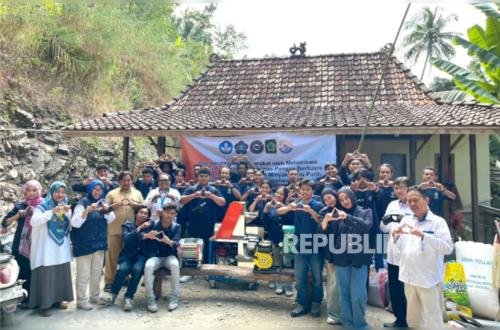
Cassava is often viewed as a simple, ordinary local food staple on the daily dining table. Yet, if managed with the right and creative approach, this abundant commodity holds extraordinary potential to drive the economy while strengthening food security based on local wisdom.
Awareness of the importance of processing the potential of regional foodstuffs prompted Universitas AKPRIND Indonesia, together with Universitas Gunung Kidul, to organise the Student Community Empowerment Grant Programme (PMM) in Padukuhan Clapar I, Hargowilis Village, Kokap District, Kulon Progo Regency. This step aims to change the community’s perspective and habits in utilising their agricultural produce.
Rather than merely selling cassava in raw form with relatively low selling value, appropriate technology is being introduced so that processed cassava can be upgraded into a variety of food products that are more attractive, competitive, and of high economic value. This empowerment programme realises its vision thanks to funding from the Directorate of Research and Community Service (DPPM), Directorate General of Research and Development, Ministry of Higher Education, Science, and Technology (Kemdiktisaintek) of the Republic of Indonesia.
Yuli Purwanto, S.T., M.Eng., chair of the PMM programme at Universitas AKPRIND Indonesia, said the programme was specifically designed to effectively optimise the local potential of the surrounding community. “We have directed this programme so that the cassava potential in the community is not only sold as raw material. With the support of appropriate technology, cassava can be processed into various products that have added value and the potential to increase community income,” Yuli said in a written statement received by Republika on Thursday (13/8/2026).
A self-reliant and sustainable lifestyle approach is at the core of this movement. According to Yuli, providing physical assistance in the form of technical equipment alone will not be enough to guarantee long-term change. In his view, the community needs intensive mentoring to be able to operate, maintain, and utilise the technology optimally and sustainably.