
Transformation Yields Results: BRI Records Solid Performance in Second Quarter
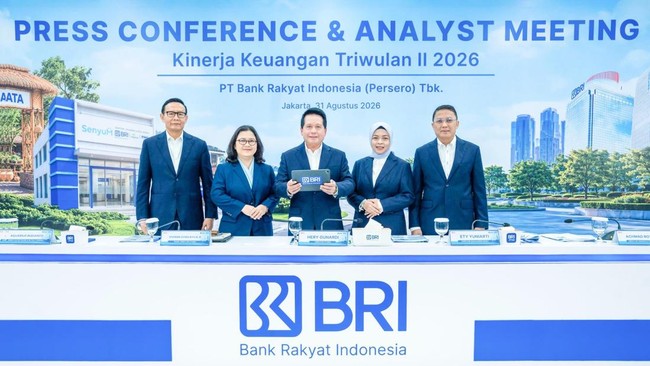
PT Bank Rakyat Indonesia (Persero) Tbk (BRI) continues to advance its corporate transformation agenda as a foundation for building healthy and sustainable business growth. This consistent transformation is now reflected in the strengthening of BRI’s performance, including a net profit of Rp31.2 trillion in the second quarter of 2026, representing a 17.5% year-on-year (yoy) growth.
BRI President Director Hery Gunardi stated that amidst high global economic dynamics and uncertainty, BRI has been able to maintain healthy growth momentum, improve asset quality, and strengthen profitability.
“The transformation we have consistently implemented since the new management arrived at BRI is starting to show positive results. We have strengthened our business, culture, efficiency, digitalisation, and risk management,” he said in an official statement on Wednesday (2/9/2026).
Hery added that BRI views sustainable growth not merely by the magnitude of profit generated, but primarily by the quality of that growth itself. Therefore, the company continues to encourage selective and prudent business expansion, maintaining asset quality, increasing efficiency, and strengthening governance and risk management across all business lines.
Through ‘BRIVolution Reignite’, BRI is continuing its transformation with two major simultaneous agendas: strengthening funding and improving existing core businesses while building new growth sources. Regarding funding, BRI is focusing on expanding its low-cost and transactional fund base through an ecosystem-based approach. This strategy is implemented by maximising digital channel capabilities, ranging from merchant acquisition and increasing BRImo and QRIS transactions to the BRILink Agent network. Simultaneously, BRI is deepening penetration into business clusters, integrating value chains, and optimising the ‘One BRI Solution’.
In its core business, BRI is revamping the micro segment, which has long been the company’s primary strength. At the same time, BRI is building new growth sources, focusing on optimising value chain and ecosystem potential, refining product value propositions, and targeting high-quality customers, as well as expanding bullion bank services through BRI Group synergy.
Furthermore, Hery noted that with increasingly strong fundamentals and a clearer transformation direction, BRI is optimistic about maintaining its positive momentum. This strengthening also provides space for BRI to continue its role in supporting various government priority agendas and driving the national economy, while maintaining asset quality and applying the principle of prudence.
“For BRI, supporting government programmes and maintaining asset quality are not contradictory. In fact, both must go hand in hand so that the growth we generate today can become sustainable growth in the long term,” he continued.
In driving and accelerating Indonesia’s sustainable economic growth, BRI actively serves as a government partner in promoting development and economic inclusion. This role is carried out through the distribution of People’s Business Credit (KUR), FLPP, support for the Free Nutritious Meal Programme, and the development of Red and White Village/Sub-district Cooperatives, as well as the distribution of various social assistance such as PKH, Sembako Stimulus, and BLTS Kesra. These programmes are part of BRI’s efforts to expand the economic impact on the grassroots and increase community welfare inclusively.
BRI’s role in supporting national development agendas runs alongside the company’s efforts to strengthen fundamentals and maintain business growth quality. This is reflected in BRI’s performance up to the second quarter of 2026, which remains solid in terms of business growth, profitability, efficiency, and asset quality.
As of Q2 2026, BRI’s total assets reached Rp2,352 trillion, growing 11.7% year-on-year. Credit distribution grew even higher at 16.2% to Rp1,646 trillion, while Third-Party Funds (DPK) reached Rp1,581 trillion, up 6.7% yoy. BRI is not only focusing on increasing DPK volume but also strengthening funding quality by increasing the CASA ratio.
The increase in profitability was accompanied by improvements in efficiency and asset quality. The Cost of Fund (CoF) on a bank-only basis decreased from 3.0% to 2.4%, while the Cost to Income Ratio (CIR) improved from 41.9% to 39.2%. Regarding asset quality, the Non-Performing Loan (NPL) ratio dropped from 3.0% to 2.9%, while the Cost of Credit (CoC) improved from 3.4% to 3.1%.
This strengthening of fundamentals also supports the company’s ability to generate solid returns. BRI’s ROA remained stable at around 2.7%, while the Return on Equity (ROE) increased from 16.6% in Q2 2025 to 18.8% in Q2 2026.
Despite the ongoing transformation, Hery emphasised that BRI’s DNA remains the same: growing alongside Indonesia’s grassroots economy. MSMEs will remain BRI’s core business. Therefore, the success of the transformation is measured not only by BRI’s ability to improve performance but also by how much that growth creates value and drives community economic activity.