
Transformation Proceeding Smoothly, Kimia Farma (KAEF) Business Improving
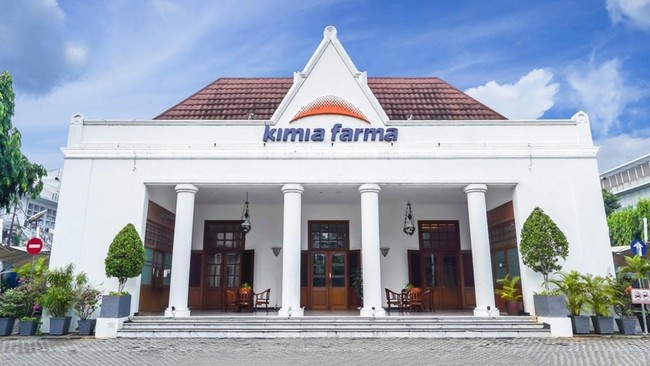
PT Kimia Farma (Persero) Tbk (KAEF) has reaffirmed its commitment to conducting a comprehensive business transformation, including the improvement of Good Corporate Governance, as mandated by Danantara as its controlling shareholder.
KAEF is undertaking fundamental business improvements with a focus on financial restructuring, product portfolio adjustment, operational efficiency, digitalisation, and the settlement of strategic past obligations. With the support of Danantara, the “New Kimia Farma” is now operating on a much stronger, transparent, digitised, and measurable profit-oriented business foundation.
KAEF President Director, Djagad Prakasa Dwialam, expressed gratitude for Danantara’s support, which has enabled KAEF to execute its business transformation rapidly. “Danantara’s support is a vital catalyst for Kimia Farma. The new management has conducted analyses and learned from the burdens of the past caused by over-investment and weak oversight systems. Following those past errors, we have implemented comprehensive corrective and preventive measures that are now fully operational,” Djagad stated in an official statement on Thursday (3/9/2/2026).
Through fundamental system improvements and operational and financial rationalisation, KAEF has successfully transformed its business at pace. After successfully reducing net losses from Rp842 billion throughout 2024 to Rp334.9 billion in 2025, KAEF’s performance continues to improve, recording a net profit of Rp54.07 billion in the first half of 2026.
This profit aligns with the growth of the company’s net sales, which reached Rp4.70 trillion, a 7.6% increase compared to the Rp4.36 trillion recorded in the first half of 2025. Operating profit also surged by 111.3% to Rp152.21 billion from the previous Rp72.01 billion.
According to Djagad, these visible improvements are essential prerequisites for future business breakthroughs, allowing KAEF to continue serving as the backbone of Indonesian healthcare services. “We are grateful to Danantara for providing the management with the space to undertake various business steps and self-improvement. It has not been easy, but thanks to the cooperation of all parties, KAEF is emerging from its difficulties and is now in a better position,” he said.
Djagad acknowledged that the message from Danantara COO Dony Oskaria would serve as an important lesson for KAEF management. Various corrective and preventive efforts are being maintained to ensure that past mistakes, as noted by Dony Oskaria, do not recur.
As an example of addressing past issues such as factory inefficiency and low return on investment (ROI), KAEF has restructured its production strategy. KAEF is now focusing its production capacity on high-margin flagship products with solid market demand certainty. This portfolio rationalisation strategy has directly proven to increase production facility utilisation to efficient levels. Additionally, KAEF continues to increase the use of domestic medicinal raw materials for its drug production.
In line with this, KAEF management has implemented improvements to the reporting and inventory systems of its subsidiary, Kimia Farma Apotek. Moving away from manual recording prone to error, KAEF now operates an integrated end-to-end IT system that connects thousands of pharmacies across Indonesia in real-time. This digitalisation of governance ensures that the entire drug distribution flow and stock availability can be tracked with high precision at every management level.
“The new Kimia Farma is an entity that is transparent, rational in its expansion, and fully focused on operational fundamentals. We are committed to maintaining this positive momentum to ensure KAEF continues to be the backbone of national health resilience, financially robust and at the forefront of serving the health of the Indonesian people,” Djagad concluded.