
Transformation from Upstream to Downstream: Minister of PANRB Outlines 2026 Work Plan
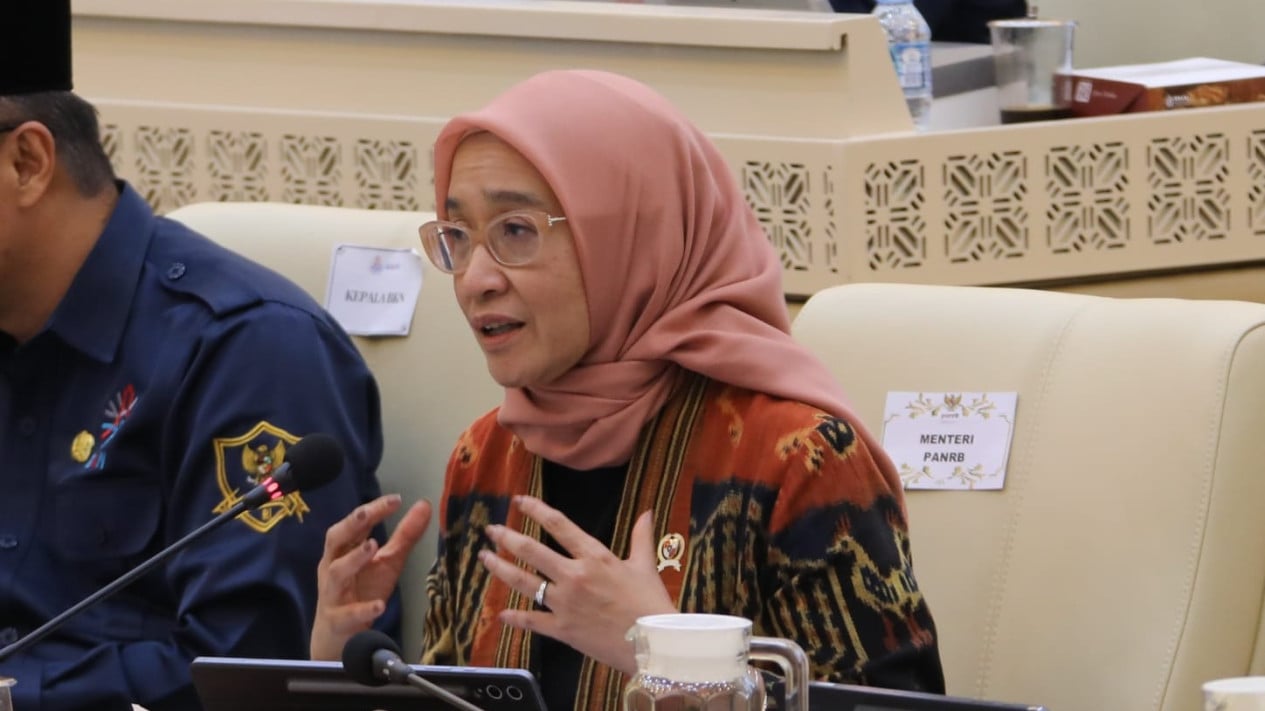
Minister of State Apparatus Utilization and Bureaucratic Reform (PANRB) Rini Widyantini has outlined her agency’s policy direction in line with the government’s 2026 performance plan (RKP). The RKP 2026 carries the theme of Food and Energy Sovereignty as well as a Productive and Inclusive Economy.
“We support the RKP 2026 through five main agendas, namely strengthening bureaucratic reform and performance accountability, institutional arrangement and business process improvement, ASN management transformation, public service transformation, and strengthening digital government governance,” said Rini during a working meeting with Commission II of the House of Representatives (DPR RI) on the 2026 Work Programme and Follow-up to BPK Audit Results, in Jakarta on Tuesday (31/3/2026).
All of the Ministry of PANRB’s programmes not only meet internal targets but are directed to become drivers of achieving Golden Indonesia 2045. As an effort to strengthen bureaucratic reform and performance accountability, the Ministry of PANRB targets an accountable bureaucracy that impacts society.
This year’s bureaucratic reform strategy focuses on two aspects. The first is the implementation of the National Bureaucratic Reform Grand Design 2025-2045 and the National Bureaucratic Reform Roadmap 2025-2029 in government agencies. The second is the transformation of integrated government performance accountability based on shared outcomes.
Bureaucratic reform is supported by strong institutions and integrated business processes. “The Ministry of PANRB targets an organisational structure that is fit for purpose, efficient, and synergistic, as well as adaptive and measurable governance,” Rini explained.
Rini emphasised that her team will align the structure and institutional governance of agencies with the government’s priority programmes and development priorities. Institutions are arranged to be fit for purpose and synergistic, up to standardising performance-based bureaucratic administration.
Rini also explained the concept of flexible working arrangements (FWA) for ASN, which is currently being discussed in the public sphere. In addition to responding to global conditions, this FWA is also to accustom ASN so that their achievements are not based on attendance, but on performance.
This concept certainly does not equate FWA with holidays. There are targets that must be achieved. Rini also assured that essential public services will not be disrupted by this concept. “In essence, the work from home that is mentioned is more about emphasising how we transform in government governance. So it is indeed time for us to improve services to the public that are digital-based while still paying attention to essential services,” Rini stressed.