
Training Students to Handle Emergencies and Disasters in Laboratory Settings
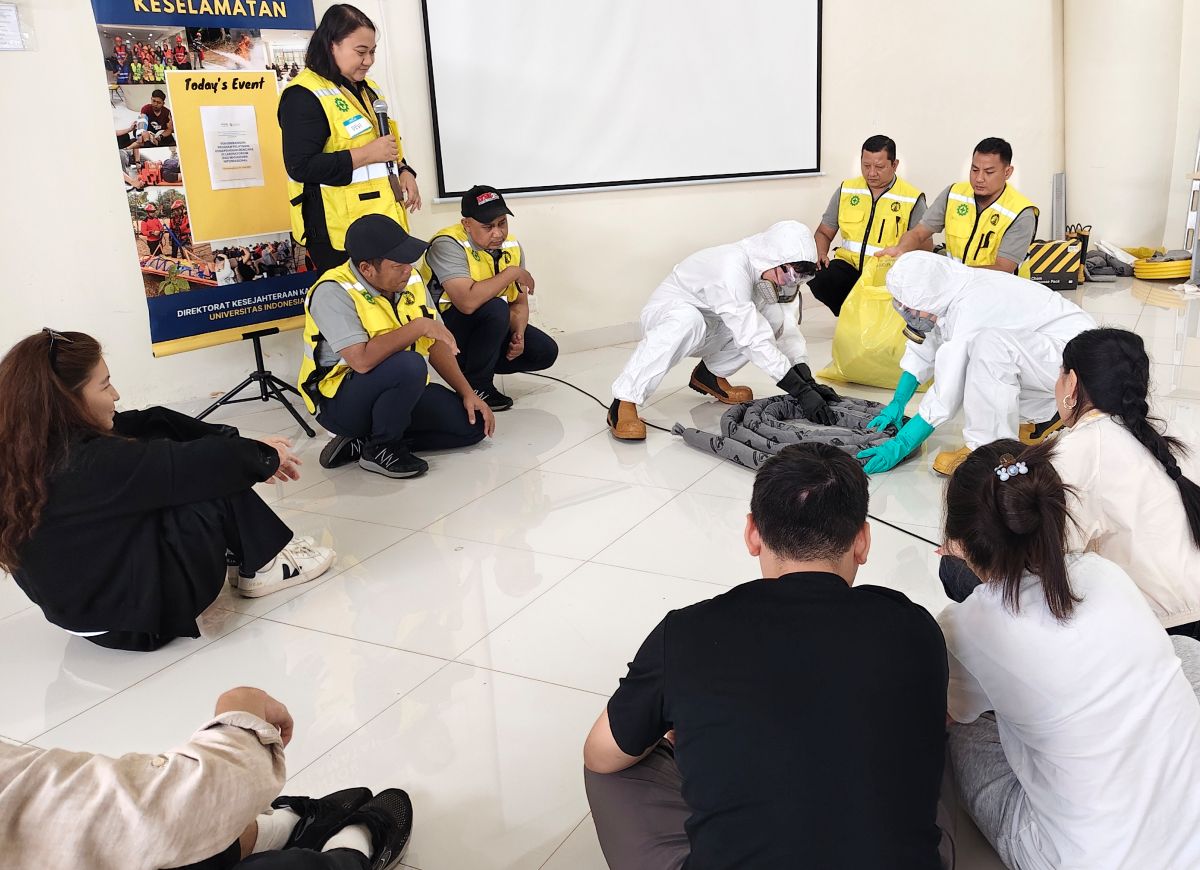
Universitas Indonesia (UI) organised a Laboratory Disaster Preparedness Training Programme specifically for international students. The event took place on 10–11 May 2026 at UI’s Depok campus and involved international students from Asfendiyarov Kazakh National Medical University, Kazakhstan.
The programme forms part of UI’s International Community Service Programme, supported by the Community Development Programme Enhancing Quality Education for International Impacts and Recognition (EQUITY) Grant from Universitas Indonesia for 2025–2026. Through this collaboration, UI aims to promote knowledge and cultural exchange, as well as the development of safety capacity on a global scale.
The Training Programme Lead, Rezi Riadhi Syahdi, explained that campus laboratories carry a high potential for occupational risks. Therefore, grounding in safety culture is crucial for international students actively conducting research in Indonesia.
“This module is expected to equip international students engaged in campus activities, especially in laboratories, which are not only places to gain education and skills but also carry various occupational risks,” Rezi said in a statement on Friday, 22 May 2026.
CPR simulations to chemical spill response
The training was designed comprehensively, combining theoretical study with hands-on field practice. The training material focused on three main emergency aspects: Basic First Aid for Accidents (P3K) including Basic Life Support (BLS/CPR), stabilization and immobilisation of victims, and methods for lifting and moving injured persons. Then, a safe drill using a Portable Fire Extinguisher (APAR).
Next, laboratory emergencies and earthquake mitigation covering procedures for handling hazardous chemical spills in the workspace, and steps for mitigating during an earthquake.
In its execution, Rezi was assisted by Meidi Utami Puteri, Ph.D., a lecturer from the UI Faculty of Pharmacy, and involved seven cross-faculty students from the Faculty of Pharmacy and the Faculty of Public Health (FKM UI). The training was also supported by staff from the Office of Safety and Environment (K2L) of the UI Campus Welfare Directorate.
Going forward, Rezi projected that the training module would continue to be developed to be adaptive to the specific characteristics and safety challenges of various laboratory types within UI.
The programme has received positive responses from the international participants. One student from Kazakhstan, Zhanbota Mukasheva, said that the hands-on CPR session was the most challenging yet useful experience for her.
“For me, the most interesting part was when giving CPR. Doing it for two minutes proved to be very draining and difficult. The training is not only beneficial but also engaging,” Zhanbota said in English.
She also hopes that the emergency skills gained during the two days at UI can be applied to help herself and others if a real critical situation arises.
In addition to receiving training certificates, the international students had the opportunity to take a campus tour to view laboratory facilities in UI’s Health Sciences Cluster (RIK) and visit several iconic campus landmarks. This programme also supports the achievement of the Sustainable Development Goals (SDGs), particularly in relation to quality education, good health, and global partnerships.