
Train Driver Named Suspect in Bintaro Tragedy, Dismissed and Left in Misery
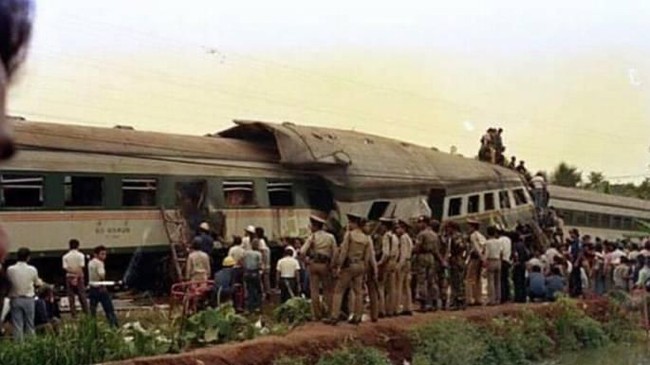
Transport accidents almost never occur due to the error of a single individual. Usually, there are various interconnected layers of problems. However, it is not uncommon for blame to be placed on a few individuals.
This is the experience of Slamet Suradio, the driver of train KA 225 involved in the collision with KA 220 in Bintaro in 1987. Slamet was subsequently named a suspect in the tragedy that claimed hundreds of lives.
Recalling the event, the head-on collision occurred when two trains were on the same track. Slamet, in the locomotive of KA 225, was unaware of the presence of another train ahead of him. The driver of KA 220 was similarly unaware.
As a result, KA 225, travelling at approximately 45 km/h, collided with KA 220, which was travelling at around 25 km/h. Slamet himself sustained severe injuries but survived the accident.
Scrutiny then turned towards Slamet, especially after the police and the Joint Investigation Team for Railway Accident Events (Gappka) identified four PJKA employees as being at fault. These individuals were the Station Master (PPKA) of Sudimara, the Station Master of Kebayoran, the driver of KA 225, Slamet Suradio, and the conductor of KA 225.
According to reports in the Waspada newspaper (24 October 1987), the Sudimara Station Master was found at fault for notifying the conductor and driver of KA 225 regarding a change in the crossing point from Sudimara to Kebayoran without the approval of the Kebayoran Station Master.
Meanwhile, the Kebayoran Station Master was deemed at fault for dispatching KA 220 without the approval of the Sudimara Station Master. For Slamet, the fault related to the departure of KA 225 after receiving notification regarding the crossing without an official order from the Station Master or the lead conductor of KA 225.
Additionally, the conductor of KA 225 was found guilty of failing to attempt to stop the train under his responsibility, despite knowing that the Station Master had not yet granted permission to depart.
However, during the trial, it emerged that the issue was not as simple as two trains being on the same track. Various other issues were revealed to have contributed to the tragedy.
One such issue was passenger numbers. Both trains were carrying hundreds of unauthorised passengers beyond the number of recorded ticket holders. Of those with tickets, it was known that KA 225 carried 700 passengers, while KA 220 carried 500.
Slamet’s working conditions also came under judicial scrutiny. Citing the Neraca newspaper (22 August 1988), the judge highlighted that he had been operating trains since the morning before immediately being assigned a follow-up service, indicating an excessive workload.
“For example, Slamet had just operated a train on 19 October at around 06:00 WIB on the Tanah Abang-Merak route. However, he was allowed to immediately operate a follow-up train because it was assumed he was accustomed to it, until the collision finally occurred,” stated the Neraca newspaper (22 August 1988).
Furthermore, scheduling issues, passenger management, communication systems, signalling, and the lack of double tracks were all part of the series of problems underlying the tragedy.
Despite these revelations, the legal process resulted in convictions for the four employees. According to the Waspada newspaper (22 August 1988), Slamet was sentenced to five years in prison, while the other suspects received sentences ranging from 10 months to 2.5 years.
For Slamet, the case altered his entire life. He served his prison sentence, lost his job as a railway employee, and lost his family. His dismissal also meant he was ineligible for a pension. Slamet passed away in June 2026.