
Traditional Medicine Training Sharpens Indonesian Medical Skills
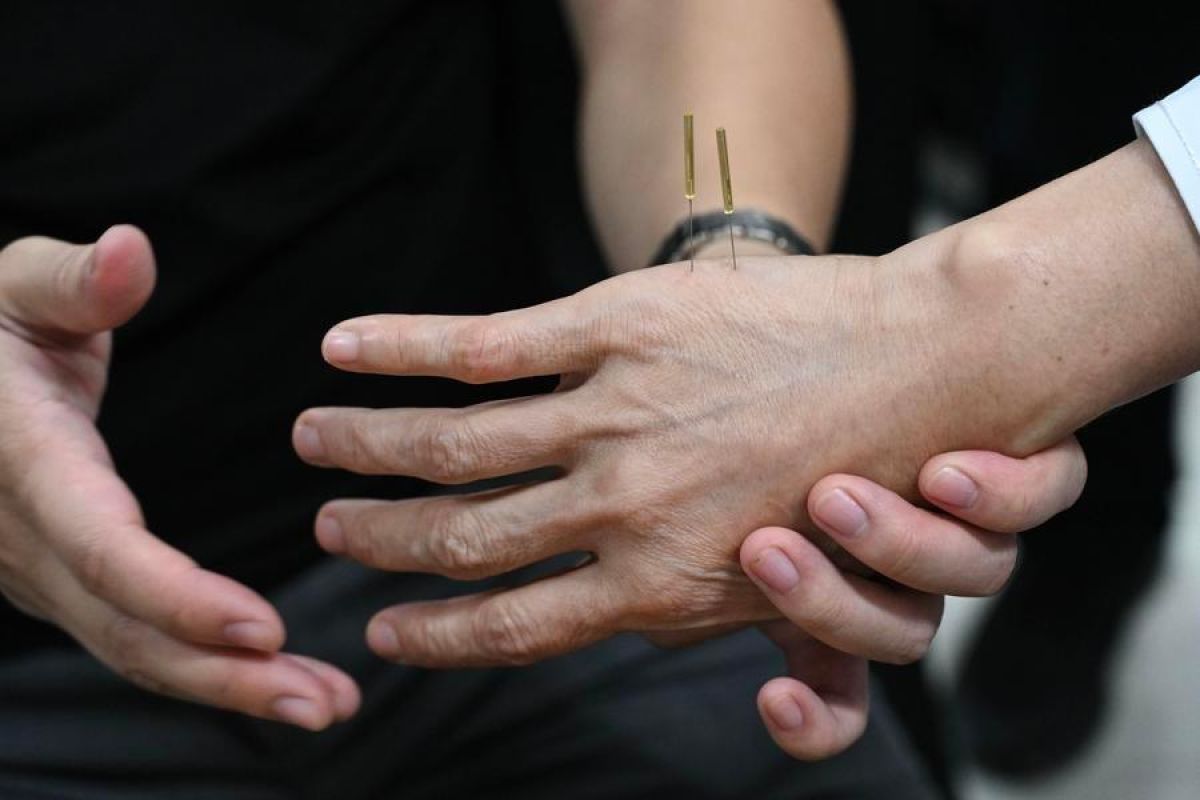
Jakarta (ANTARA) – For three gruelling months, even simple movements caused pain in Dr Hetty Helen’s hand. As a doctor at Panglima Besar Soedirman National Defence Central Hospital (RSPPN) in Jakarta, she finally found relief from an unexpected source: the hands of a traditional Chinese medicine (TCM) practitioner.
“My hand feels lighter and better,” Hetty said, her face clearly showing relief. Having tried acupuncture before, she said the techniques used by the Chinese medical team felt much more precise because they targeted the source of her pain directly.
Hetty’s experience underlined the distinctive value of TCM and the vital role of medical exchanges in strengthening Indonesia’s healthcare capabilities.
Under the Belt and Road Acupuncture Station initiative, launched at RSPPN Panglima Besar Soedirman, Chinese specialists worked alongside Indonesian medical staff from 13 to 15 October.
The programme included clinical training, free public consultations and practical workshops on advanced AI-assisted TCM diagnostics.
Organised by the Shenzhen Shouzheng Innovative TCM Development Foundation, the training went beyond theory, guiding participants on needle safety, emergency procedures and the precise location of acupuncture points.
Doctors and students rolled up their sleeves to practise specialised techniques for shoulder and knee problems, as well as scalp and abdominal acupuncture.
For Indonesian medical trainees, the programme bridged the gap between textbooks and clinical realities, building confidence through hands-on practice that they rarely get under expert guidance.
Natalia Santoso, a student of acupuncture and herbal medicine in Jakarta, said she had a moment of understanding during the workshop. Learning directly from Chinese experts helped her make sense of techniques that had long confused her.
“Studying TCM, which we consider difficult, turns out not to be so hard once we understand the key points or acupuncture points,” she said.
Natalia added that hearing concepts explained directly by native Mandarin speakers gave her a much deeper understanding than reading translated Indonesian-language textbooks.
Alongside traditional techniques, the programme introduced participants to AI-based TCM diagnostic devices, offering a first-hand look at the future of digital healthcare.
Hetty Helen Yanti, head of the hospital’s TCM department, said cross-border collaboration of this kind enabled local doctors to hone their skills, particularly in identifying acupuncture points with a high degree of precision.
Hafna Rosita of the Indonesian Traditional Health Council described the exchange as a two-fold opportunity: to improve local practitioners’ skills and promote the development of Indonesia’s own traditional medicine.
“TCM has developed rapidly, with extensive documentation, analysis and research,” Hafna said, adding that Indonesian traditional medicine also had significant untapped potential.
The two systems could complement one another, for example by combining precision acupuncture techniques with Indonesia’s rich herbal remedies, she said.
Dr David Song, a doctor in the hospital’s Traditional Indonesian and Chinese Medicine (TICM) division, said the initiative ultimately aimed to combine Indonesian local medicine with time-tested Chinese practices.
“Through the TICM division at RSPPN Panglima Besar Soedirman, we are seeking to integrate local Indonesian herbal remedies, known as jamu, with thousands of years of TCM knowledge, to better meet the healthcare needs of our community,” David said.
Looking ahead, David said he was confident that partnerships with Chinese institutions would foster deeper exchanges in medical technology, research and clinical training.
Chen Zhigeng, medical department director at Wenzhi Traditional Chinese Medicine, an AI-based digital healthcare company focused on TCM, said the programme’s results had far exceeded expectations and expressed strong hopes for an enduring partnership.
The event served as a bridge for medical and cultural exchange, enabling Chinese participants and their Indonesian partners to learn from one another and deepen long-term cooperation in traditional healthcare, he said.