
Traders Reveal Premium Rice is Increasingly Scarce, Here's the Likely Cause
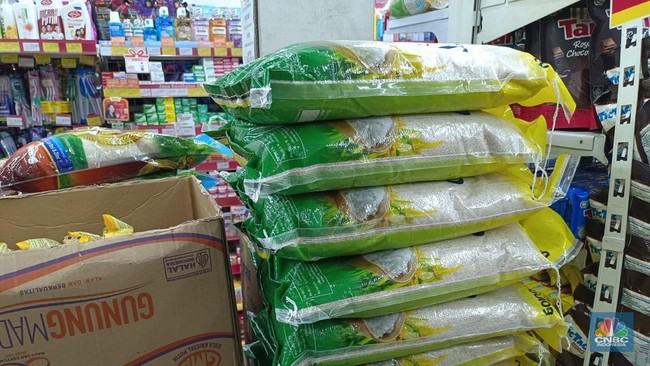
The Chairman of the Cipinang Rice Wholesale Market Traders Cooperative (KOPIC), Dedy, claims that premium rice stocks are becoming increasingly scarce in the market and prices continue to creep up, because rice producers are now choosing to switch to producing special or fortified rice which is considered more profitable. He said this is because rice producers are now struggling to sell premium rice in accordance with the Highest Retail Price (HET) regulations, as the price of unhusked rice as a raw material continues to rise. “As far as I know, Bulog wants to produce premium SPHP rice, perhaps this is the impact of the premium rice vacuum at the retail level. Because many rice producers are no longer able to sell at the retail level where the price is capped at Rp14,900 per kg. Clearly this is very reasonable because they are getting expensive raw materials (unhusked rice),” Dedy told CNBC Indonesia. This view aligns with the analysis of agricultural observer from the Center of Reform on Economics (CORE), Eliza Mardian. According to her, the condition is triggered by reduced premium rice supply amid a spike in unhusked rice prices, causing producers to switch to producing fortified rice. Eliza assessed that the continuously rising price of unhusked rice has made the profit margins for premium rice producers increasingly thin. On the other hand, producers are also constrained by the highest retail price (HET) regulation, limiting their room to raise prices. “Now the large mills are switching to producing more fortified rice because the unhusked rice price is already high,” Eliza said when contacted separately. She explained that this shift is a normal business decision because fortified rice is considered to provide added value and greater profits compared to premium rice. “Because the price of unhusked rice is already expensive now, producers prefer to produce fortified rice rather than premium because the margin is very small, while the price of raw materials, unhusked rice, has risen, and producers cannot raise prices because of the HET rules,” she clarified. “Basically, companies maximise profit. If the incentive to produce premium rice is lacking, then they will switch to producing something more profitable,” she added. As a result of this production shift, the supply of premium rice in the market has shrunk, making the product increasingly difficult to obtain. According to Eliza, consumers who previously bought premium rice are now starting to switch to fortified rice. “The supply is decreasing. Upper-middle-class consumers, because their purchasing power is high, when premium is not available, they switch to fortified rice,” said Eliza. Besides being influenced by the production shift, Eliza said the increase in unhusked rice prices also occurs as production begins to decline after the second harvest season. Production of dry unhusked rice (GKG) in June 2026 was recorded at 4.19 million tonnes, lower than May 2026 which reached 4.92 million tonnes. Meanwhile, the price of unhusked rice in Lampung and East Java has been in the range of Rp7,600-Rp8,000 per kilogramme. At the same time, Perum Bulog is still continuing to absorb farmers’ unhusked rice to meet the government’s rice reserve stock (CBP) target. This condition puts Bulog in competition with corporations in obtaining unhusked rice, while small and medium mills are increasingly struggling to get raw materials due to capital limitations. Eliza added that this condition also impacts the middle class whose purchasing power is under pressure. When the price of premium rice continues to rise or it becomes hard to find, some consumers are forced to downgrade their choice to medium rice or reduce their rice consumption. “It is true that the middle class, whose purchasing power is weakening, will find it increasingly difficult to buy premium rice. However, because this staple food is inelastic in nature, no matter the price, it will be bought, as long as it is available,” she said. “The strategy for the middle class with increasingly weak purchasing power is to be forced into the existing medium segment. Or reduce rice consumption, replace it with wheat products that are cheaper than rice, and switch to other food sources,” concluded Eliza.