
Trade Surplus Shrinks, Indonesia's Current Account Deficit Threatened to Widen
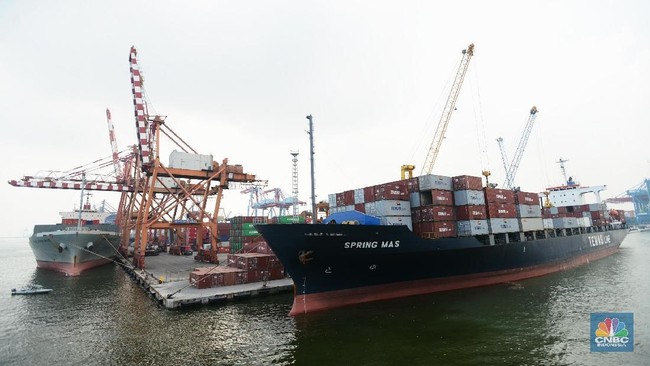
Jakarta, CNBC Indonesia - The Indonesian Central Statistics Agency (BPS) recorded a deep contraction in Indonesia’s trade balance surplus in April 2026, falling to just US$ 90 million from the US$ 3.32 billion recorded in March 2026.
This condition was triggered by a surge in Indonesian imports, which rose by 22.49% in April 2026 to US$ 25.21 billion, while exports remained slightly higher at US$ 25.30 billion, despite a lower growth rate of 21.98%.
The increase in imports was driven by the depreciation of the rupiah, which inflated the cost of imported goods, and rising commodity prices, particularly for oil and gas.
Fakhrul Fulvian, Chief Economist at Trimegah Sekuritas Indonesia, confirmed this, noting that Indonesia’s trade performance in April 2026 signals increasing pressure on the external balance, following the spike in oil and gas imports and the ongoing impact of the Middle East conflict on global energy prices.
According to Fakhrul, the market’s primary concern is no longer just the scale of Indonesia’s exports, but the speed at which rising energy imports are eroding the trade surplus. “If we look at the detailed data, the increase in oil and gas imports is very significant. In April 2026, oil and gas imports reached US$ 4.60 billion, up more than 80% compared to the same period last year. This surge primarily stems from imports of petroleum products and crude oil, which increased sharply due to rising energy needs and the impact of the war in the Middle East on global oil prices,” Fakhrul told CNBC Indonesia on Wednesday (3/6/2026).
He noted that Indonesia’s oil and gas sector deficit reached US$ 3.44 billion in April 2026, while the non-oil and gas surplus of US$ 3.53 billion was almost entirely consumed to cover energy import needs. Consequently, the national trade surplus was left at approximately US$ 89 million.
Fakhrul emphasised that this situation requires attention as commodity trade serves as the primary foundation for Indonesia’s current account transactions. “In recent years, Indonesia has been relatively aided by large commodity trade surpluses. However, when energy prices rise and oil and gas imports increase, that cushion begins to thin. If this trend continues, we could potentially see a widening of the current account deficit in the second quarter of this year.”
Fakhrul assessed that the risk is increasingly relevant as energy inflation pressures are becoming visible domestically. May inflation data shows that the transportation group still experienced significant price increases, particularly for petrol, diesel, airfares, and lubricants. This indicates that the impact of the war has not yet fully subsided and is still permeating the domestic economy.
Faklam also warned that financial markets are typically more sensitive to changes in the balance of payments than to export growth alone. “What investors are watching now is whether Indonesia can still generate a large enough foreign exchange surplus to finance its external needs. When the trade surplus drops from billions of dollars to just tens of millions in a single month, the market will certainly begin to question the future direction of the current account.”
Therefore, according to Fakhrul, these recent developments reinforce the urgency of improving the macroeconomic policy mix. He noted that Bank Indonesia (BI) has taken the right step by raising interest rates by 50 basis points last month. However, he emphasised that rupiah stability cannot be supported by monetary policy alone; improving the structure of the balance of payments must be a priority. “In this context, a more credible yield curve and aligned fiscal policy will be crucial to maintaining investor confidence,” he said.
Faisal Rachman, Head of Macroeconomics & Market Research at Permata Bank, predicts that Indonesia’s current account deficit will widen in 2026, driven by pro-growth domestic policies and slowing global demand, with additional downside risks from geopolitical tensions in the Middle East.
“Assuming geopolitical tensions subside significantly in the second half of 2026, we project the current account deficit (CAD) will widen to 1.07% of GDP in 2026, from a deficit of 0.11% of GDP in 2025,” Faisal stated in his notes.
Faisal observed that Indonesia’s trade balance will likely continue to record a surplus, but that surplus is expected to narrow gradually as import growth outpaces export growth. “This reflects the government’s pro-growth policy stance, which is expected to strengthen domestic demand and ultimately increase imports.”
Regarding exports, growth is likely to return to normal after the early shipments to the US last year, while weaker global demand, particularly from China, is expected to weigh on export performance. Faisal emphasised that Middle East geopolitical tensions present further downside risks to Indonesia’s external sector. Increased tensions could weaken global economic activity and external demand, thereby dampening export growth. Simultaneously, higher global energy prices could increase Indonesia’s import bills, particularly for fuel-related imports, putting additional pressure on the trade and current accounts. He noted that these conditions support Bank Indonesia’s decision to maintain its current monetary policy, which remains focused on maintaining stability, specifically regarding the BI interest rate path.