
Trade Ministry Urges Businesses to Use ASEAN Plus Agreements to Expand Export Markets
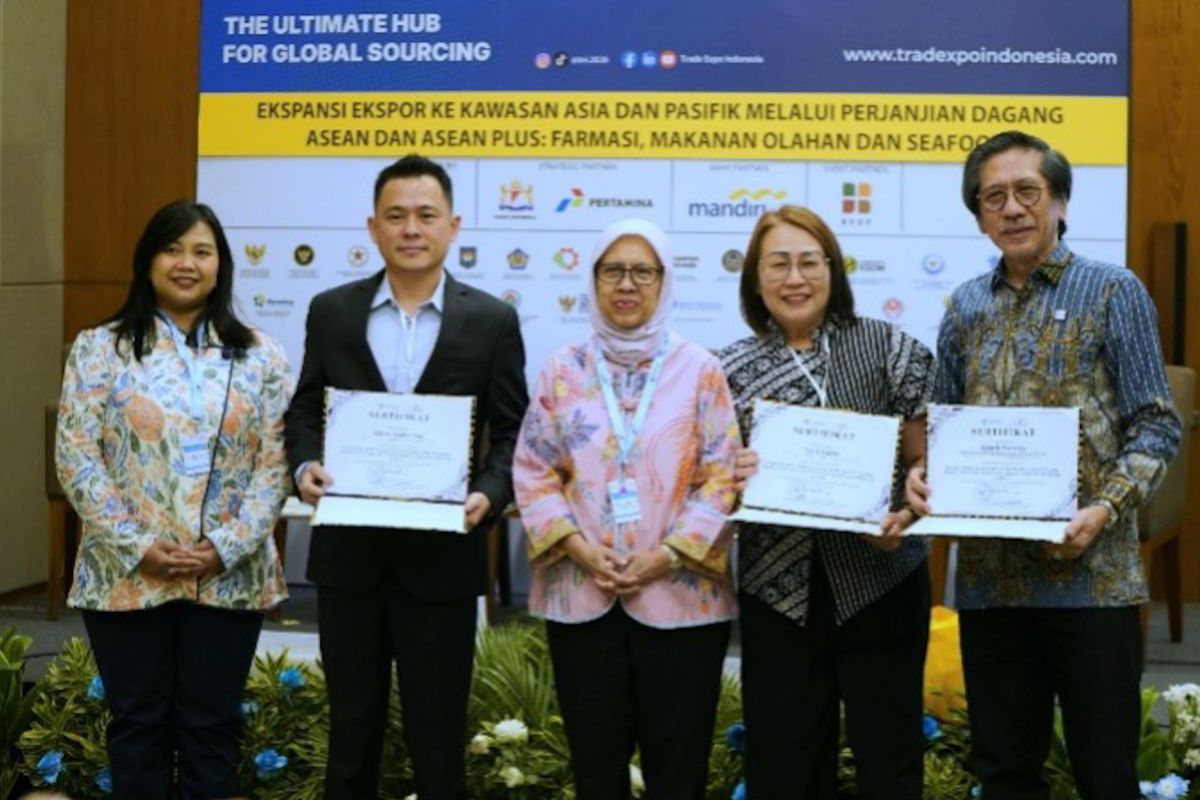
Using ASEAN and ASEAN Plus trade agreements is a strategic way to broaden market access for pharmaceutical products, processed food and seafood across Asia and the Pacific.
Jakarta (ANTARA) — The Ministry of Trade is encouraging businesses to take advantage of ASEAN Plus trade agreements to expand export markets, improve product competitiveness and unlock trade opportunities in the Asia-Pacific region.
“Using ASEAN and ASEAN Plus trade agreements is a strategic way to broaden market access for pharmaceutical products, processed food and seafood across Asia and the Pacific,” Nugraheni Prasetya Hastuti, the ministry’s Director of ASEAN Negotiations, said in a statement in Jakarta on Sunday.
She said businesses could benefit from preferential tariff facilities, make their products more competitive and reach potential markets in ASEAN partner countries. Micro, small and medium-sized enterprises (MSMEs) could also take advantage of these opportunities.
She made the remarks while opening a seminar in Tangerang Regency, Banten, entitled “Export Expansion to Asia and the Pacific through ASEAN and ASEAN Plus Trade Agreements: Pharmaceuticals, Processed Food and Seafood”.
The seminar was part of the 41st Trade Expo Indonesia (TEI), held at the Indonesia Convention Exhibition (ICE) in BSD City, Tangerang.
Nugraheni said ASEAN had eight trade agreement arrangements in operation: one covering the 10 ASEAN member states, six with dialogue partners such as China, South Korea and Japan, and one mega free trade agreement, the Regional Comprehensive Economic Partnership (RCEP).
“Indonesian businesses must be able to take advantage of ASEAN’s various cooperation arrangements because they cover large markets,” she said.
She said several ASEAN partner countries under the ASEAN Plus One arrangements had sizeable imports from around the world of pharmaceuticals, processed food and seafood.
South Korea had the largest import value across the three product groups, at US$36.7 billion, followed by Australia at US$29.48 billion and New Zealand at US$2.39 billion. The Philippines and Thailand were also potential markets for Indonesian products.
Jahja B. Soenarjo, deputy chairman for trade at the Indonesian Employers Association (Apindo), said businesses needed supportive policies and regulations that made exporting easier and helped widen access to international markets.
He said the strategy should also include meeting product standards and certification requirements, structured training, export assistance for MSMEs and participation in domestic and overseas trade fairs.
Improving access to global market information and data, strengthening the role of business associations and diplomatic representatives, and making use of Indonesian diaspora networks in other countries could also help expand exports, he said.
“Indonesian diaspora networks in various countries can also be used to help widen access to export markets,” Jahja said.
Junita Syartika Syarief, Indonesia’s Trade Attaché in Beijing, said China was a potential market for Indonesian seafood, processed food and raw materials for the traditional medicine industry.
To make the most of that opportunity, businesses needed to understand the relevant rules and technical requirements, including food safety and quarantine measures.
One key requirement is that of China’s General Administration of Customs (GACC), which plays an important role in the entry of certain products into the Chinese market.
Businesses seeking access to China’s large market must meet GACC requirements, which are particularly important for products subject to quarantine controls, she said.
“Even if a product is offered at a competitive price, it cannot enter the Chinese market if it does not meet GACC requirements,” Junita said.
Sylvia Kurnia of the Indonesian Food and Beverage Association’s (GAPMMI) Committee on International Cooperation said the food and beverage industry remained an important sector of Indonesia’s economy.
In the first half of 2026, the industry grew by 6.77 per cent and accounted for 41.86 per cent of non-oil and gas manufacturing’s contribution to gross domestic product. Exports from the food and beverage industry reached around US$24 billion over the same period.
Sylvia said barriers to trade within ASEAN needed to be addressed to maximise exports, including financial and regulatory obstacles.
These included limited cross-border payment systems and currency transactions, misaligned technical standards between countries, and higher sectoral taxes, she said.
“On the operational and market side, the challenges include limited logistics capacity and containers, parallel imports, and price competition,” Sylvia said.
Abrizal Andrew Ang, chairman of the Indonesian Pole & Line and Handline Fisheries Association (AP2HI), said Indonesia had abundant fisheries resources and an advantage in sustainable traditional fishing methods. He said free trade agreements should support these strengths to promote higher-value exports.
Source: jawawa.id (https://jawawa.id/newsitem/trade-ministry-urges-businesses-to-use-asean-plus-agreements-to-expand-export-markets-1792309857)
Originally published by Antara (Indonesian) (https://www.antaranews.com/berita/5794609/kemendag-minta-pelaku-usaha-manfaatkan-asean-plus-perluas-pasar-ekspor), translated from Indonesian