
Trade Ministry Responds to Proposal for State-Owned Enterprises to Fully Handle Minyakita
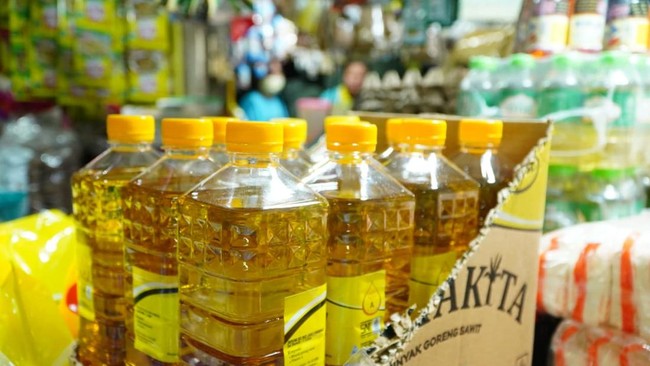
The Ministry of Trade (Kemendag) is still reviewing a proposal for the distribution of the people’s cooking oil brand Minyakita to be fully handled by State-Owned Enterprises (BUMN). The government considers that a decision cannot be made hastily as it concerns a distribution mechanism involving private business actors.
Director of Domestic Market Development at the Ministry of Trade, Nawandaru Dwi Putra, stated that the realisation of the Domestic Market Obligation (DMO) for BUMN has currently reached 50.49 per cent. Thus far, Minyakita distribution is still carried out jointly with private business actors.
‘If we look at the monthly DMO realisation graph carried out by exporters or exporting business actors, it is recorded that as of the period from 1 to 26 June (2026), the DMO realisation was recorded at 76 thousand tonnes,’ Nawandaru Dwi Putra said during the 2026 Regional Inflation Control Coordination Meeting on Monday (29/6/2026).
In addition, the Ministry of Trade is observing an increase in the number of cities/districts experiencing a rise in cooking oil prices, from 166 cities/districts to 170 cities/districts. Consequently, the Ministry of Trade will immediately coordinate further with food BUNNs to optimise the supply of cooking oil to regions experiencing these price increases.
Regardless, the national average price of Minyakita is still in the range of Rp 15,877 per litre. The existence of Minyakita serves as a balancer or stabiliser amidst fluctuations in global crude palm oil (CPO) prices.
Regarding the proposal for 100 per cent of the Minyakita DMO to be channelled through BUMN, Nawandaru emphasised that his party is still compiling a comprehensive study. According to him, a decision regarding the size of the Minyakita DMO portion, whether 60 per cent, 70 per cent, or 100 per cent, must go through technical discussions up to a ministerial-level coordination meeting because it concerns a national strategic policy.
Nawandaru continued that a cautious approach is certainly necessary considering the DMO scheme differs from a government subsidy. In this case, the Minyakita DMO programme does not use the state budget (APBN), but rather takes the form of an obligation for private cooking oil producers to the public through a business-to-business (B2B) mechanism.
‘This is what we must observe carefully, the mechanism differs from a subsidy. If it were a subsidy, we could perhaps transfer it directly under government authority, but because it is a contribution and B2B in nature, we need to decide this within the corridor of a limited coordination meeting,’ he said.
Previously, the Ministry of Trade had stated that the government was preparing to strengthen the role of food BUNNs such as Bulog and ID Food in the Minyakita distribution process. Currently, the distribution portion of Minyakita through BUMN is still around 35 per cent. However, the government is open to increasing this distribution portion to above 50 per cent as an initial stage before considering a larger distribution scheme.
The government assesses that Minyakita distribution through Bulog and ID Food is relatively easier to supervise, considering that the two BUNNs directly appoint retailers in the market. With this mechanism, retailers who sell Minyakita above the Highest Retail Price (HET) can be immediately removed from the list of product distributors.
Source: jawawa.id (https://jawawa.id/newsitem/trade-ministry-responds-to-proposal-for-state-owned-enterprises-to-fully-handle-minyakita-1782726741)
Originally published by CNBC Indonesia (https://www.cnbcindonesia.com/news/20260629140207-4-746536/ada-usulan-minyakita-ditangani-penuh-bumn-begini-respons-kemendag), translated from Indonesian