
Trade Minister to Request Alfamart, Indomaret and Others Sell Chicken Meat Amid Price Slump
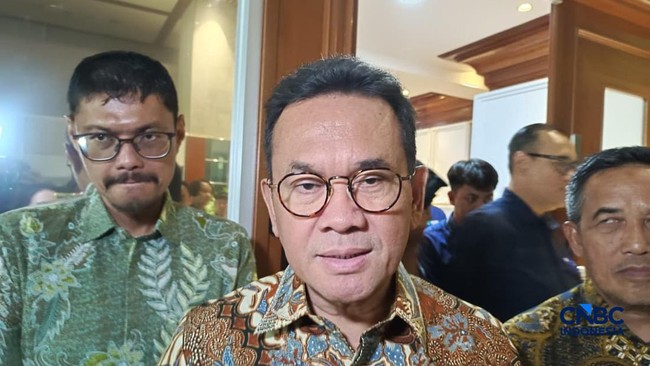
Jakarta, CNBC Indonesia - The government is starting to prepare measures to expand the market for broiler chicken meat, amid complaints from broiler farmers who are suffering losses due to the plummeting price of live birds.
Trade Minister Budi Santoso is even planning to directly contact the Chairman of the Indonesian Retailers Association (Aprindo), Solihin, to encourage the sale of chicken meat in modern retail networks, including minimarkets.
This move is a response to the aspirations of broiler chicken farmers who previously asked the government to expand distribution channels and sales of poultry products. One of the proposals put forward by farmers is to increase sales of chicken meat in national minimarket and supermarket networks to help absorb the abundant production.
Responding to the proposal, Budi said that basically there is no prohibition for modern retail to sell chicken meat.
“Indeed, it is allowed, chicken meat is allowed, there is no prohibition,” Budi said when met at the Parliament Complex, Jakarta, Wednesday (10/6/2026).
When pointed out that currently only some minimarkets sell chicken meat, Budi confirmed that his ministry would immediately coordinate with Aprindo.
“Oh yes, we will coordinate with Aprindo later so that it can enter modern retail,” he said.
According to Budi, expanding chicken meat sales in modern retail could be an instrument to help absorb supply when chicken meat prices at the farm level are under pressure.
However, he stressed that the government has also prepared an absorption scheme through the Free Nutritious Meal (MBG) Programme. So far, the programme has been largely linked to egg absorption. Going forward, chicken meat will also become part of the absorption scheme when prices fall.
“First, we previously agreed with MBG, so foodstuffs are not only eggs if prices fall then absorbed by MBG, but also includes chicken meat. We have already agreed, so later if the price falls it will be absorbed by MBG,” he explained.
Besides through MBG, the Ministry of Trade will also ask modern retail to increase absorption of chicken products when prices are weakening.
“Secondly, we will coordinate with Aprindo so that when prices fall, more is absorbed by modern retail as well,” he said.
He assessed that the relationship between farmers and traders needs to be strengthened through a partnership model to create a balance between supply and market absorption.
“We actually call the pattern a partnership, so we must synergise between producers and traders,” he explained.
Budi even admitted he would immediately contact Aprindo to discuss follow-up measures. “Ah, I will call them right after this,” he continued.
According to him, there is actually already a circular letter regarding the sale of food products in modern retail. However, further coordination will still be carried out with the retail association.
“Actually, the Circular Letter already exists, I will call again later,” Budi said.
“So the circular is already there, but we will call after this, meet Mr Solihin, the chairman of Aprindo. We always coordinate,” he continued.
Previously, independent broiler chicken farmers complained about increasingly depressed business conditions due to the plunge in live bird prices at the farm level.
Chairman of the Indonesian Independent People’s Breeders Association (Permindo), Kusnan, said the price of live birds in the Jabodetabek and Banten areas is currently only in the range of Rp15,000-Rp16,000 per kilogramme (kg), far below the estimated cost of production (HPP) which has reached Rp21,000-Rp22,000 per kg.
This condition causes farmers to bear losses of around Rp5,000-Rp7,000 per kg of live bird or the equivalent of Rp10,000-Rp14,000 per bird with a harvest weight of 2 kg.
Because of this, Permindo asked the government not only to focus on regulating production but also to enlarge the market and strengthen distribution.
One of the proposals submitted is to expand sales of poultry products through national modern retail networks, from minimarkets to supermarkets, so that the surplus chicken production can be absorbed more optimally and prices at the farm level can improve.