
Trade Minister Budi Says KAI Has Yet to Apply to Import Used Trains from Japan
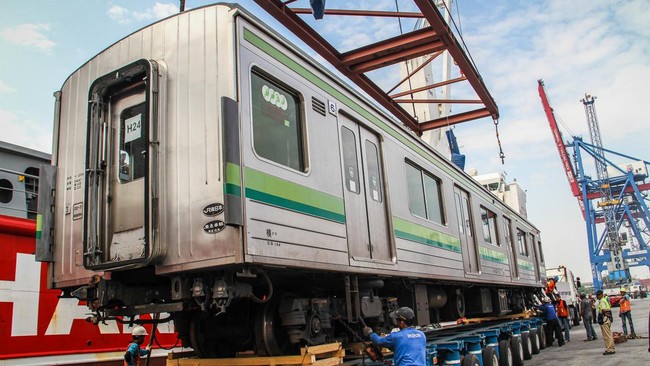
Jakarta, CNBC Indonesia — Plans to import used electric multiple units (EMUs) from Japan to meet transport demand in Greater Jakarta remain unresolved. Amid a surge in passenger numbers and an ageing fleet, Trade Minister Budi Santoso said he hoped demand for trains could be met by domestic production, without importing used trains from overseas.
Speaking on the sidelines of the opening of the Trade Expo Indonesia at ICE BSD, Tangerang, on Wednesday (14 October 2026), Budi said the Ministry of Trade had not received an application for a permit to import used EMUs from Japan. The plan previously discussed by state-owned railway operator PT Kereta Api Indonesia (KAI) has therefore not entered the ministry’s import-permit processing stage.
“We hope domestic production, which is already available, can meet the need, so I hope there will be no imports of used trains. But so far, no application has been submitted,” Budi said.
He said the ministry would wait in case an application was filed. However, there is still no certainty over whether the plan will proceed, including whether KAI will actually pursue the option of procuring used trains from Japan.
“We’ll wait if one comes in, but we don’t know yet,” Budi said.
KAI, meanwhile, has proposed importing used EMUs as a way to address its growing fleet requirements. KAI President Director Bobby Rasyidin previously said the number of Jabodetabek commuter-rail passengers rose by 11.5% in the first half of 2026 compared with the same period a year earlier, well above the initially forecast growth of 3% to 4%.
“There’s an anomaly when we compare 2025 with 2026: it’s 11.5%. That’s the first half compared with the first half. Daily passenger numbers, which used to average less than one million, are now at 1.1 million,” Bobby said at a hearing with Commission VI of the House of Representatives on Wednesday (23 September 2026).
The increase is also evident at several busy stations. At Bogor Station, the number of passengers boarding and alighting, previously below 100,000 a day, has now reached about 160,000. This highlights the public’s growing reliance on commuter trains for daily travel.
The age of the fleet is adding further pressure to operations. KAI says around 92 trainsets are 40 years old and must be progressively withdrawn for conservation. The issue is expected to become more urgent in 2029, when several trainsets will be about 45 years old and face spare-parts shortages and deteriorating material condition.
“The highest number [of ageing trainsets] will be in 2029, when our trainsets are 45 years old. At 45, we’re no longer in a good position: first, spare parts are no longer available; second, the metal is beginning to fatigue,” Bobby said.
KAI considers used-train imports a potential temporary solution while the domestic industry increases production capacity. Procuring new trains takes longer, while second-hand trains from Japan could be delivered sooner to cover the urgent fleet shortfall. KAI has also said it intends to use the imported trains for a limited period of about 10 years.
“If we import new trains, domestic train production could be disrupted. The used trains would only be for the transition,” Bobby said.
Source: jawawa.id (https://jawawa.id/newsitem/trade-minister-budi-says-kai-has-yet-to-apply-to-import-used-trains-from-japan-1792043423)
Originally published by CNBC Indonesia (https://www.cnbcindonesia.com/news/20261015112306-4-776405/mendag-budi-ungkap-pt-kai-belum-ajukan-impor-kereta-bekas-dari-jepang), translated from Indonesian