
Trade Minister Assures that Merah Putih Cooperatives Will Not Undermine Modern Retailers
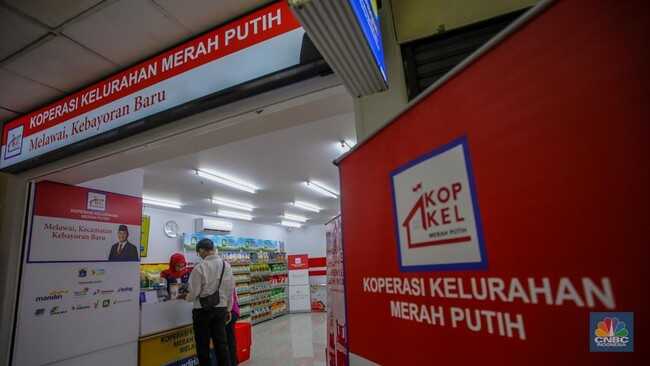
Jakarta, CNBC Indonesia - The Minister of Trade (Mendag) Budi Santoso has affirmed that the presence of Village/Urban Merah Putih Cooperatives (KDKMP) is not intended to be a competitor to modern retailers or traditional shops. Instead, the Village/Urban Merah Putih Cooperatives are opened as a space for collaboration so that the distribution of goods to rural communities can be closer and more efficient.
This was conveyed by the Minister of Trade after meeting with the Minister of Villages, Disadvantaged Regions Development, and Transmigration (Mendes) Yandri Susanto, to discuss the fate of modern retailers and traditional shops along with the development of Village/Urban Merah Putih Cooperatives. Budi appealed to both types of businesses to collaborate with the KDKMP.
“(We) met with Mendes yesterday,” said Budi when met at his office, Jakarta, Thursday (February 26, 2026).
According to Budi, the Village/Urban Merah Putih Cooperatives were formed from the beginning to empower the village economy. The existence of the KDKMP can actually be an opportunity for modern retailers and distributors to channel their products to rural areas through a partnership scheme.
“So, the Village Cooperatives are indeed aimed at empowering the economy in the village. So the village cooperatives or existing cooperatives in the regions actually want to be closer in distribution to consumers in the village,” he said.
He said that this kind of collaborative pattern is not new. So far, traditional shops in various regions have also received a lot of supplies from modern retailers and large distributors.
“Well, this is actually a good opportunity to collaborate with minimarkets, with distributors to channel their products through village cooperatives. This practice of collaboration or partnership has also been and is often carried out, and it still applies to traditional shops,” he explained.
Furthermore, Budi explained that the Village/Urban Merah Putih Cooperatives have the advantage of having a wider scope of business compared to modern retailers. In addition to functioning as a minimarket with a variety of products, the KDKMP can also provide other needs for the community in the village.
“First, it can function as a minimarket with a wider variety of products. For example, if we look at it, the KDKMP also sells a lot of agricultural tools. There is also fertilizer, there are medicines,” he explained.
In addition, the KDKMP can also carry out additional functions as a pharmacy, clinic, and even act as an exporter.
“Then, second, the KDKMP can also function as a pharmacy, as a clinic, and also one of them as an exporter,” added Budi.
Regarding concerns about the expansion of modern retailers, Budi emphasized that the licensing for the establishment of modern retailers is entirely in the hands of the local government, in accordance with applicable laws and regulations.
“Then, according to regulations, the licensing for modern retailers is delegated to the local government. So it is in accordance with the RT/RW, or the Regional Spatial Plan,” he said.
He hopes that the local government can act wisely in developing village cooperatives and regulating the existence of modern retailers, so that the goal of empowering the village economy can still be achieved.
“So I think the local government will be wise in developing the cooperatives, for the prosperity of the village. Because the village cooperatives belong to the village,” said Budi.
With this scheme, the government hopes that the KDMP can grow proportionally and become a strong village economic institution.
“So that whatever is produced for the welfare of the village community or the village government, so that economic empowerment can run well. So we hope that the KDMP will become more proportional, so that it becomes an institution that is indeed strong, and an institution that has a function to empower the economy in the village,” he concluded.