
Trade Balance Deficit: Economist Warns of Continued Export Risks
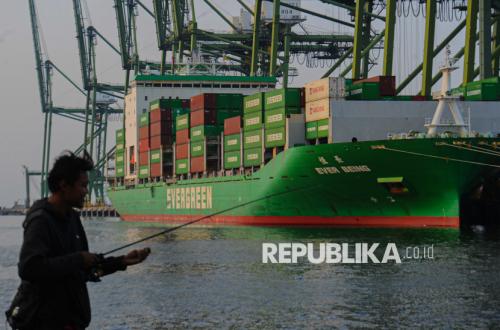
An economist from the Center of Reform on Economics (CORE) Indonesia, Yusuf Rendy Manilet, has assessed that Indonesia’s export prospects for the second half of 2026 remain overshadowed by several challenges, ranging from the impact of United States tariff policies to pressure on global commodity prices. Speaking on Friday (3/7/2026), Yusuf stated that the full impact of the US import tariff policy is expected to be felt only in the second half of this year, as adjustments to orders from importers take several months.
Beyond the US tariffs, he noted that Indonesia must also anticipate the risk of export orders being diverted to competing countries such as Vietnam and Mexico, which are considered to have higher competitiveness in the American market. Meanwhile, the prices of several key export commodities, such as coal and crude palm oil (CPO), continue to face cyclical pressure. Demand for industrial metals from China has also not fully recovered, as the country’s economic stimulus is proceeding more slowly than expected.
Despite these challenges, Yusuf identified several supporting factors that could sustain Indonesia’s export performance. He noted that Indonesia’s non-oil and gas exports to China grew by 17.7 percent year-on-year during the January to May 2026 period, providing a cushion against weakening demand in other markets. Furthermore, as long as demand for nickel derivative products is maintained, opportunities for export growth remain open. “With these conditions, I estimate that export growth in the second half will be in the range of zero to two percent, with risks leaning to the downside if tariff negotiations with Washington do not result in easing,” he said.
Previously, Trade Minister Budi Santoso stated that Indonesian exports to the US are currently subject to a universal tariff of 10 percent, which is valid for 150 days until 24 July 2026. This tariff serves as a temporary replacement for the US reciprocal tariff policy that was previously annulled by the US Supreme Court. Once the universal tariff period expires, the US government will establish a new tariff policy applicable to its trading partners, including Indonesia. The government has stated that it continues to engage and negotiate with the US to obtain more competitive tariffs, including pushing for zero percent tariffs on certain commodities.
Meanwhile, the Central Statistics Agency (BPS) reported that the value of Indonesia’s non-oil and gas exports in May 2026 reached 22.45 billion US dollars, representing a contraction of 4.5 percent compared to May 2025. This contraction was primarily influenced by a decline in exports of precious metals and jewellery or gems, metal ores, slag and ash, as well as iron and steel. By sector, non-oil and gas exports were still dominated by the processing industry with a value of 19.05 billion US dollars, though this represented a year-on-year contraction of 3.59 percent. Exports from the agriculture, forestry, and fisheries sector fell by 20.43 percent to 500 million US dollars, while mining and other sector exports declined by 7.03 percent to 2.89 billion US dollars.
Source: jawawa.id (https://jawawa.id/newsitem/trade-balance-deficit-economist-warns-of-continued-export-risks-1783137081)
Originally published by Republika (https://ekonomi.republika.co.id/berita/thms25490/neraca-dagang-defisit-ekonom-ingatkan-masih-ada-risiko-ekspor), translated from Indonesian