
Tracing the symphony of the 'Ekkek-Keuling'
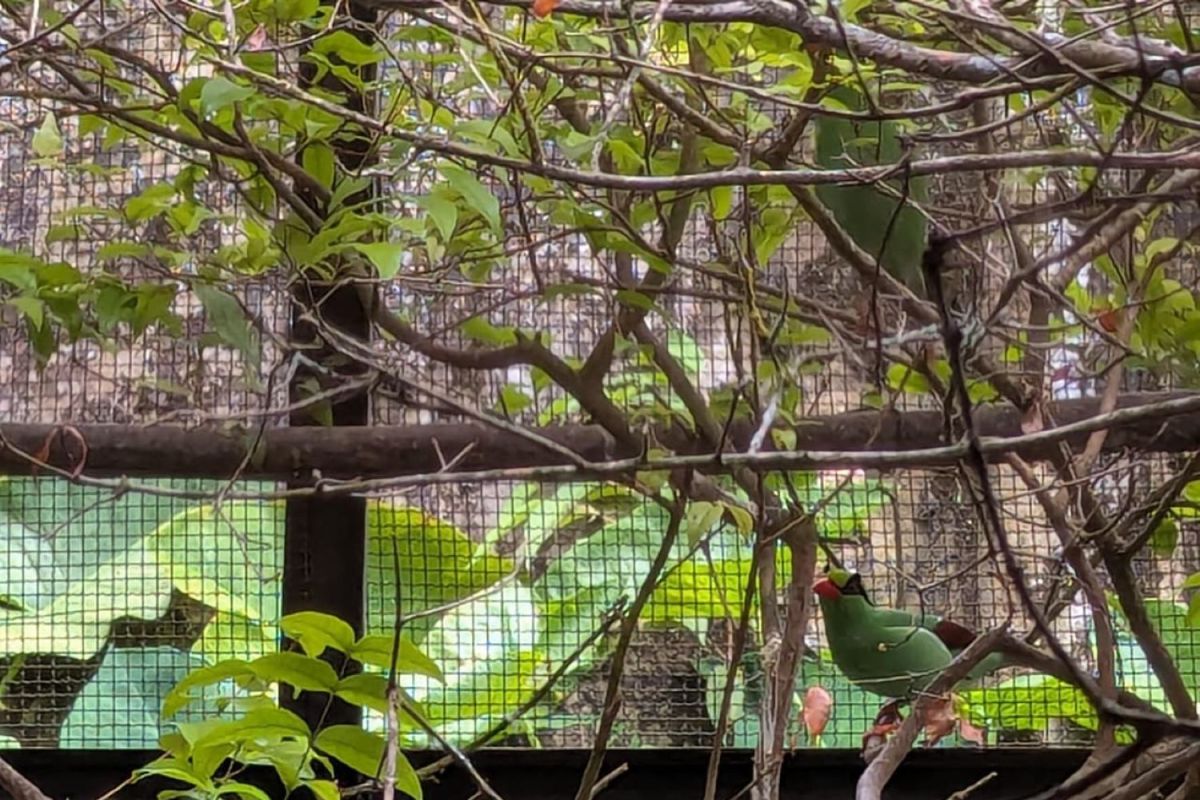
Long before the sound of vehicles broke the silence or the bustle of tourists filled the Cibodas road in Cianjur, West Java, the forest in that area had its own symphony.
In 1950, the colonial ornithological journal Limosa recorded the bird sounds that formed part of nature’s orchestration amid the dense Cibodas forest. The notes described a bird whose presence was more often known from its call than from its body hidden among the thick trees.
According to the journal, the bird was not a common sight throughout the year. However, periodically, it could be observed daily in the primary forest near and above ‘Tjibodas’, the name for Cibodas at that time.
Usually, this bird was found in groups consisting of several individuals and often moved together with mixed bird flocks. Its habitat was in the middle of dense forest, not too high above the ground.
However, one thing made its presence easily recognisable: its call.
‘Usually in groups consisting of several individuals and accompanying mixed bird flocks. This bird is generally seen in the middle of dense forest and not too high above the ground, often attracting attention through a distinctive loud call that reveals their presence from afar,’ the journal noted.
The call was described as rough and hoarse, like a repeated ‘ekkek’. There was also a sound like ‘ekkek-keuling’. It was from this last call that the bird got its local name.
The notes also recorded other calls, such as ‘hie-tie-tjiet’ repeated several times at a very loud pitch, as well as ‘truut-truut-truut’ or ‘ruut-uut’.
To modern human ears, these sounds may seem like mere strings of words that are hard to imagine. But for the forest of Mount Pangrango and the Tatar Pasundan region at that time, these sounds were part of a natural symphony that was still intact.
The bird in question is the Javan green magpie, also known as the Javan green magpie, with the scientific name Cissa thalassina.
The colonial ornithological journal not only recorded the bird’s calls and habits but also noted its diet.
The Javan green magpie was known to prey on grasshoppers, insects, large caterpillars, large cicadas, and beetles. The bird was even described as very greedy because it could eat almost anything of animal origin as long as it could still swallow it.
Its nest was usually located in primary forest or amid dense vegetation. It was not too high above the ground, around three to six metres, and situated on a slender branch.
The nest was quite sturdy and well formed, resembling a cup with a diameter of about 15–17 centimetres and a height of 7–8 centimetres.
The base and exterior were made of dry leaves, both tree leaves and rattan leaves or similar plants. The inside of the cup was lined with thin, dark-coloured plant material resembling fine roots, along with leaf stalks, stems, and other plant material.
In a single clutch, there were only two eggs.
‘The breeding season of this bird is in January, April, and December,’ the notes stated.
Long before the 1950 record was made, the archive of Natuurkundig tijdschrift voor Nederlandsch-Indie in 1886 had already mentioned the Javan green magpie as one of the most beautiful birds among Java’s avifauna.
Its beauty lay in the combination of its feather colours.
Its body feathers were a bright light green-blue, with a striking green band crossing the head, belly, and sides of the body. The small outer wing coverts were dull blue-green, while the larger ones were bright reddish brown.
Almost all of its flight feathers — except the two innermost ones — had dull olive tips with greyish-yellow outer edges. The rest were reddish brown.
The two innermost flight feathers had a different pattern. The innermost feather was light green like the colour of the head, with a dull dark outer edge. The next feather had a colour like the other flight feathers, but was decorated with a broad light blue longitudinal stripe on the inner web.
Its tail feathers were dull blue with black feather shafts.
Then there was a feature that made the bird’s face even more distinctive: a broad black line that began near the corner of the mouth, circled the eye and ear area, then gradually narrowed and extended to the back of the neck. There, the line met the line from the opposite side.
That is how the Javan green magpie was described in old records; a beautiful bird, loud-voiced, living in dense forest, and part of the natural life of Java’s mountains.