
Tracing the Eruption's Path, Encountering Wawan at Mbah Marijan's House
On Monday morning, 15 June 2026, the Merapi Lava Tour area was not yet crowded. Unlike weekends packed with tourists, the atmosphere on the mountain’s slopes felt quieter that morning. Most residents were still going about their work routines when I, my wife, and our two sons began our journey tracing the path of Mount Merapi’s eruption.
At the departure area, dozens of jeeps lined up waiting for passengers. The vehicle that carried us that morning was a 1957 Willys Jeep. Its small body was painted in an army green that had begun to fade with age. The jeep looked as if it had just rolled out of a military museum. From a distance, it resembled a combat vehicle lost on Merapi’s slopes rather than a tourist vehicle taking a family on holiday. There were no doors on either side, nor any seat belts to make passengers feel more at ease. The only safety equipment we received was a cream-coloured helmet.
My wife, who sat next to the driver, seemed not entirely convinced. Understandably, the vehicle we were in looked more like an old combat vehicle than a family tour car. Our driver, Juhari, apparently noticed the unease. ‘Relax, ma’am. God willing, it’s safe,’ he said with a smile.
A few moments later, the jeep began to move, leaving the Kaliurang area for the routes once traversed by Merapi’s pyroclastic flows and lava. Kaliurang’s main road was relatively smooth. But once we entered the lava tour route, conditions changed. The rocky and bumpy road lifted our bodies from the seats several times. Our stomachs were jolted every time the wheels hit a pothole or rolled over large stones. Our youngest son, who had initially been the most enthusiastic, suddenly fell silent as the jeep was shaken quite hard. Both his hands gripped the back of the front seat. ‘Don’t throw up, okay, little brother,’ his older sibling teased.
It turned out the jeep had undergone major surgery. ‘The engine has been replaced with a first-generation Kijang box engine, sir,’ Juhari said.
The jeep continued to climb towards several favourite destinations. We stopped at Bunker Kaliadem, built as an emergency shelter when Merapi’s activity increases. From this spot, Merapi’s peak stood firm, though partly shrouded in thin mist. The journey continued to Batu Alien, a giant boulder shaped like a human face, and then to the Mini Museum Sisa Hartaku, which houses various objects damaged by the eruption, from household appliances to the charred frame of a vehicle hit by pyroclastic flows.
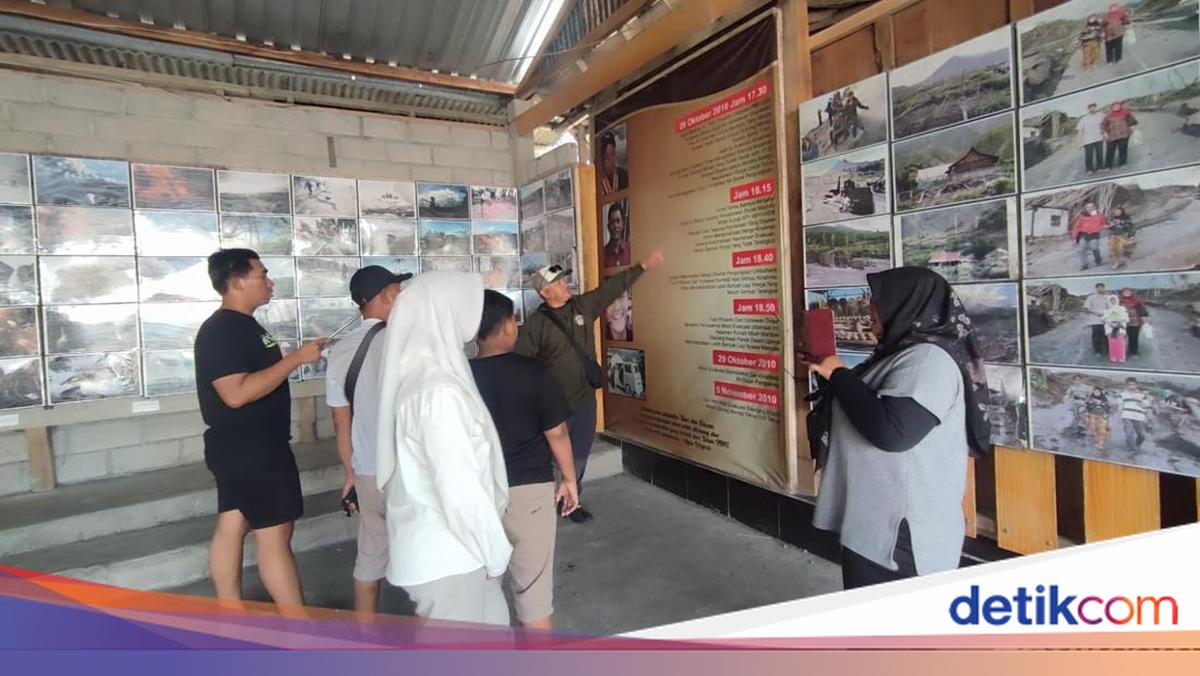
But of all the places we visited that morning, one left the deepest impression on my memory: the Mbah Marijan Museum. There, various objects bear witness to Merapi’s fury in 2010. There is the charred frame of an APV car, wrecked motorcycles, and household items deformed by extreme heat. Not far away hang photos of the eruption victims. My gaze stopped on a photo of a man in a red shirt. His hair was neat, slicked back. The photo was placed right beneath a photo of Mbah Marijan.
‘That’s Om Wawan, Ayah’s friend,’ my wife said to our two sons. I fell silent. His full name was Yuniawan Nugroho. We usually called him Wawan. I knew him from when we were both reporters covering the parliament complex in the early days of reformasi. At that time, Wawan worked as a journalist for Suara Pembaruan. After more than a decade at that publication, he later joined VIVAnews. To me, Wawan was a warm person, easy to get along with, and always generous with his smile. Among journalists, he was often the target of jokes. He had a handsome face and a tall, sturdy build. ‘You should have been a photo model or a film actor,’ was a joke we repeatedly threw at him. Wawan would usually just laugh.
On 26 October 2010, when Merapi unleashed pyroclastic flows that killed hundreds of people, Wawan was in the area carrying out his journalistic duties as a reporter for VIVAnews. He came to cover the story. He never returned home.