
Tracing French Poet Arthur Rimbaud's Journey Across Java
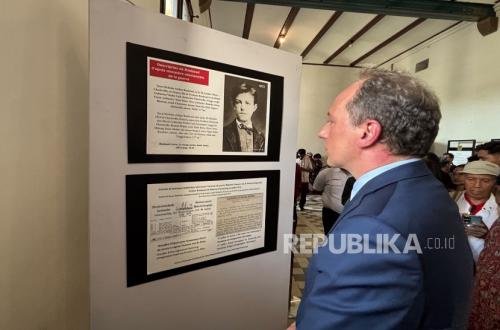
The great 19th-century French poet Arthur Rimbaud once set foot on the island of Java. Batavia, Semarang, and Salatiga bore silent witness to Rimbaud’s journey in the land then known as the Dutch East Indies. The exhibition titled ‘Arthur Rimbaud: A Journey Across Java’, held at Lawang Sewu in Semarang from 6 to 8 August 2026, presents a retracing of Rimbaud’s time on Javanese soil.
The exhibition displays Rimbaud’s poems in his native French as well as in Indonesian translation. There are also old photographs of places, particularly railway stations, that the poet born in Charleville once visited. To help visitors understand the chronicle of Rimbaud’s journey, an infographic is provided that sequences the chronology of his arrival in Java through to his return to France.
One of the team members who compiled the chronology of Rimbaud’s journey in Java is Nina Witasari, a history lecturer at Semarang State University (Unnes). The Arthur Rimbaud: A Journey Across Java exhibition was organised by Alliance Française Semarang (AFS) and the Semarang city government, in cooperation with Unnes and PT Kereta Api Indonesia (KAI).
Nina revealed that the chronicle of Rimbaud’s journey in Java was compiled over about one month. She and her team conducted archival research from various sources, including those held by the Koninklijk Instituut voor Taal-, Land- en Volkenkunde (KITLV), or the Royal Netherlands Institute of Southeast Asian and Caribbean Studies.
‘The key word is KNIL (the Royal Netherlands East Indies Army). Because Rimbaud came to Java as a KNIL soldier. When the word KNIL appeared, we were able to trace it to various sources,’ Nina said in an interview at the exhibition opening on Thursday (6/8/2026).
Rimbaud began his wanderings in 1874. Nina said Rimbaud arrived in Batavia on 22 July 1876, at the age of 21. By then he had already produced a number of poems. His arrival in the Dutch East Indies came after Rimbaud decided to stop writing in 1875.
Rimbaud’s life after leaving the world of writing was one of travel and wandering. Most of his wanderings took place in Africa, where he worked as a trader of various goods in Abyssinia (now Ethiopia).
According to Nina, the reason Rimbaud joined the KNIL was so he could come to the Dutch East Indies more cheaply. She said that after arriving in Batavia, Rimbaud underwent eight days of training. Then on 30 July 1876, he and his group departed for Semarang.
‘From Semarang, he was not alone, but with four other Frenchmen. KNIL members came from various countries, but their job was the same: as mercenaries for the Dutch,’ Nina said.
She explained that Rimbaud and the other KNIL troops, numbering 160 men, were planned to be deployed in the Aceh War. ‘But it turned out that in the second week, when he arrived in Salatiga (August 1876), Rimbaud fled, or it could be called desertion,’ she said.
Nina added that to make his escape less conspicuous, Rimbaud sold his belongings. ‘The money was then donated to an orphanage in Salatiga. As historians, we suspect that the orphanage was located not far from the current mayor’s office. After donating everything, he left Salatiga,’ she said.
She explained that during his flight in Java, Rimbaud left no written trace whatsoever. Therefore, his journey cannot be traced. According to Nina, some historians suspect Rimbaud returned to Batavia aboard the ship Prince van Oranje, where he worked as a crew member. ‘From Batavia, Rimbaud then went to Africa,’ Nina said.
Nina admitted she could not confirm whether Rimbaud ever wrote poetry while in Java. However, the Arthur Rimbaud: A Journey Across Java exhibition displays a number of Rimbaud’s poems, one of which is titled ‘Sensation’.
The poem reads:
On blue summer evenings, I shall go down the paths,
Pricked by the wheat, treading the tender grass:
Dreaming, I shall feel its coolness on my feet.
I shall let the wind bathe my bare head.
I shall not speak; I shall think of nothing.
But infinite love will swell in my soul;
And I shall go far, far away, like a wanderer,
Through Nature — happy as with a woman…
Today Rimbaud’s work is still studied in secondary schools and universities as an important part of French literature.