
Toxic Smoke from Tangerang Landfill Fire Forces Hundreds to Flee, Air Quality Plummets
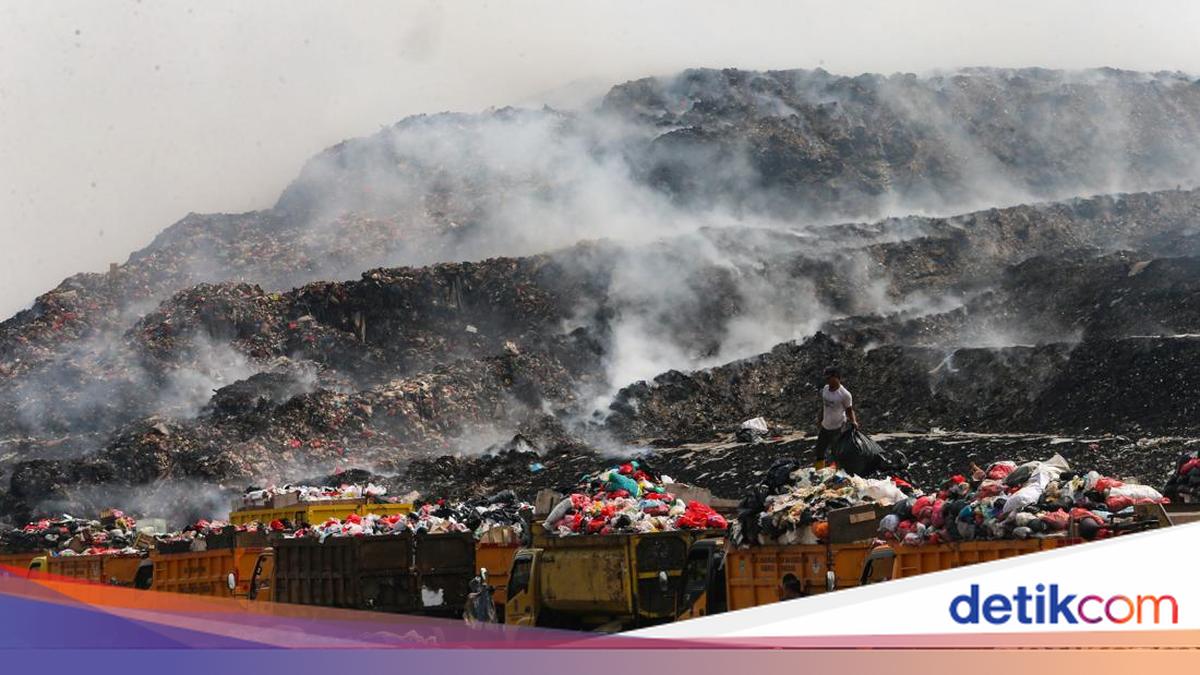
Asan’s throat was raw. His breathing grew increasingly laboured. His wife felt the same. The pair endured a night in their home surrounded by smoke from the fire consuming the waste mountain at the Jatiwaringin landfill. The smoke even penetrated their house in Kampung Jungkel, Tanjakan Mekar Village, Tangerang Regency, Banten.
By the following morning, on Wednesday, 1 July 2026, the white and black smoke grew thicker around their home. It felt like living in a fog-shrouded mountain range. The toxic fumes filled every room from the bedroom to the kitchen. Visibility shortened by the minute.
Without thinking twice, Asan quickly put his wife on the back of his motorcycle. They left home at nine in the morning and rode away from the village in search of somewhere with air fit to breathe.
“Whenever the smoke hits me, I just run towards the wind. This is the second fire, and this one is the worst,” said the 64-year-old man, who has lived in Jungkel since 1983.
Asan and his wife eventually sought refuge at the village office. For nine days, the building served as their shelter from the relentless encirclement of smoke.
Asan, who suffers from asthma, said he could no longer endure staying at home. Smoke from the landfill fire kept drifting towards his settlement, making his breathing increasingly tight.
Even after evacuating, their complaints did not disappear immediately. Their throats still burned and bouts of breathlessness kept recurring. While at the evacuation post, both received treatment in the form of reliever medication and paracetamol.
When they finally returned home, traces of the fire remained. The stench of rubbish clung to clothes and furniture, while flies swarmed around the house. Asan said that in the first days after the fire, Kampung Jungkel was almost deserted. Nearly all residents chose to evacuate to avoid exposure to the smoke.
“My hope is simply that people care about the environment of Tanjakan Mekar Village, which has been hit by this massive landfill fire. One entire neighbourhood unit, RT 14, was affected,” he told detikX.
Firefighters tackling the blaze at the Jatiwaringin landfill in Mauk, Tangerang Regency, Banten, on Friday, 3 July 2026.
Asan is one of 232 residents displaced by the Jatiwaringin landfill fire. According to data obtained by detikX, the Tangerang Regency Environment and Cleanliness Agency at one point recorded PM 2.5 pollutant levels around the fire site reaching 425.2 per cent above the ambient air quality standard.
Tohiroh, head of the Rajeg Mulya Village Community Health Centre, acknowledged that Kampung Jungkel was the area of greatest concern because its air quality remained unsafe.
“It is right next to the landfill. Frankly, people are not advised to go there yet today, but residents want to return home. PM 2.5 is still above 137, and PM 1.0 is still at 283. Fine and coarse dust levels in the air remain high and have not yet met the healthy breathing standard,” Tohiroh explained to detikX when met at the Tanjakan Mekar Village Office on Wednesday, 8 July 2026.
Indeed, Tohiroh continued, for nine days residents had been shuttling between their homes and the evacuation post. They returned home when the smoke haze began to subside or when the wind direction did not carry it towards their village.
Besides the 334 residents who suffered acute respiratory infections, the smoke from the waste fire also caused residents, including children, to suffer from itchy skin.
When detikX visited Kampung Jungkel on 8 July 2026, plumes of smoke were still billowing from several points at the Jatiwaringin landfill. From the village, less than a kilometre away, the scorched site was clearly visible in the distance. The scene was reminiscent of burning peatland forests that continue to exhale smoke for days after the flames are extinguished.
The air felt hot and stuffy, mixed with the acrid smell of burning rubbish that stung the nose. Fine ash drifted about before settling on residents’ yards and terraces. In the gardens, once-green plants appeared withered. Their leaves had yellowed and drooped. Others were left with nothing but dry stalks.
A water-bombing helicopter belonging to the National Disaster Management Agency (BNPB) was seen criss-crossing the sky above Kampung Jungkel. From a distance, the helicopter flew low towards the fire points on the waste mountain, then circled back to collect its water load before repeating the same manoeuvre. The spectacle continued throughout detikX’s time at the location, as firefighting operations were still under way.
The Jatiwaringin landfill fire began on Tuesday, 30 June 2026. Local residents said they had seen flames from around 07:30 Western Indonesia Time. However, the Tangerang Regency Fire Department only received an official report at 11:10.
By the time officers arrived, the blaze had spread across the towering heaps of waste, making the extinguishing process far more difficult. The height of the waste piles, gusting winds and the emergence of fire from the lower layers kept the blaze alive for days.
With the fire persistently out of control and the smoke threatening the health of thousands of residents, the Tangerang Regency Government declared a disaster emergency status on 1 July 2026, effective until 14 July.
Although the status was declared by the regional government, the response involved the central government. On the ground, excavators took turns digging and breaking apart the waste mountain to expose the embers hidden in the lower layers, while bulldozers formed pathways and firebreaks to stop the flames from spreading.
On various sides of the landfill, fire engines and water tanker trucks shuttled back and forth supplying water to officers battling the blaze. Firefighting assistance arrived from various regions, from Tangerang City to DKI Jakarta.
The response was carried out in an integrated manner involving a number of ministries and agencies, making it a large-scale operation involving both central and regional governments.
“There are three helicopters and six backhoes. This is what we call ‘turap’ — the slopes still emitting smoke are excavated and then sprayed with water. This takes the form of embers, the source of the fire. This is decomposed plastic; it is difficult if the piles are not opened up. The fire will be hard to extinguish,” explained Imam, a firefighter from South Tangerang City who had been at the site overnight.
Initially, Imam continued, extinguishing was carried out using foam, a liquid that forms a blanket over the surface of the fire. This was intended to cut off the oxygen supply and prevent the embers from reigniting. That method was later discontinued and replaced with water spraying directed at the source of the embers.
“It is like peatland. So, if the smoke lessens this afternoon, for instance, the next day, if the embers are not fully extinguished, thick smoke can appear again,” Imam told detikX.
The characteristics of the waste piles, which retain embers in their lower layers, meant the extinguishing process took days. The situation has also thrown a spotlight on waste management problems at the Jatiwaringin landfill.
To date, the Jatiwaringin landfill still practises open dumping, that is, discarding and piling waste in open land without periodic covering.
Meanwhile, Agustin Hari Mahardika, head of the Waste, Hazardous and Toxic Materials Management (PSLB3) Division at the Tangerang Regency Environment and Cleanliness Agency (DLHK), said the Tangerang Regency Government is striving to transition towards a waste management system that no longer uses the open dumping method.
“On the subject of open dumping, we are working to comply with Law Number 18 of 2008. Open dumping is not permitted under the prevailing regulations. One of the causes of this fire is indeed the existence of open dumping, particularly because this waste contains methane,” Agustin told detikX.
According to Agustin, the challenges of managing the Jatiwaringin landfill stem not only from its operational age, which stretches back to 1999. Over nearly 27 years, the site is estimated to have received around 20 million metric tonnes of waste, with piles reaching approximately 15 metres in height.
He said the problem is exacerbated by the habit of disposing of waste in mixed form without separation at source, with illegal dumping still being found. These conditions cause the waste piles to keep growing and produce methane gas, which is highly flammable.
Agustin said one measure now being pushed is to restructure the waste piles so they are no longer left exposed. According to him, covering the waste piles is important to reduce methane gas exposure to sunlight, suppress odours, and stabilise the pile slopes, thereby reducing the risk of landslides.
He admitted that before the fire occurred, there were still sections that had not been fully covered, including on the outer side of the landfill area.
“The covering is to reduce the direct ignition of methane exposed to sunlight, reduce odours, and arrange the piles so that landslides do not occur. The problem previously was indeed that not everything was covered, even outside the landfill, and that was the trigger,” he said.
He added that abandoning open dumping practices cannot be done in a short time, as it requires systemic changes to management as well as substantial budgetary support.
Firefighting at the Jatiwaringin landfill finally ended on 10 July 2026, after a process lasting more than 200 hours. Ima — not her real name — was still carrying her nine-month-old daughter when she spoke with detikX. Since the fire began, the baby had suffered from relentless itching. Scratch marks on her neck were still visibly red.
That morning, Ima had just brought home ointment from the health post. She applied the ointment gently to her daughter’s neck, hoping the redness would soon fade. Outside her home, on Ima’s first day back from the evacuation post, plumes of smoke from the Jatiwaringin landfill were still billowing skyward.
Source: jawawa.id (https://jawawa.id/newsitem/toxic-smoke-from-tangerang-landfill-fire-forces-hundreds-to-flee-air-quality-plummets-1784109411)
Originally published by detikcom (https://news.detik.com/spotlight/d-8575431/petaka-asap-gunung-sampah-di-tangerang), translated from Indonesian