
Towards the 2030 Network Era: WBBA Launches AI-Net, a Global Data Communication Certification
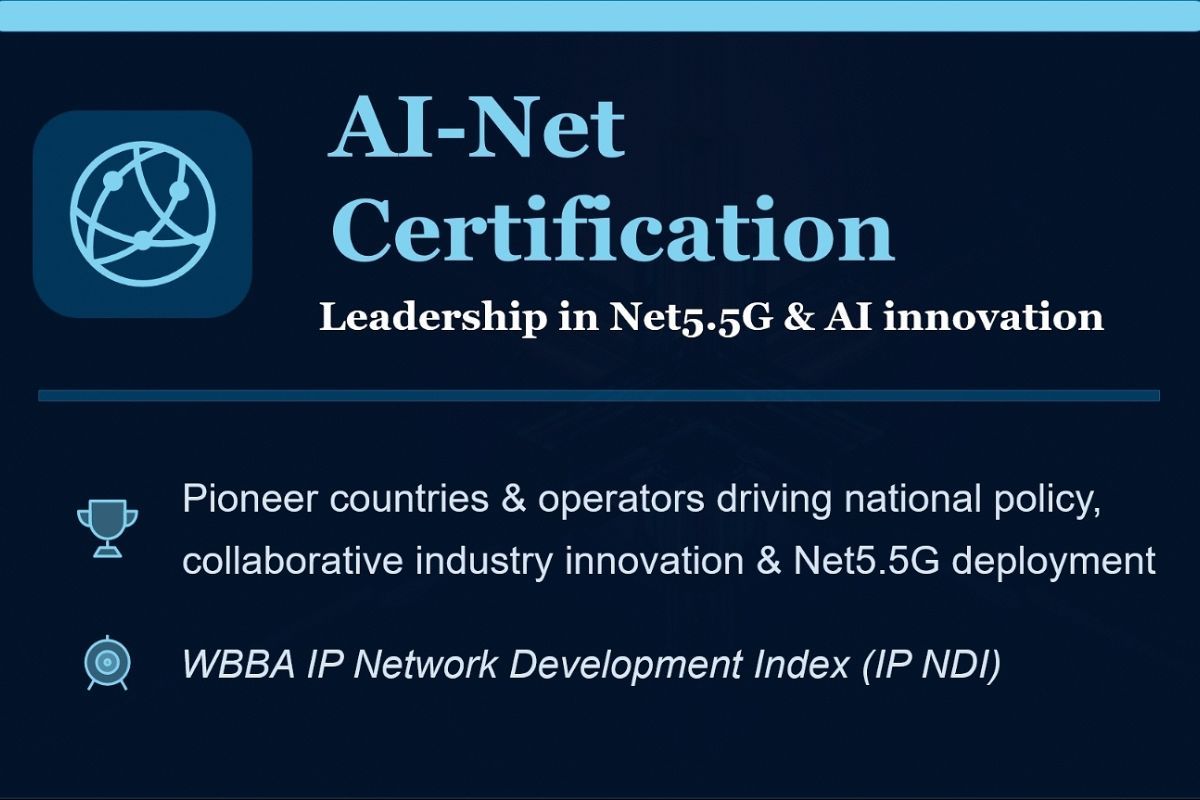
The World Broadband Association (WBBA) officially launched AI-Net at the Asia-Pacific Broadband Development Summit (BDS) in Bangkok. AI-Net is a global data communication certification for various countries and telecommunications operators worldwide. This certification marks a significant milestone in the development of global digital infrastructure. AI-Net offers a strategic framework that supports the transformation of telecommunications networks from being merely connectivity-oriented to networks that underpin the era of intelligence. Through this approach, the WBBA aims to accelerate the transition from the ‘All-Cloud’ era to the ‘All-Intelligence’ era, as well as drive smarter industrial evolution and digital transformation.
The rapid advancement of artificial intelligence (AI) is reshaping the global economic landscape. This trend also demands that digital infrastructure possess higher capacity, scalability, and intelligence. Amid the increasing adoption of Net5.5G, conventional indicators such as bandwidth and network coverage are no longer sufficient to describe a country’s competitiveness in the AI era. Therefore, the WBBA introduced the AI-Net Certification, which is based on three main pillars: national policy direction, industry ecosystem collaboration, and the Net5.5G penetration rate. This measurable assessment system aims to accelerate the global implementation of Net5.5G by aligning strategic policies and developing the industry ecosystem as indicators of technological maturity.
During the launch event, the WBBA explained that the AI-Net Certification delivers two main complementary values. First, the ‘Network for AI’ concept positions the network as the primary foundation for intelligent computing, rather than just a data transmission path. With high throughput, near-zero packet loss, and ultra-low latency, modern telecommunications networks can maximise the potential of AI comprehensively. These capabilities enable closer coordination between computing resources and network management, ensuring service quality for ever-changing needs. This technology also improves data processing efficiency in large-scale AI model training and inference. Second, the ‘AI for Network’ concept introduces intelligent technology directly into network devices and management platforms. AI integration supports networks in evolving from systems that merely direct data traffic into systems capable of autonomously understanding conditions, performing automatic repairs, and continuously optimising their performance. This transformation drives the emergence of ‘Agentic’ network operations and maintenance (O&M) with a higher level of AN L4 automation. Consequently, operators can reduce operational complexity while lowering the network maintenance burden.
The AI-Net assessment also covers macroeconomic and microeconomic aspects. From a macroeconomic perspective, this certification evaluates the alignment of national policies and industrial development. Indicators assessed include strategic policies related to Net5.5G, IPv6, and intelligent networks, as well as contributions to the development of global standards and international ecosystem collaboration. Meanwhile, from a microeconomic perspective, the assessment is conducted on telecommunications operators through the IP Network Development Index (IPDI), which the WBBA introduced at the Mobile World Congress (MWC). This index measures the intelligence level of operational networks, as well as the density of Advanced IP and Net5.5G implementation, to identify pioneers of next-generation network transformation.
The scope of AI-Net also extends beyond Wide Area Networks (WAN). This certification assesses the entire digital foundation, including the integration of interconnected data centre networks and comprehensive endogenous security systems. This multidimensional approach not only reflects a country’s strategic readiness and vision but also validates an operator’s capability to deliver secure and reliable networks for various needs, from automated logistics and smart retail to the development of smart cities.
The WBBA views AI-Net as ‘a trusted and industry-recognised benchmark for transforming various digital transformation drivers into measurable progress towards the Network 2030 vision.’ Going forward, the WBBA will leverage this certification to build a global consensus among policymakers, industry standards bodies, and leading telecommunications operators. By accelerating standards harmonisation and narrowing the digital divide, this initiative is expected to build a network foundation ready to support the AI era and accelerate the journey towards an intelligent future by 2030.