
Towards Five Centuries: Jakarta Continues to Transform into a Global City
Entering its 499th year, Jakarta continues to prepare for a new era in its journey. The arrangement of areas, strengthening of public transport integration, and changes in waste management patterns are part of the city’s steps towards becoming an inclusive and sustainable global city. This year’s anniversary commemoration is not merely filled with ceremonial activities. The DKI Jakarta Provincial Government is using it as an opportunity to showcase the results of improvements that can be directly felt by residents, while preparing long-term development towards the city’s five-century mark.
Assistant for Economy and Finance of the DKI Jakarta Regional Secretary and Chair of the Jakarta 499th Anniversary Committee, Suharini Eliawati, stated that the city’s transformation must be supported by collaboration between the government, the business world, and the community. ‘Approaching its 500th year, Jakarta continues to improve and move forward. With a spirit of collaboration, we are working together to realise Jakarta as an inclusive and sustainable global city,’ she said in a statement on Saturday (20/6/2026).
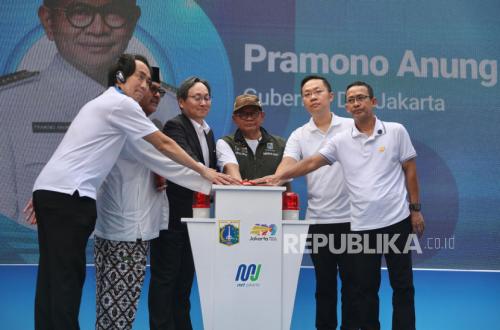
One of the improvements carried out is the arrangement of Jalan H.R. Rasuna Said in South Jakarta. Governor Pramono Anung inaugurated the results of the corridor’s arrangement on Sunday (21/6/2026). The 3.8-kilometre arrangement ended the existence of abandoned monorail pillars that had been there for around two decades. A total of 109 pillar points were dismantled starting January 2026, with all work completed in approximately five months. The DKI Provincial Government also improved the road elevation and width consistency, drainage channels, pavements, green spaces, public street lighting, and pedestrian facilities. The corridor now also serves as the location for the Car-Free Day every Sunday from 5:30 AM to 9:00 AM WIB.
‘Rasuna Said has been completed and I have just inaugurated it. This inauguration is also an effort to present infrastructure that supports citizen mobility towards Jakarta as a global city,’ said Pramono. On the same occasion, the Transjakarta Setiabudi bus stop was officially renamed Halte Setiabudi Integritas. The renaming, a collaboration between the DKI Jakarta Provincial Government and the Corruption Eradication Commission (KPK), carries an anti-corruption message into public spaces traversed by citizens daily. The name change was followed by adjustments to signboards, route maps, and voice announcements in the Transjakarta fleet. Pramono hopes that the value of integrity is also reflected in the quality of public services provided to residents.
Connectivity improvements continued with the launch of the Dukuh Atas Pedestrian Deck construction. The infrastructure, known as the ‘Donut Bridge’, will connect the MRT Jakarta, LRT Jabodebek, KRL Commuter Line, Soekarno-Hatta Airport Train, Transjakarta, and LRT Jakarta. The project, targeted for completion by the end of 2028, is designed to facilitate intermodal transfers and improve the safety and comfort of pedestrians, including those with disabilities. ‘Its presence will enhance connectivity, safety, and comfort for pedestrians, while strengthening integration between public transport modes,’ Pramono stated. Beyond serving as a connecting route, the pedestrian deck is expected to enliven public spaces and economic activity in the Sudirman-Dukuh Atas area. The DKI Provincial Government is open to creative financing opportunities with the banking sector, regional-owned enterprises, and other stakeholders so that development does not rely solely on the regional budget.
The push towards becoming a global city is not only carried out through infrastructure development. The DKI Provincial Government is also encouraging changes in community habits regarding waste management starting from the source. This commitment was reinforced through a Waste Segregation Alert Roll Call led by Pramono together with Coordinating Minister for Food Zulkifli Hasan at the National Monument, Central Jakarta, on Sunday (21/6/2026). This movement is crucial because Jakarta produces around 9,000 tonnes of waste every day. Meanwhile, the Bantargebang Integrated Waste Treatment Plant is nearing maximum capacity, with average waste pile heights reaching around 60 metres. This condition can no longer be addressed solely by a collect-and-dispose pattern.
Through Governor Instruction Number 5 of 2026 on Waste Segregation and Management from the Source, households, residential areas, schools, offices, markets, commercial centres, and business areas are encouraged to separate organic and inorganic waste. Pramono noted that several community neighbourhood units have developed various processing methods, from maggot cultivation to converting waste into fertiliser. He stressed that these practices must be expanded so that segregation does not become a temporary programme. ‘Many RT and RW have progressed further than we expected. Therefore, this movement must not slacken and must continue to be expanded so that it becomes a culture for all Jakarta residents,’ he said.
Coordinating Minister Zulkifli Hasan assessed that community involvement is the key determinant of success in waste management. Organic waste can be processed into fertiliser or other products, while inorganic waste can enter the recycling process. ‘DKI Jakarta has not only introduced regulations but has also carried out massive actions down to the RT and RW level. Other regions can emulate the steps taken by Jakarta,’ he said. As a form of appreciation and to encourage citizen participation, the DKI Provincial Government presented awards to several of the best RWs in the five administrative cities and the Kepulauan Seribu Regency that have successfully implemented waste segregation at the source.