
Towards 2027, Indonesian Investment Shadowed by Interest Rates and Geopolitics
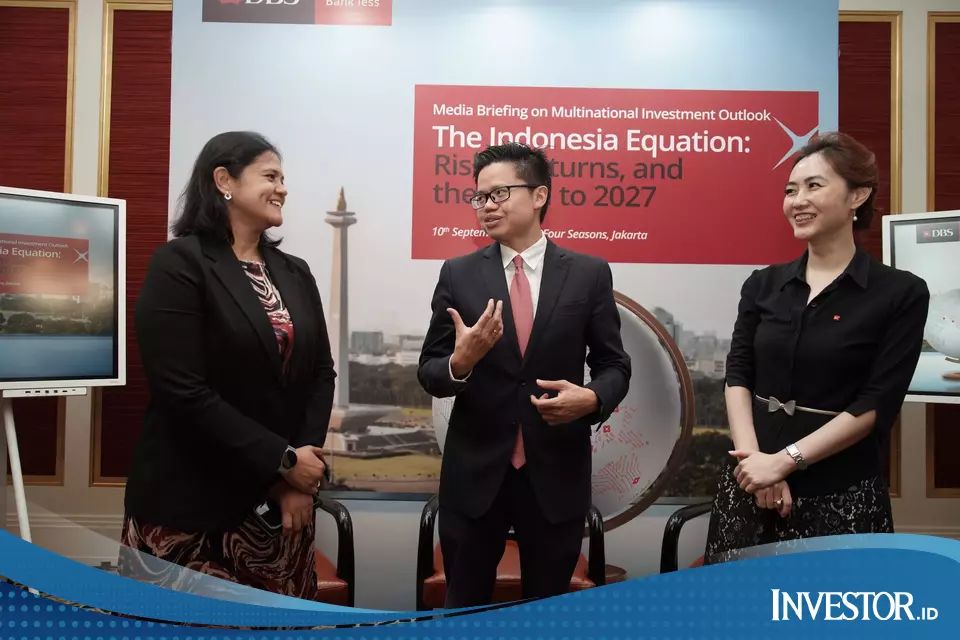
Global supply chain shifts, the direction of US interest rates, market fluctuations, and intensifying investment competition in Asia are prompting multinational corporations to re-evaluate their expansion strategies heading towards 2027.
Amidst these dynamics, Indonesia is still considered to possess attractive opportunities for new investment, particularly in the manufacturing, energy, infrastructure, technology, electronics, semiconductor, and electric vehicle sectors.
Radhika Rao, Senior Economist at DBS Group Research, revealed that the increasingly multipolar global economic development opens opportunities for Indonesia to strengthen its position as one of the new growth hubs. According to her, Indonesia’s attractiveness is determined not only by natural resources and its large domestic market, but also by its ability to attract technology-based investment, strengthen domestic value chains, develop the digital economy, and maintain policy and macroeconomic stability.
“Indonesia’s future advantage lies not only in natural resources and market size, but also in its ability to attract technology-based investment, strengthen domestic value chains, develop the digital economy, and maintain policy and macroeconomic stability,” she stated during ‘The Indonesia Equation: Risks, Returns and the Road to 2027’ forum in Jakarta on Thursday.
Data presented at the forum showed that Asia remains one of the primary destinations for foreign investment. Foreign Direct Investment (FDI) in East Asia in 2025 was recorded at approximately US$245 billion, while Southeast Asia increased from around US$225 billion in 2024 to nearly US$250 billion in 2025. This increase is linked to the relocation of global supply chains, manufacturing expansion, and growing investor interest in the ASEAN region.
One trend poised to benefit Indonesia is the ‘China+1’ and ‘Taiwan+1’ strategy, as companies seek to diversify their production bases outside of a single country. This shift presents opportunities for Indonesia to attract manufacturing investment, including within the electric vehicle ecosystem. The downstreaming agenda is also seen as a way to expand investment opportunities in the energy, infrastructure, and processing industries.
However, this potential faces increasingly fierce competition among Southeast Asian nations in attracting foreign capital. Consequently, Indonesia’s investment appeal will increasingly depend on the quality of infrastructure, logistics efficiency, labour availability, regulatory certainty, the speed of licensing, as well as exchange rate and economic policy stability.
Riyatno, Deputy for Investment Climate and Development at the Ministry of Investment and Downstreaming/BKPM, noted that investment realisation in the first half of 202ability 2026 still shows a positive trend. He stated that the achievement is approaching 50% of the annual investment target amidst intensifying global investment competition.
“The investment potential in Indonesia remains very large with quite good economic resilience,” he said. Riyatno added that the government is striving to improve the investment climate through regulatory reforms, the preparation of investment sector roadmaps, and the simplification of licensing processes.
Interest Rates and Exchange Rates as Key Considerations
Beyond structural factors, the direction of US interest rate policy is expected to continue influencing capital flows, the Rupiah exchange rate, and Indonesia’s funding costs towards 2027. This situation requires multinational companies to account for interest rate and exchange rate risks in their investment and financing planning.
Companies also face the choice of expanding investments, deepening existing exposure, or reviewing business plans altogether. These decisions will vary by sector and are heavily influenced by risk tolerance, financing needs, operational efficiency, and market prospects.
Natalia Ratulangi, Head of Large & Multinational Corporates Institutional Banking Group at DBS Bank Indonesia, explained that the needs of multinational companies today are not solely related to financing. She noted that companies must also manage the impact of changes in interest rates, exchange rates, regulations, and domestic economic sentiment.
“The needs of multinational companies are becoming increasingly diverse, not just regarding financing, but also how to overcome the impacts of interest rate volatility, exchange rates, regulatory policies, and local economic sentiment,” she said.
Infrastructure and Regulation are Key
Approaching 2027, Indonesia’s position as an investment destination is seen to possess several strengths, including a large domestic market, available labour, natural resources, and the development of industrial ecosystems. However, these factors are insufficient without improvements in policy certainty and the ease of doing business.
The strengthening of energy, transport, and logistics infrastructure must proceed alongside improvements in human resource quality, licensing efficiency, and regulatory certainty. The ability to maintain these factors will determine how effectively Indonesia can capitalise on global investment shifts and maintain its competitiveness against other nations in the Southeast Asian region.
Source: jawawa.id (https://jawawa.id/newsitem/towards-2027-indonesian-investment-shadowed-by-interest-rates-and-geopolitics-1789404733)
Originally published by investor.id (https://investor.id/macroeconomy/454044/menuju-2027-investasi-indonesia-dibayangi-suku-bunga-dan-geopolitik), translated from Indonesian