
Tourism Minister states tourism remains resilient amidst geopolitical pressures
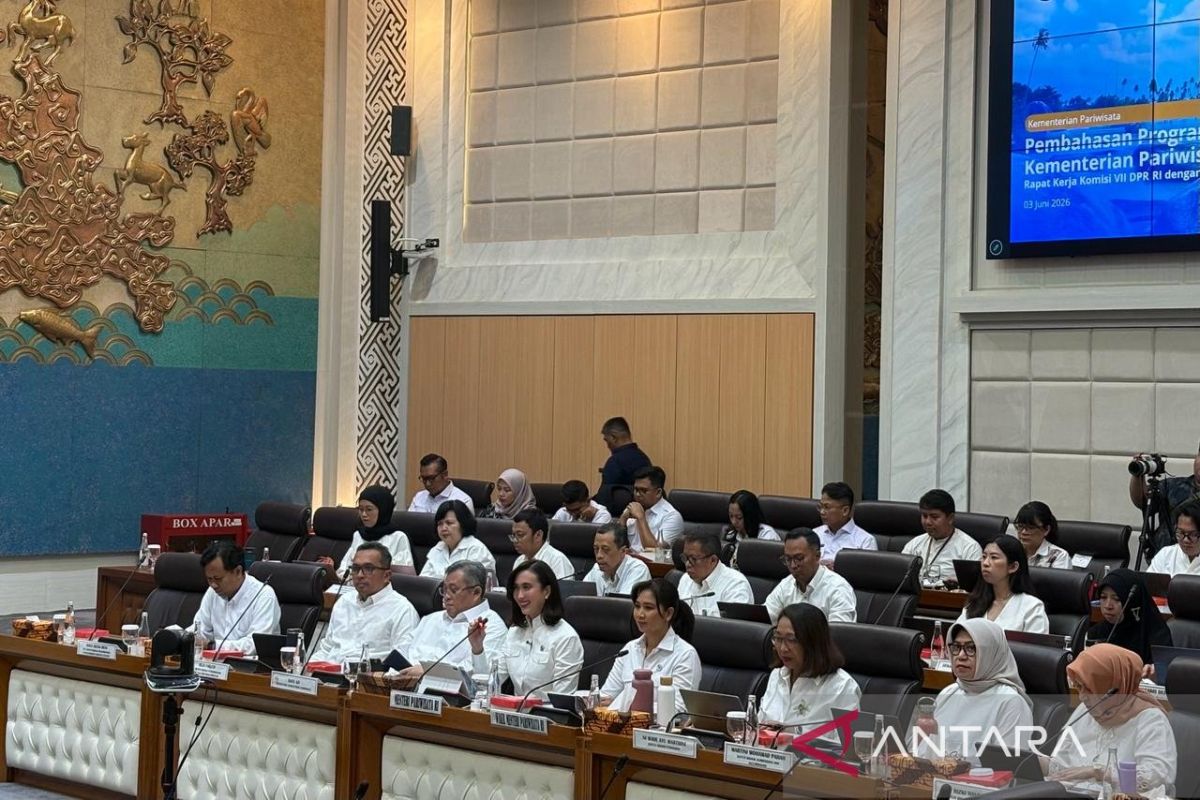
Jakarta (ANTARA) - Minister of Tourism Widiyanti Putri Wardhana stated that Indonesia’s tourism sector continues to grow strongly amidst global geopolitical pressures.
“We are not only pushing tourism to increase tourist arrivals, foreign exchange, investment, and contributions to GDP. Equally important, tourism growth must be directly felt by the community,” said Widiyanti during a Working Meeting of the Ministry of Tourism with Commission VII of the Indonesian House of Representatives (DPR RI) in Jakarta on Wednesday.
Citing data from the Central Bureau of Statistics (BPS) for the period of January to April 202<0xA0>6, international tourist arrivals reached 4.68 million, representing an 8.24 per cent growth compared to the same period in 2025.
Minister Widiyanti noted that these achievements must be directed towards providing added value to the community, one way being through the strengthening of tourism villages as an instrument for equitable development.
The Ministry of Tourism will continue to encourage community empowerment and assistance, the certification of sustainable tourism villages, and collaboration with the Halal Product Assurance Agency (BPJPH) to expand halal certification for micro, small, and medium enterprises (MSMEs) within tourism villages.
The Ministry of Tourism, alongside the BPJPH, has facilitated 31,548 halal certifications for MSME actors across 1,116 tourism villages spread throughout 34 provinces as of 30 May 2026. This step is expected to increase the competitiveness of local products while strengthening tourist confidence in regional tourism services.
In addition to tourism villages, the equitable distribution of tourism benefits is being strengthened through the organisation of regional activities. The Karisma Event Nusantara programme, which has been implemented in 15 provinces, recorded the involvement of 20,669 workers and 3,936 MSMEs, with economic movement reaching over Rp45.57 billion.
“Events are not just spaces for destination promotion, but also spaces for the people’s economy. There are MSMEs, artists, creative workers, communities, transport providers, culinary sectors, accommodation, and various other supporting sectors involved,” said Widiyanti.
Widiyanti further emphasised that an economy involving the tourism sector must deliver a real impact that flows down to villages, driving MSMEs, creating jobs, and strengthening regional economies.
On the other hand, she highlighted that future tourism development must become increasingly high-quality, inclusive, and sustainable. Therefore, the Ministry of Tourism will continue to strengthen collaboration with the DPR RI, local governments, ministries/agencies, industry, communities, and the public.
“Tourism must be an economic force that grows alongside the people and provides the greatest possible benefit to Indonesia,” she concluded.