
Total of Rp 26.8 Billion Disbursed to 38 Provinces for Orphans and Persons with Disabilities Lebaran
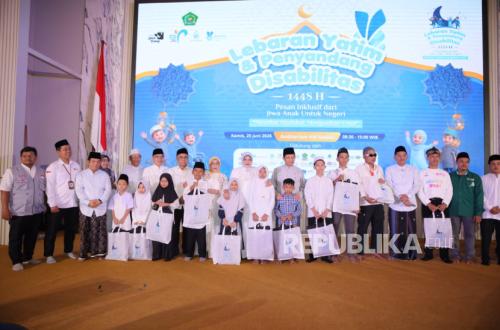
A total of Rp 26.8 billion has been distributed to 38 provinces across Indonesia as part of the 2026 ‘Lebaran Yatim’ (Orphans’ Eid) and disability programme. The initiative was organised by the Directorate General of Islamic Community Guidance of the Indonesian Ministry of Religious Affairs (Kemenag) through the Directorate of Zakat and Waqf Empowerment.
During the event held on 10 Muharram 1448 H at the HM Rasjidi Hall, Ministry of Religious Affairs Office in Jakarta, the Director of Zakat and Waqf Empowerment, KH Waryono Abdul Ghafur, emphasised that this achievement serves as concrete evidence of increasingly measurable and accountable management of religious social funds.
“Every rupiah collected from the community must be clearly accountable,” he stated. “Where it goes and for what purpose—this year we have ensured that the entire distribution process is well-documented, so the public can see for themselves how zakat and waqf funds are truly working for the future of orphans and persons with Alwith disabilities,” Waryono told reporters.
He explained that from the total funds, Rp 11.8 billion was allocated as direct cash assistance to meet the basic financial needs of the beneficiaries. Additionally, Rp 5.4 billion was distributed in the form of basic food packages and school supplies. The remainder was allocated for capacity empowerment programmes, business capital through the ‘Barokah Market’, and educational scholarships spread across 38 provinces.
Waryono explained that this shift in distribution patterns aligns with the new direction of Islamic philanthropy management encouraged by the Ministry of Religious Affairs, which aims to move away from short-term charitable approaches towards a model of sustainable empowerment.
“Providing assistance is important, but it should not stop there. That is why we have directed part of the funds towards business capital and scholarships, rather than just providing consumptive aid. We want these sponsored children to have the tools to stand on their own two feet in the future,” he added.
The Ministry of Religious Affairs further explained that this approach is reflected in the event’s design, which features a five-zone festival concept: the ‘Growth Zone’ as a centre for interactive education, the ‘Empowerment Zone’ for soft-skill development, the ‘Barokah Market’ as a showcase for products from the economic empowerment of sponsored children, the ‘Expression Zone’ as a space for artistic creativity, and the ‘Light Zone’ which hosts auctions for the best works produced by the sponsored children.