
Torture in Zionist Israel's Dog Kennel
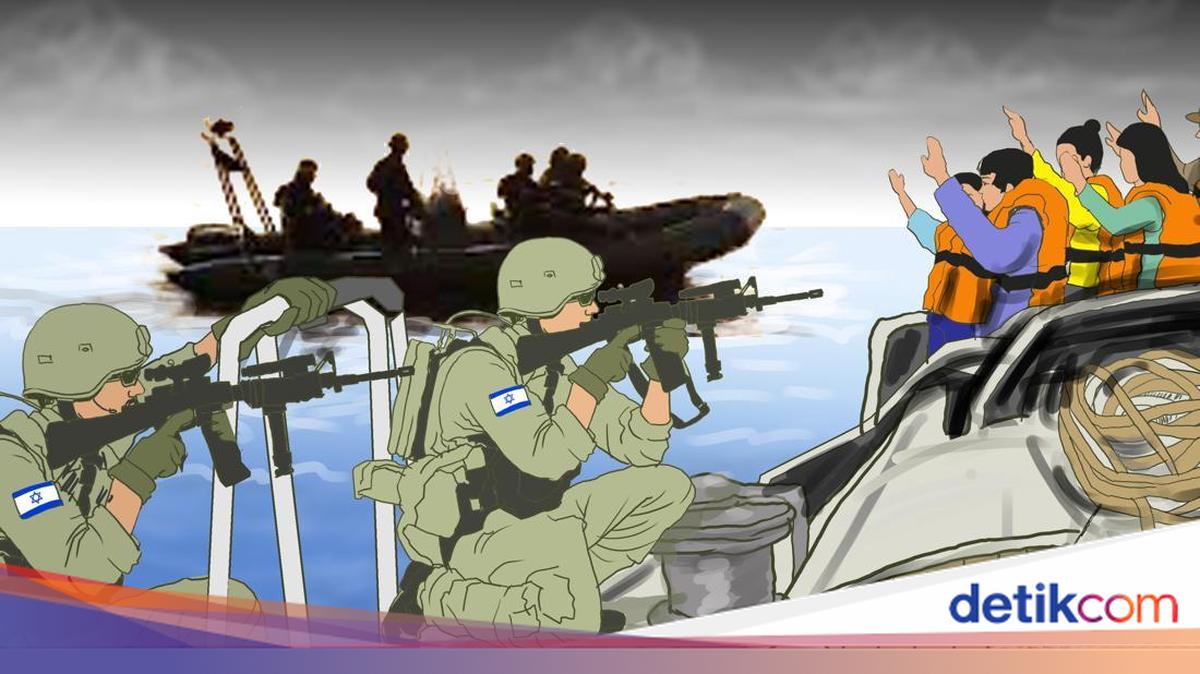
The Orzugluk’s signal suddenly disappeared as an Israeli warship approached. All external communications were cut off. The portable radios (portofon), used for ship-to-ship communication by Global Sumud Flotilla (GSF) volunteers on a humanitarian mission to Gaza, Palestine, also ceased to function. “When we turned on the handheld radios (HT/portofon), Israeli songs started playing through them,” said Indonesian freelance journalist Rahendro Herubowo, who was aboard the Orzugluk. The coal barge-sized vessel circled the Orzugluk for three hours before a small lifeboat approached and halted its progress in international Mediterranean waters, approximately 240 kilometres from Gaza’s coastline — roughly the distance between Jakarta and Pekalongan. “Stop, or we shoot!” shouted an Israel Defense Force (IDF) soldier, pointing a long-barrelled weapon at the Orzugluk crew on Monday, 18 May 2026. Alongside Heru, several Indonesian journalists were aboard the Orzugluk, including Thody Badai and Bambang Noroyono from Republika and Andre Prasetyo Nugroho of TV Tempo. The crew of ten comprised four Indonesians, two Malaysians, two Turks, one Austrian, and one American. All were transferred to the Israeli warship without any belongings except passports. They were forced to remove all warm clothing, including jackets, causing several to suffer severe cold in the Mediterranean waters, which were at 16-17 degrees Celsius. “My head was electrocuted too. If I hadn’t shouted loudly, they would have continued beating me indiscriminately.” Torture began here. GSF volunteers and journalists were forced to lie prone on the ship’s hull. Rising seawater soaked their bodies, causing some to struggle to breathe and shiver from the cold. Amidst this, Israeli soldiers began beating and electrocuting them one by one. Some volunteers, including Heru, endured severe torture; he was repeatedly stamped on, leaving bruises across his body. After the initial torture left all volunteers exhausted, they were taken to a large container on deck where dozens of other GSF volunteers had already been detained. They were divided into three large containers arranged in a U-shape, with a badminton court-sized open space in the centre for sunbathing. Their wrists were tagged with numbers; Heru received number 80. For three days and two nights, Heru and other detainees received only one meal a day: a plastic bag of dry bread shared among all and a gallon of mineral water. Before feeding, Israeli soldiers would throw stun grenades and fire shots to intimidate the prisoners. No medical supplies were provided for injuries or bruises. Desperate measures were taken to treat wounds; bruises were compressed with water-soaked bread on medical volunteer advice, and broken bones were splinted with dry clothing. “I was told to press my body against the container during the day to stay warm. It was a pain relief therapy,” Heru said. Two Dompet Dhuafa volunteers, Ronggo Wirasanu and Herman Budianto Sudarsano, suffered similar torture after their vessel, Zapyro, was intercepted a day after the Orzugluk. Upon hearing news, the Zapyro altered course towards southern Gaza waters. After 12 hours of evading, it seemed safe as Israeli vessels no longer appeared on radar. However, when they returned to the northern Gaza route the next day, Israeli ships reappeared and pursued them. The Zapyro was eventually intercepted in international Mediterranean waters a few kilometres from northern Gaza. All ten crew members, including Ronggo and Herman, were abducted and taken to the same warship where Heru was held. “Then the violence happened, and we were put in the ship’s container detention area, with a court-sized open space in the middle. We stayed there for one night,” Ronggo said. Before being reunited with other detainees, Ronggo’s abdomen was kneed and punched multiple times by Israeli soldiers. Herman also reported being kneed in the stomach and beaten. At one point, when Israeli soldiers asked for the Zapyro’s captain, Herman was shoved and fell, injuring his hand. He witnessed those who remained silent when ordered to identify the captain endure harsher torture; some were shot at close range with rubber bullets. “My French friend was tied so tightly it left marks, risking severed arteries,” Herman said. Physical and psychological torture continued until hours before their release. On Thursday, 21 May 2026, the warship docked at Ashdod Port, Israel. Detainees were ordered out of the containers and gathered on deck, forced into prostration under the scorching sun with hands bound by cable ties, while Israeli songs played. “I was beaten again. Left, right, back,”