
Toll Road Era Ends, Construction Issuers Scramble for New Projects: Who Leads?
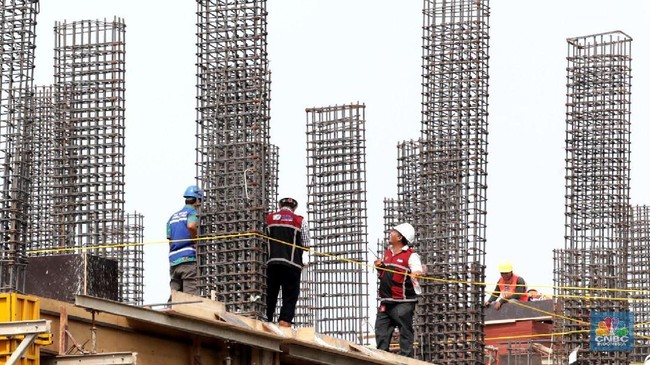
The performance of issuers in the construction sector remains divided. Several contractors have begun to record profit recovery and an increase in new contract acquisitions, whilst others are still grappling with substantial losses and declining revenues.
The performance disparity is evident among PT Adhi Karya (Persero) Tbk (ADHI), PT PP (Persero) Tbk (PTPP), PT Wijaya Karya (Persero) Tbk (WIKA), PT Waskita Karya (Persero) Tbk (WSKT), PT Total Bangun Persada Tbk (TOTL), and PT Nusa Raya Cipta Tbk (NRCA). The financial data uses the latest available consolidated reports as of 22 July 2026. PTPP and WSKT have published their first-half 2026 reports, whilst the other four issuers are still using first-quarter 2026 reports. For new contracts, the data cut-off is a maximum of 31 March 2026.
In terms of revenue, the figures represent consolidated revenue in the income statement. Therefore, the values may differ from the ‘production revenue’ figures in company presentations, which sometimes include portions from joint operations.
Regarding profit attributable to owners of the parent entity, TOTL shows the most consistent earnings quality. Its 2025 profit rose 56.1% to Rp414.3 billion and grew a further 37.3% in the first quarter of 2026. NRCA also remained profitable, although its first-quarter 2026 profit fell by approximately 5%. The 2024 figures for ADHI and PTPP use comparative figures that have been restated in the 2025 audit report. ADHI changed from a profit of Rp252.5 billion to a loss of Rp86.8 billion, whilst PTPP changed from a profit of Rp415.7 billion to a loss of Rp1.52 trillion. WSKT’s first-half 2025 figure also uses the latest comparative figure, which is a loss of Rp2,309.5 billion.
To avoid mixing different project types, the analysis of dominant construction types and their largest projects is divided into two tables. It should be noted that companies do not present their composition on a uniform basis. ADHI, PTPP, and WSKT use the composition of new contract values; WIKA and TOTL use revenue composition, whilst NRCA does not disclose the percentage value, so it is calculated based on the number of main projects mentioned by the company.
ADHI secured the most building construction contracts, accounting for 43% of new contracts in 2025. This portion is larger than water resources at 15% and roads and bridges at 14%. At PTPP, the official building and residential category contributed 40% of new contracts up to March 2026. Because the company does not separate the percentage for buildings and housing, the 40% figure cannot be claimed as purely office buildings. WIKA earned revenue of Rp6.25 trillion from the combined infrastructure and building segment in 2025, equivalent to approximately 46.9% of consolidated revenue. As WIKA’s report does not separate the percentage for infrastructure and buildings, the type selected is infrastructure based on the profile of large projects within that segment. WSKT obtained the most connectivity contracts, at 46% of first-quarter 2026 contracts. The next positions were occupied by water infrastructure at 33.9% and buildings at only 6.3%. TOTL is different. Based on the 2025 project revenue composition, the largest category is utilities at 29%, followed by industrial and hotels at 21% each. In TOTL’s portfolio, data centres are placed as utilities projects. NRCA does not announce the percentage of contracts by project type. However, of the 21 main 2025 projects listed by the company, 20 are buildings or structural works. This means approximately 95.2% by frequency, not by contract value.
Cumulative new contract figures are year-to-date values. Therefore, quarterly values for the same year cannot be directly summed as the projects overlap.
TOTL, NRCA, ADHI, PTPP, and WSKT show a strengthening trend. TOTL has the most solid fundamental trend. Its 2025 revenue rose 26.4% and profit attributable to the parent entity soared 56.1%. In the first quarter of 2026, revenue did dip slightly by 1.1%, but profit still grew 37.3%. A note of caution is that new contracts as of March 2026 amounted to Rp1.50 trillion, approximately 24.2% lower than the Rp1.98 trillion in the same period last year. NRCA is also relatively healthy. Its 2025 revenue grew 7.1% and profit surged by about 115%. The first quarter of 2026 weakened slightly, with revenue down 5.8% and profit down 5%. However, new contracts rose by about 29.5% to Rp893.5 billion, providing a cushion for future revenue. ADHI showed a sharp recovery in the first quarter of 2026, with profit reaching Rp154.1 billion compared to just Rp0.3 billion in the first quarter of 2025. New contracts rose 131.5% to Rp4.72 trillion, although revenue still fell slightly by 1.1%. This recovery must still be read cautiously as ADHI had just recorded a loss of Rp5.40 trillion in 2025. PTPP is beginning to recover on the profit side. Its first-half 2026 profit increased 196.5% to Rp193.5 billion. However, revenue fell 11.2% and new contracts as of March fell by about 25.2%. Thus, PTPP’s trend is strengthening in short-term profitability, but not yet in revenue and contract growth. WSKT shows operational improvement, although it has not yet emerged from losses. First-half 2026 revenue rose 58.5%, whilst the loss was reduced by about 17% to Rp1.92 trillion. In other words, the direction is improving, but the level of loss is still very large.
WIKA is the most pressured issuer with the most negative trend. Its 2025 revenue fell 30.8% to Rp13.33 trillion, whilst the loss attributable to the parent entity swelled to Rp9.71 trillion. The pressure continued into the first quarter of 2026, with revenue falling a further 16.3% and the loss widening 45.7% to Rp1.14 trillion. On a positive note, WIKA’s new contracts rose 17.2%.