
Tofu and Tempeh Makers Baffled as Imported Soybean Prices Fall
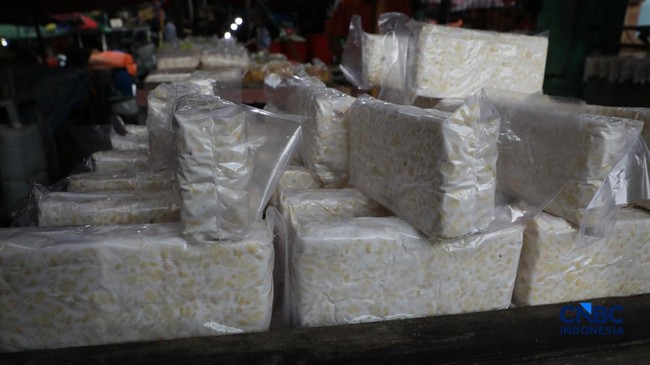
Jakarta, CNBC Indonesia – The Indonesian Tofu and Tempeh Producers Cooperative Association (Gakoptindo) has highlighted an anomaly in domestic soybean prices. Amid a rising global soybean price trend, the price of imported soybeans sold by importers in Indonesia has actually tended to remain stable or even fall, meaning the soybean subsidy promised by the government has yet to be disbursed.
According to global trade data, the world soybean price reached US$1,238.57 per bushel on 23 July 2026, up 0.45% from the previous day. Over the past month, soybean prices have also surged by around 11.71%.
However, this contrasts with conditions at home. Importers’ delivery order (DO) price data shows prices still ranging between Rp10,000 and Rp10,400 per kilogram as of 23 July 2026.
Gakoptindo Secretary General Wibowo Nurcahyo said the situation is a strange one, or an anomaly.
“Soybeans are actually not going up here, and are even tending to fall in Indonesia,” Wibowo told CNBC Indonesia on Friday (24/7/2026).
According to him, the situation relates to the fact that the Rp2,000 per kilogram soybean subsidy previously promised by the government has not yet been paid out.
“Thankfully, that subsidy still hasn’t been disbursed,” he said.
Wibowo explained that, under the prevailing rules, the subsidy can only be channelled once the imported soybean price reaches the Reference Selling Price (HAP) set by the government at Rp12,000 per kilogram at the importer level. Currently, however, imported soybean prices remain around Rp10,000 per kilogram, so that requirement has not been met.
“What’s happening now is that imported soybeans are priced at around 10,000 (per kilogram). It even fluctuates – up and down and down and down, rising a little then falling repeatedly. That means the subsidy automatically cannot be triggered,” he said.
Wibowo believes the rise in global soybean prices should already be reflected in domestic prices. However, based on Gakoptindo’s analysis, this has not happened because importers are allegedly keeping their selling prices below the HAP.
“My analysis is that importers actually do not want the subsidy to happen. That’s why they’ve been moving to sell at low prices,” he asserted.
According to Wibowo, this approach is considered more advantageous for importers than if the government subsidy were actually disbursed.
“People will surely ask, ‘so they’re making a loss then?’ They’re not losing. Where would the loss come from? They’ve been making profits for years – soybean prices have for quite some time been profitable for the importers,” Wibowo said.
“So rather than losing out when the subsidy is disbursed – because the distribution network they have built would collapse, would be disrupted, so to speak – that’s what’s happening. And that’s not what they want. So they keep soybean prices from reaching the HAP, and the subsidy ultimately never materialises,” he continued.
On the other hand, Wibowo stressed that low soybean prices do not mean the burden on tofu and tempeh producers has eased. He said other production costs keep rising, from logistics and transport to fuel and packaging.
Gakoptindo’s data shows that compared with 2022, imported soybean prices have fallen by around 18%–23%, but various other cost components have risen. The US dollar exchange rate has climbed around 20%–25%, plastic packaging prices have risen by 60%–90%, and logistics costs have risen 25%–45%, while tempeh and tofu prices have stayed at Rp5,000. This has put producers’ profit margins under increasing pressure.
“The impact is that we’ve had to thin out our tofu and tempeh output, so that we don’t lose too much profit,” Wibowo said.
Because of this, Gakoptindo is urging the government to promptly evaluate the HAP provision that serves as a condition for disbursing the subsidy. The organisation has even sent a letter to the Coordinating Minister for Food, Zulkifli Hasan, requesting a review of the soybean HAP using a zoning scheme, so that it better reflects distribution costs in each region.
“That’s why we’re asking the government to re-regulate and review the HAP. We’re asking for the government’s Reference Selling Price to be reviewed. But to this day, the HAP still hasn’t changed,” he said.
He expressed hope that the government will revise the rules so that the promised subsidy can genuinely be felt by tofu and tempeh producers.
“Of course we hope the subsidy will still be disbursed, because it is a government promise. But our request is that the rules hindering the subsidy be revised, so that the subsidy is truly channelled,” he concluded.