
Tobacco Farmers, Workers, and Entrepreneurs Send Message to Prabowo Rejecting Derivative Regulations of PP 28/2024
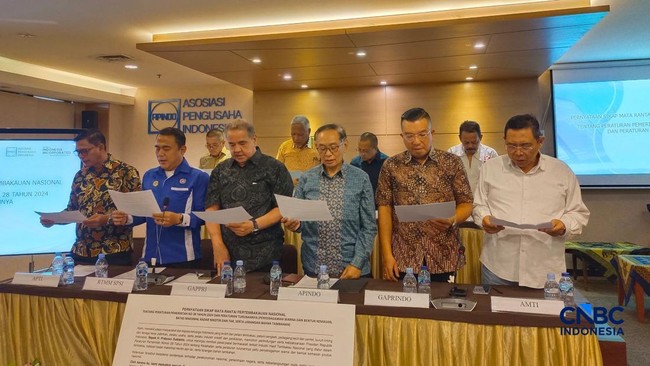
Rejection of several derivative regulations of Government Regulation (PP) Number 28 of 2024 concerning Health, which regulates tobacco products, is intensifying. This time, the opposition comes from various elements of the tobacco ecosystem, ranging from entrepreneurs and tobacco farmers to labour unions, who believe these rules could disrupt the sustainability of the industry and millions of livelihoods. They have sent an important message to President Prabowo Subianto.
During a press conference facilitated by the Indonesian Employers Association (Apindo), representatives of the associations unanimously expressed their rejection of the planned regulations on standardised cigarette packaging, restrictions on tar and nicotine levels, and the ban on additives being prepared by the government as derivative rules of PP 28/2024.
Apindo’s Head of Public Policy, Sutrisno Iwantono, stated that his party supports the government’s efforts to safeguard public health. However, he cautioned that such policies must also consider their impact on an economic sector involving millions of people. According to him, the rules on standardised packaging, tar and nicotine limits, and additive bans could potentially cripple the legal tobacco industry. “So, we expect that these three rules… standardised packaging, then tar and nicotine limits, and the ban on additives, will de facto shut down the legal industry, and the impact will certainly be on the workforce, and will actually fuel the illegal cigarette trade without providing meaningful health benefits,” Sutrisno said at the Apindo Head Office in Jakarta on Thursday (23/7/2026). He also requested that the government harmonise policies across ministries to avoid conflicts between health interests and business sustainability.
Meanwhile, the Chairman of the Indonesian White Cigarette Producers Association (Gaprindo), Henry Nayoan, assessed that the derivative rules of PP 28/2024 could disrupt the entire supply chain of the tobacco industry, which currently supports millions of workers. “For this, our stance as of today is that we reject the government’s plan to standardise cigarette packaging, and we reject the government regulation regarding the restriction of tar and nicotine levels, as well as the ban on additives,” Henry said at the same event. According to Henry, the tobacco industry involves around 6 million people throughout the supply chain and contributes significantly to state revenue. He therefore urged the government to consider the economic impact before issuing the regulation.
Similar rejection was also voiced by the Indonesian Tobacco Farmers Association (APTI). APTI Secretary General Mudi Kusnadi assessed that the regulation on tar and nicotine limits would directly impact farmers’ harvests. He explained that the majority of local tobacco has tar and nicotine content that does not meet the government’s planned limits. Meanwhile, about 99% of farmers’ harvests are absorbed by the tobacco industry. “In essence, representing tobacco farmers across Indonesia, we firmly reject any form of regulation concerning restrictions, whether on tar and nicotine, packaging standardisation, or the ban on other additives,” Mudi stated. He explained that tobacco farmers are among the most potentially affected parties if the government proceeds with the tar and nicotine limit rules. According to him, farmers will struggle to sell their harvests because the characteristics of local tobacco cannot immediately adapt to the new standards. “Because the implications are too large and broad if this is enforced. Specifically, Indonesian tobacco is local tobacco, the majority of which we grow and which thrives in Indonesia. The tar and nicotine content averages above 2% to 12%,” he explained. “If this standardisation is enforced now, what will be the fate of the farmers? Who will accommodate our harvests? Because 99% of our cultivation results are absorbed entirely by the tobacco industry, which helps the sector from upstream to downstream,” he continued.
From the labour side, the Head of Research and Development for the Federation of Cigarette, Tobacco, Food, and Beverage Workers Unions of the All-Indonesia Workers Union (FSP RTMM-SPSI), Didik Aswadi, also voiced strong opposition. Didik stated that his organisation has more than 242,000 members, with around 80% working in the tobacco industry. He warned that the policy could trigger a wave of unemployment. “We are not anti-regulation, but the unemployment that will occur in this tobacco industry…” he said. He even declared that his party is ready to stage demonstrations if the regulation is enacted. “If this regulation is still enacted, we will mobilise a protest in Jakarta and lay siege to the Ministry of Health,” he asserted.
Rejection also came from the Indonesian Street Vendors Association (APKLI). Chairman Ali Mahsun stated that his organisation supports the stance of all elements of the tobacco ecosystem in asking the government to review the derivative rules of PP 28/2024. According to him, the policy will not only impact the cigarette industry but also hit small traders who depend on income from tobacco product sales.
Here is the content of their message to Prabowo:
We, representing millions of tobacco farmers, clove farmers, workers, street vendors, and entrepreneurs of the Tobacco Products Industry (IHT) across Indonesia, hereby convey the following:
We support the government’s efforts to improve public health, but we reject the derivative regulations of PP 28/2024 that threaten the sustainability of the national IHT ecosystem.
We firmly reject the regulation on standardised cigarette packaging, as it will eliminate the characteristics of legal products, open up opportunities for the circulation of illegal cigarettes, and harm the creative industry sector.
We firmly reject the regulation on limiting tar and nicotine levels, as it will kill the local tobacco industry and eliminate the livelihoods of millions of farmers and workers.
We firmly reject the regulation on the ban of additives in tobacco products, as it will eliminate the distinctiveness of Indonesian tobacco products and harm the clove and other supporting commodity industries.
We request that President Prabowo Subianto review these problematic articles and protect the national tobacco ecosystem, which involves millions of Indonesian citizens.
We, representing millions of Indonesian citizens and heads of families consisting of tobacco farmers, clove farmers, small traders and retailers, hand-rollers and factory workers, business actors, and creative and advertising industry players, appeal for the protection and wisdom of the President of the Republic of Indonesia, Mr. Prabowo Subianto, to review the problematic articles related to the Tobacco Products Industry.