
Tobacco and Clove Farmers Demand Health Ministry Review Draft Health Warnings Regulation
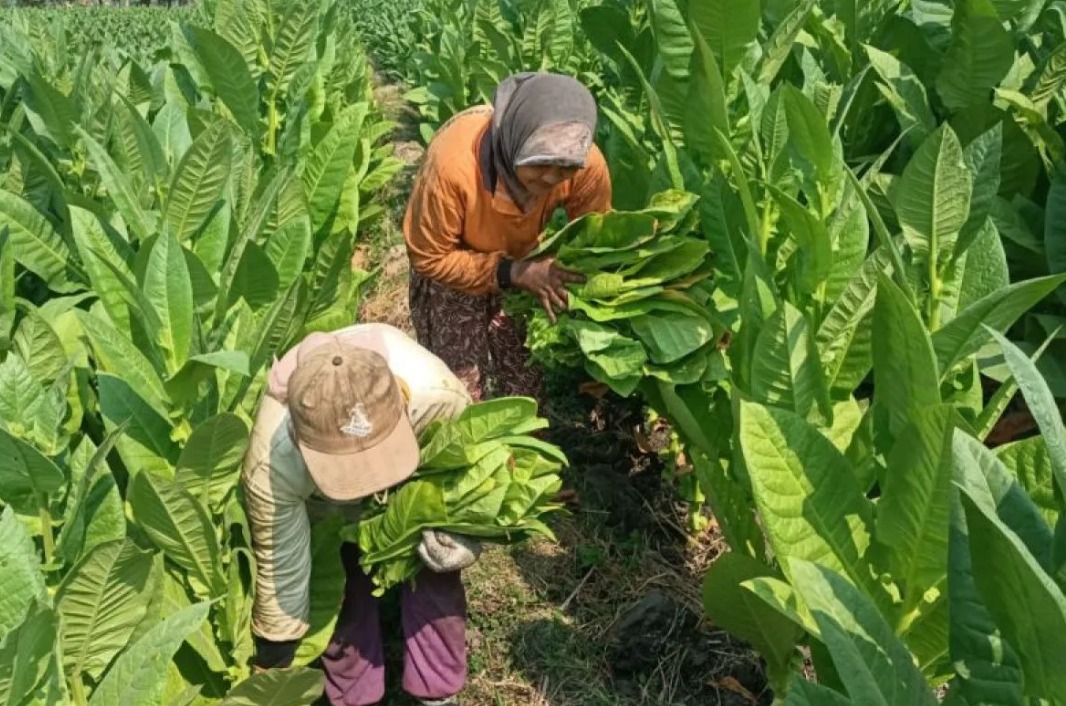
Several national tobacco sector farmer associations have called on the government to review the Draft Ministerial Regulation (RPMK) on Health Warnings. The regulation, initiated by the Ministry of Health (Kemenkes), is seen as threatening the livelihoods of millions of tobacco and clove farmers upstream due to clauses mandating plain packaging.
The strong opposition emerged during a public consultation on the regulation derived from Government Regulation No. 28 of 2024, which implements Law No. 17 of 2023 on Health. Farmers argue the RPMK draft still contains clauses requiring all tobacco and e-cigarette packaging to be standardised in Pantone 448C or plain. They also claim the Health Ministry has overstepped its authority by regulating matters outside health concerns.
Agus Parmuji, Chairman of the National Board of the Indonesian Tobacco Farmers Association (DPN APTI), stressed that the packaging standardisation regulation risks triggering a domino effect harmful to farmers. If tobacco product industries struggle to sell due to plain packaging rules, local farmers’ raw material purchases will inevitably be reduced.
“Do not pit us, rural farmers, against the industry. The draft packaging standardisation clearly makes it harder for industries to sell their products. Ultimately, purchases of raw materials from farmers will be cut. People are being pitted against the tobacco industry,” Agus stated on Thursday (28 May 2026).
Agus lamented the Health Ministry’s failure to consider the realities of tobacco farming ecosystems in regional centres such as West Java, Central Java, East Java, and West Nusa Tenggara. He noted tobacco has long been a backbone of local economies, yielding higher Farmer Trade Value (NTP) than other commodities.
It is ironic that the plain packaging regulation is being pushed as farmers enter the dry season planting period, when tobacco is the only viable crop.
“This packaging regulation is a trap to kill the tobacco ecosystem. We need to survive. It’s planting season now. It’s extremely difficult for us,” Agus said.
He also criticised the Health Ministry’s sectoral ego for excluding relevant ministries, such as the Ministry of Agriculture (Kementan), from the public consultation discussions.
Meanwhile, I Ketut Budhyman, Secretary-General of the Indonesian Clove Farmers Association (APCI), stated that such strict packaging standardisation would directly impact the livelihoods of approximately 1.5 million clove farmers across 10 provinces. In reality, the domestic kretek cigarette industry absorbs nearly all local clove harvests.
“We, clove farmers, strongly object to and reject this packaging standardisation. Imposing such strict rules will inevitably affect upstream farmers of tobacco and clove. The RPMK clauses will severely disrupt our livelihoods,” Budhyman said.
Budhyman also criticised the Health Ministry for incorrect benchmarking in drafting the regulation. He said the ministry is looking to foreign countries whose populations do not rely on tobacco ecosystems, despite Indonesia being one of the world’s largest clove producers, with 97-98% of its output absorbed by the local kretek industry.
“So the comparison is not apples to apples,” Budhyman concluded.
GAPPRI has stated that the nicotine and tar restrictions outlined in Article 431 of Government Regulation No. 28/2024 will harm the domestic kretek industry.