
To Strengthen Rupiah, Economist Calculates Indonesia Needs US$11 Billion in Foreign Investment
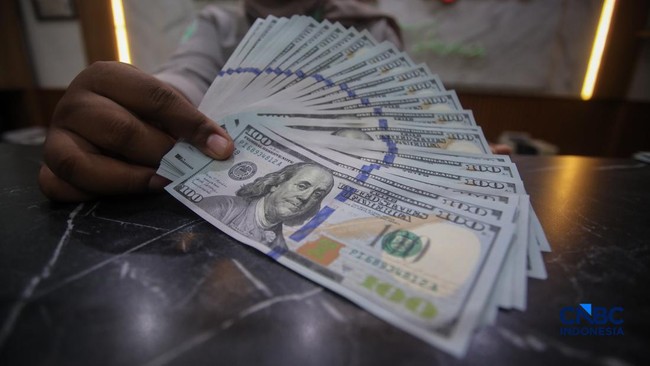
Jakarta, CNBC Indonesia – Indonesia needs billions of dollars in investment to maintain the stability of the rupiah exchange rate. This was stated by Chief Economist at Trimegah Sekuritas Indonesia, Fakhrul Fulvian.
He said a sufficiently large inflow of foreign investors is important to maintain the balance of payments equilibrium, which in turn supports exchange rate stability.
“Indonesia still needs a fairly large additional inflow of foreign capital so that the balance of payments becomes stronger. Therefore, we must not be complacent too quickly,” Fakhrul said in his note on Thursday (9/7/2026).
“We need an increase in foreign investor positions in the second half of 2026 of US$8–11 billion to maintain rupiah stability,” he added.
According to Fakhrul, foreign investors’ decisions depend on three main factors: consistency of fiscal consolidation, the normalisation process of government bond yields, and certainty over the direction of monetary policy.
“Global investors always compare Indonesia with other developing countries. If we can offer a combination of strong fundamentals, competitive yields and credible policy, I am optimistic that foreign investor participation will continue to increase in the second semester.”
He believes rupiah movements in the second semester will be determined more by the combination of fiscal and monetary policy than merely by the direction of Bank Indonesia’s interest rates.
“I see the second semester as a very decisive period. If fiscal consolidation proceeds as planned, oil prices remain moderate and the bond market normalisation process continues, pressure on the rupiah will gradually ease,” he said.
Maintaining exchange rate stability cannot rely solely on market intervention or liquidity management.
“Rupiah stability must ultimately be built through a combination of mutually supportive policies. Credible fiscal policy, an attractive bond market and consistent policy communication will be far more effective than relying on monetary instruments alone.”
Exchange rate stability is itself a selling point to investors looking to put their capital into Indonesia. If the rupiah continues to weaken over the long term, the effect is that foreign capital flows will be reluctant to enter the country.
Hendra Hartono, CEO of Leeds Property, said rupiah instability actually damages investors’ long-term calculations, particularly regarding return on investment (ROI).
“When the rupiah is this volatile, foreign investors will not come in straight away. Even if they see the rupiah as cheap, they are actually asking themselves: how low can it go? If they buy now and the rupiah keeps weakening, they lose even more. Especially if the asset is leased out again, the ROI does not add up when converted to dollars,” Hendra told CNBC Indonesia on Thursday (9/7/2026).
Industry is the last sector touched by foreign investors when entering a country. Usually, they go through a long adaptation cycle before daring to inject large amounts of capital into factories or land.
“Foreign investors don’t come straight in looking for factories. They go through a cycle first; staying in hotels, talking to corporate lawyers or local entrepreneurs about joint ventures. Then they rent a serviced apartment, move into a serviced office for a small team, and only then look for a large office. Finally, once they are confident about political and economic stability in Indonesia, they invest in factories,” he explained.
As a result, industry is the sector most vulnerable to the psychological impact of the current macroeconomic uncertainty. If this situation persists, investors are feared to avoid long-term commitments.
“The industrial sector is the most vulnerable of all to this rupiah weakness. If the rupiah keeps weakening, people will not think long term. In the end everyone will say ‘I’ll just rent a factory’. Well, that’s what we don’t want. We want them to buy land, not just keep renting and then being able to exit tomorrow,” Hendra asserted.
Source: jawawa.id (https://jawawa.id/newsitem/to-strengthen-rupiah-economist-calculates-indonesia-needs-us-11-billion-in-foreign-investment-1783590708)
Originally published by CNBC Indonesia (https://www.cnbcindonesia.com/market/20260709152212-17-749493/buat-perkuat-rupiah-ekonom-hitung-ri-butuh-investasi-asing-us--11-m), translated from Indonesian