
To Reduce Imports, Food Coordinating Ministry Launches Soybean Pilot Project in Cariu
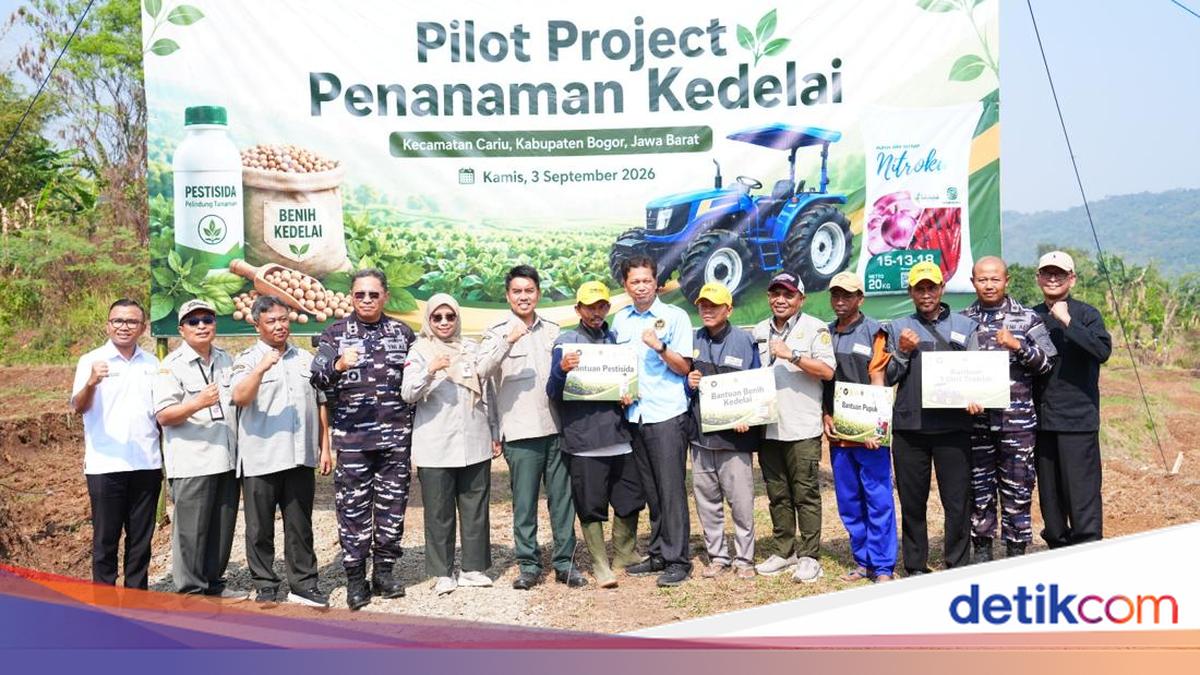
The government is strengthening efforts to increase national soybean production amidst Indonesia’s continued high dependency on foreign supplies. Currently, approximately 95% of national soybean requirements are met through imports.
To address this challenge, the Coordinating Ministry for Food Affairs (Kemenko Pangan), alongside the Ministry of Agriculture, the Indonesian Navy (TNI AL), the Bogor Regency Government, PT Pupuk Indonesia (Persero), and the Indonesian Tempeh and Tofu Producer Cooperatives Union (Gakoptindo), has launched a Soybean Planting Pilot Project in the Cariu District, Bogor Regency.
“The Pilot Project is being implemented on 25 hectares of land, which is projected to increase to 100 hectares by 2027,” stated Gunawan, Head of General Affairs and Public Relations at the Coordinating Ministry for Food Affairs, in a written statement on Saturday (5/9/2026).
The programme serves as an initial step by the government to bolster domestic soybean production while simultaneously reducing the gap between national demand and production capacity.
National soybean demand is projected to continue rising. In 2026, requirements are expected to reach approximately 2.79 million tonnes, increasing to around 3 million tonnes by 2029. Conversely, domestic soybean production remains far below these requirements.
“Meanwhile, domestic soybean production is still unable to meet national needs, with 2025 production figures only reaching around 79,000 tonnes, while national demand reached 2.72 million tonnes. This condition demonstrates the significant gap between demand and national production capacity, necessitating accelerated steps and stronger collaboration to increase domestic soybean production,” said Gunawan.
Gunawan noted that this programme is not only aimed at producing soybeans but also at strengthening the availability of high-quality soybean seeds. These seeds are expected to support the expansion of planting areas in subsequent years.
Through the Assistant Deputy for Increasing the Competitiveness of Food Crop Products, the Coordinating Ministry for Food Affairs is also coordinating the strengthening of cross-sector collaboration in national soybean development.
In terms of production, the Cariu Pilot Project has received support for infrastructure and facilities, ranging from superior seeds, fertilisers, and pesticides to water pumps and tractors. This support is expected to help ensure the cultivation process runs optimally and serves as a learning model for soybean development in other regions.
Beyond strengthening the upstream sector, the programme’s success is supported by market certainty in the downstream sector. The soybean harvest from the Cariu Pilot Project will be absorbed by Gakoptindo as an off-taker partner, both to be redeveloped as a seed source and to meet the raw material needs of the tofu and tempeh industries.
This guaranteed absorption of the harvest is expected to provide market security and increase business certainty for farmers. Consequently, farmers will not only receive support during the production process but will also have certainty regarding the marketing of their harvests.
“The Coordinating Ministry for Food Affairs hopes that the Soybean Planting Pilot Project in Cariu can serve as a model for integrated and sustainable national soybean development. Moving forward, it is hoped that this collaborative model can be replicated and developed in various regions with soybean potential, thereby gradually increasing domestic production and strengthening national food sovereignty,” he concluded.