
To Improve Public Services, Government Renews Commitment to SP4N-LAPOR!
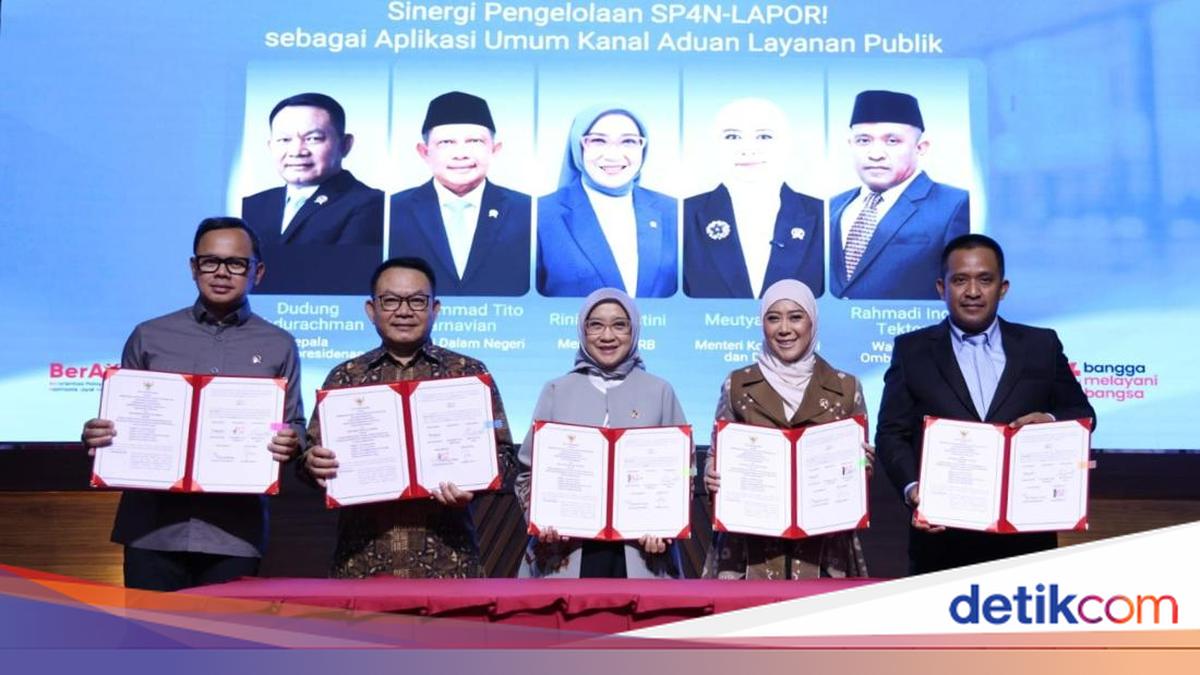
Public voices are a vital component of how the government operates, particularly in improving the quality of public services. This is being implemented by the government through the Public Service Complaint Management System - Public Aspirations and Online Complaints Service (SP4N-LAPOR!).
Through SP4N-LAPOR!, which adopts a ‘No Wrong Door Policy’, the public has a space to voice their concerns, and the government ensures those voices reach and are resolved by the authorised agencies. This shared commitment was established by the Minister of State Apparatus Empowerment and Bureaucratic Reform (PANRB), the Minister of Communication and Digital, the Minister of Home Affairs, the Chief of Staff to the President, and the Deputy Chair of the Ombudsman of the Republic of Indonesia.
“Through the signing of this memorandum of understanding, I request all parties to strengthen coordination and response capacity so that every public voice can be handled quickly, accurately, and sustainably. This is to ensure that the public’s voice becomes an essential part of how the government works, responds to issues, and improves public services,” stated the Minister of PANRB, Rini Widyantini, in a written statement on Tuesday (29/9/2026).
It is noted that the signing of this memorandum of understanding marks the third renewal of this commitment, following previous agreements in 2016 and 2021. SP4N-LAPOR! is described not merely as a reporting channel, but as a platform for mutual learning and communication, forming part of a citizen-centric public service policy.
“SP4N-LAPOR! is not just about the government building a complaint management application, but rather about how government agencies build increasingly comprehensive synergy in complaint management,” explained Rini.
Rini explained that new tasks exist in public service complaint management following today’s signing. Consequently, there are steps that government agencies must observe to uphold this shared commitment. First, coordination forums must run routinely and actively to discuss issues, share best practices, and ensure cross-agency issues are promptly followed up. Second, the commitment must be translated into operational cooperation. Third, every agency must have a responsive liaison officer. Lastly, monitoring and evaluation must be conducted periodically.
Over its 10-year journey, SP4N-LAPOR! has connected with 718 government agencies, including ministries, institutions, regional governments, and State-Owned Enterprises (BUMN). A total of 1,178,168 complaints have been managed, with an average of 454 complaints per day and an average response rate of 88.5 per cent.
Rini emphasised that the success of complaint management through SP4N-LAPOR! does not simply end when a complaint ticket is closed. Success is achieved when government services become faster, more accurate, transparent, and continuously improving.
“Today’s signing of the memorandum of understanding is an affirmation of the government’s commitment to listening to and acting upon the public’s voice. We invite all connected government institutions to continue working hand-in-hand and listening to public grievances. A rapid response must be followed by appropriate handling and real resolution,” explained Rini.
Chief of Staff to the President, Dudung Abdurachman, added that following President Prabowo’s directives, public service transformation is being carried out digitally to make it more accessible, faster, and more certain, with connected services to facilitate the public.
In managing LAPOR!, the KSP (Presidential Staff Office) plays a role and is committed to coordinating, monitoring, and analysing follow-up actions related to complaint data for national priority programmes. “Through LAPOR! as a public service complaint channel, the public should not hesitate to report, ranging from damaged roads, MBG (Free Nutritious Meals), social assistance, schools, and community health centres, to government performance aspirations, as well as extortion and suspected corruption,” explained Dudress.
Meanwhile, the Minister of Communication and Digital, Meutya Hafid, stated that the implementation of LAPOR! is not only to provide answers to complaints but also to obtain data and input from the public. This data can then be processed as a basis for subsequent policy-making for improvements. The commitment of the Ministry of Communication and Digital in managing public service complaints is divided into four sectors: strengthening the reliability of infrastructure and applications; ensuring the integration of technological development; facilitating data interoperability; and strengthening public communication and dissemination.
“The main goal of managing public service complaints through LAPOR! is to increase public trust through responsive and reliable services,” explained Meutya.
Furthermore, the Minister of Home Affairs, represented by Deputy Minister of Home Affairs Bima Arya Sugiarto, explained that the key to the complaint management commitment is how government agencies synergise to strengthen the existing system in LAPOR!. The Ministry of Home Affairs plays a role in coordinating the guidance, supervision, monitoring, and evaluation of SP4N-LAPOR! by regional governments.
Therefore, Bima emphasised the Ministry of Home Affairs’ commitment to: first, strengthening the integration of all regional government complaint channels into SP4N-LAPOR!; second, strengthening hierarchical guidance and supervision in regional governments; third, conducting periodic monitoring and evaluation; and finally, requesting regional heads to strengthen the socialisation of the SP4N-LAPOR! channel to the public.
The Deputy Chair of the Ombudsman of the Republic of Indonesia (ORI), Rahmadi Indra Tektona, stated that the ORI will continue to strengthen external supervision over the implementation of complaint management through LAPOR! and provide advice and considerations for improvement for government agencies. Additionally, the ORI will continue to encourage the resolution of complaints that require coordination.