
To Feed 1.4 Billion People, Xi Jinping Forbids Farmland from Falling Below 120 Million Hectares
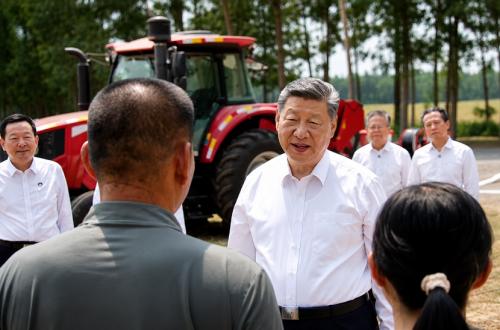
Chinese President Xi Jinping has once again stressed that food security is the main foundation of national development. During an agricultural inspection in Dezhou City, Shandong Province, Xi emphasised that China must not depend on other countries to meet the food needs of its more than 1.4 billion people.
Xi’s visit took place during the wheat harvest and summer maize planting season, a critical period for China’s annual food production. In Dongyujia Village, he directly inspected the condition of farmland, spoke with farmers, agricultural machinery operators, and technicians, and examined the progress of the harvest and replanting.
Rather than simply receiving official reports, Xi asked detailed questions about the area of land planted, storage facilities, farmers’ profits, coordination of agricultural machinery use, and this season’s harvest yields.
“Better than last year,” replied Yu Shulei, a farmer who manages more than 400 mu, or about 27 hectares, of land.
According to Yu, this year’s harvest was achieved after a long struggle. High rainfall last autumn had delayed the planting season, so farmers and agricultural technicians had to undertake various efforts to maintain crop growth.
Hearing the report, Xi expressed his appreciation. After learning that wheat production had increased again and maize planting was proceeding on schedule, he reiterated the importance of maintaining stable food production.
“Ensuring a stable supply of grains and other agricultural products is the top priority in agricultural production,” Xi said.
On that occasion, Xi again reminded of the importance of keeping the total national farmland area from falling below the minimum limit set by the government.
“I have stressed that the country’s total farmland area must not fall below the red line of 1.8 billion mu (120 million hectares) and that all prime farmland must be reserved for grain production. Why?” Xi stated.
He then answered his own question by emphasising the importance of food independence for China.
“Because no matter how modernised our country becomes, we must rely on ourselves to feed our people. With a population of 1.4 billion, we cannot depend on others. We must remain focused on grain production,” Xi said.
The statement aligns with the Chinese government’s policy, which for years has made food security a national strategic priority. With nearly 20 per cent of the world’s population but only about 9 per cent of global arable land, China continues to strive to maintain food self-sufficiency through farmland protection and productivity improvements.
The summer harvest is significant for China as it accounts for about 40 per cent of the national staple food production each year. After the wheat harvest is complete, farmers must immediately plant maize, soybeans, or rice to catch the next planting season.