
To Combat Forest Fires, BNPB Intensifies Weather Modification in Various East Kalimantan Regions
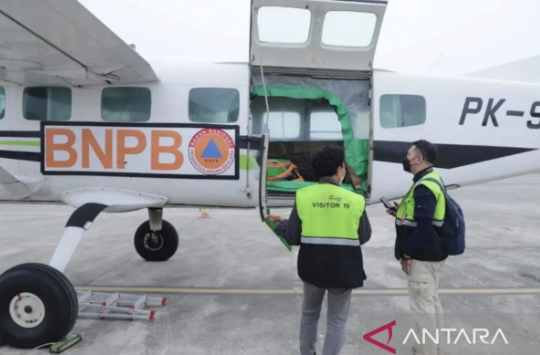
The National Disaster Management Agency (BNNP) is intensifying the implementation of Weather Modification Operations (OMC) in East Kalimantan Province. This step is being taken to trigger artificial rain in order to tackle forest and land fires (karhutla) as well as the extreme drought currently hitting the region.
For this operation, the BNPB has prepared three tonnes of seeding material in the form of Sodium Chloride (NaCl), or salt. The Expert Lead of the BNPB, Air Marshal Albertus Irianto, stated that existing clouds with the potential to produce rain are being utilised to the maximum extent to help reduce the impact of thick smoke and drought in several areas.
“We hope that the clouds capable of producing rain will allow conditions in the affected areas to gradually improve,” said Albertus after leading an emergency preparedness meeting for forest fires and drought at Aji Pandaeran Tumenggung (APT) Pranoto Airport, Samarinda, East Kalimantan, on Thursday.
Albertus detailed that the cloud seeding implementation had previously been intensified on Wednesday. Between 08:20 and 10:20 WITA, the seeding operation focused on the Kutai Kartanegara Regency. Subsequently, the aerial mission moved to the Kutai Timur region and Samarinda City between 12:02 and 14:25 WITA. Towards the late afternoon, specifically at 17:02 WITA, the operation continued, targeting Balikpapan City, West Kutai Regency, Kutai Kartanegara, and North Penajam Paser Regency.
For the implementation of the OMC on Thursday, the joint team has prepared the full three tonnes of NaCl to be dispersed across potential points. The execution of the OMC is not conducted randomly but is based on accurate daily weather analysis and forecasts. This includes monitoring the potential for cloud growth and projecting rainfall accumulation in the light to moderate category across several affected areas.
Based on recent meteorological monitoring, the probability of rain-producing cloud growth in various parts of East Kalimantan currently ranges from medium to high, approximately 50 to 70 per cent. However, Albertus warned that this weather engineering must be accompanied by continuous and strict monitoring of atmospheric dynamics and the distribution of hotspots.
On the other hand, the Head of the East Kalimantan Regional Disaster Management Agency (BPBD), Buyung Dodi Gunawan, revealed that they are facing significant challenges due to a surge in forest fire cases caused by extreme dry weather. The situation is exacerbated by the characteristics of certain areas, particularly peatland regions, which require specialised and extra handling techniques.
“Handling is not only done when fires occur, but also through monitoring, prevention, and preparedness. We continue to optimise personnel and cross-agency coordination so that hotspots do not develop into large-scale fires,” said Buyung.
The impact of the series of forest fires hitting East Kalimantan recently has also triggered a significant decline in air quality in the provincial capital, prompting integrated emergency handling by both central and regional governments.