
To Boost Productivity, Farmers Need More Open Access to Financing
Food sovereignty has become a goal continuously promoted by the government. To realise this, strengthening financing access in the agriculture sector must be carried out to facilitate farmers in increasing their productivity.
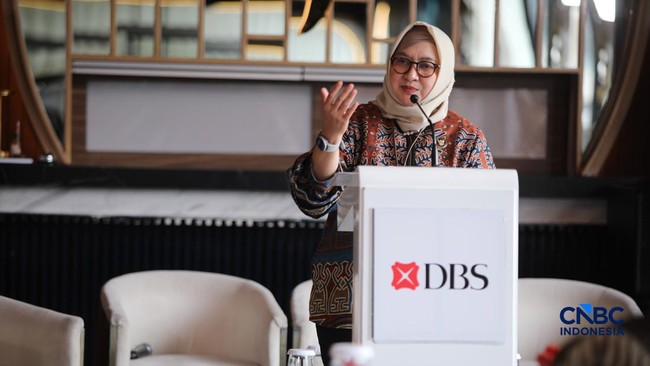
Deputy Coordinator for Food and Agriculture Business at the Coordinating Ministry for Food, Widiastuti, stated that they acknowledge that financing access in the agriculture sector still faces several obstacles. Moreover, risks in the agriculture sector are considered high due to dependence on natural factors. Conversely, the scale of farmers’ businesses tends to be small, and farmers are usually constrained by limited collateral.
Challenges like these need serious attention from the government and financial institutions. Considering that farmers require substantial financing support to improve their productivity performance.
“So, by possibly changing the financing approach so that it is no longer seen as something independent or standalone, but also encouraging value chain-based financing where farmers, off-takers, financial institutions, and the government unite and connect in one ecosystem,” she explained during the Coffee Morning event themed Securing Indonesia’s Food Sovereignty through Value Chain and Financing Amid Global Disruption at Parle, Senayan, as reported on Wednesday (29/4/2026).
Widiastuti added that the role of banking, including Bank DBS Indonesia, will be increasingly strategic to become an enabler of ecosystem-based financing. In this regard, Bank DBS Indonesia can promote value chain schemes in sustainable financing by utilising digital technology to expand credit access in the agriculture sector.
The Coordinating Ministry for Food also hopes for a more adaptive risk-based financing scheme, so that it can be utilised and distributed proportionally through policy instruments and financial mechanisms.
“One form of it might be, besides real ones, there is branded finance and others, or strengthening government guarantees which can also become a government instrument that can be a focus, that can be done,” she said.
Furthermore, Widiastuti emphasised the importance of maintaining institutional arrangement and strengthening the coordination function of value chain-based institutions and standardisation. This is to accelerate the strengthening of a resilient national food ecosystem in facing global disruptions, so that ultimately the agriculture sector directly related to food gains high trust from financial institutions.
Not to be forgotten, Widiastuti reaffirmed that food sovereignty is the foundation for the Indonesian nation in facing various challenges and global disruptions. In line with that, the government will continue to carry out new integrated, innovative, and collaborative approaches through strengthening value chains and inclusive financing.
“We believe that strong synergy between the government and all stakeholders in the sector and others, Indonesia will not only be able to face global challenges but become the main force in the Indonesian food system and the world food system that we must realise,” she concluded.