
To Attract Long-Term Investment, Indonesia Needs Transparent Trade
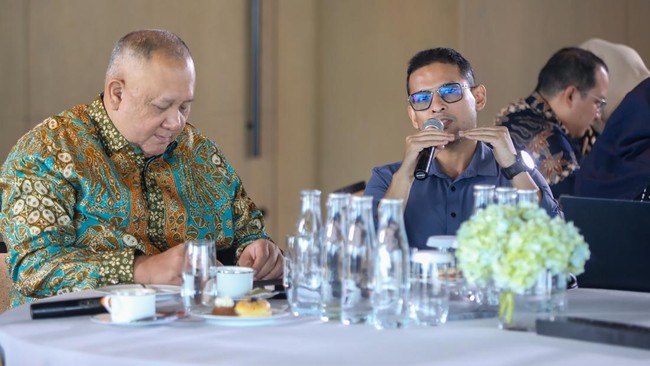
The success of global trade is determined by the balance between domestic protectionism and efforts to maintain a fair and open trading system. This was stated by Sophie Freeland-Haynes, Country Director for Trade at the British Embassy Jakarta, who noted that achieving this balance is a key target for many nations, including the United Kingdom.
“From our perspective, lowering tariffs, reducing market access barriers, and ensuring a fair, predictable, and transparent investment climate can serve as an attraction, allowing companies and business actors to make long-term investment decisions as an ideal solution,” Sophie explained during the CNBC Indonesia Coffee Morning themed “Redefining Trade Rules: Fair Tariffs for Long-Term Sustainable Partnerships.”
This vision has prompted the UK to aggressively negotiate more trade agreements with its partners. She noted that the UK possesses extensive experience and is striving to deepen trade relations with various countries to ensure support for fair, open, and transparent low-tariff trade.
Indonesia is identified as a key target for increased trade cooperation. Furthermore, Indonesia’s potential accession to the Comprehensive and Progressive Agreement for Trans-Pacific Partnership (CPTPP) is viewed as a vital pathway. In the context of Indonesia-UK trade, the CPTPP could serve as a mechanism to reduce regulatory overlap (the “spaghetti bowl of regulation”), trade tariff discrepancies, and expand networks.
“The UK is also looking at the future form of bilateral free trade agreements. Naturally, Indonesia, as one of the major economic powers in ASEAN and Asia, is part of those discussions in London. We recognise that balancing the protection of domestic industries while remaining open to foreign investment is a very difficult challenge to execute precisely,” Sophie asserted.
She noted that this balance is essential to drive economic growth, particularly for Indonesia to maintain its impressive economic growth rates. Amid current global economic dynamics, Sophie believes an approach prioritising partnership is far more important than isolationism.
Consequently, she encouraged strengthened dialogue between the Indonesian and British governments, as well as business actors, to foster a shared understanding of economic and investment challenges. Beyond bilateral cooperation, the UK also promotes collaboration through multilateral forums such as the World Trade Organization (WTO) to create more inclusive and sustainable economic growth for both nations.
Currently, Indonesia is not yet a primary trading partner, ranking 55th in the UK’s partner list, contributing 0.2% of total overall trade.
During the same event, Fithra Faisal, an Expert Staff member of the Government Communication Agency, stated that current trade and investment policies are a continuation of a long-term strategy formulated since 2016. The primary focus is expanding international trade cooperation, strengthening industrialisation, and increasing Indonesia’s participation in global supply chains.
Since then, the government has mapped potential countries for trade cooperation through free trade agreements and Economic Partnership Agreements (EPA). Ongoing collaborations, including those with the European Union, Australia, and the UK, are the results of a long process built across administrations, from the era of Joko Widodo to Prabowo Subianto.
Fithra stated that a key government focus is creating added value from domestic production through industrialisation. While Indonesia possesses significant natural resource strength, the next challenge is processing that potential into competitive industrial products.
“To support industrialisation, the government is beginning to evaluate various trade barriers, including import quota policies which are deemed to limit Indonesia’s participation in global production networks. Based on various studies, import quotas make it difficult for Indonesia to become more deeply involved in global production networks,” he said.
He argued that more effective trade policies should rely on measurable tariffs rather than excessive import restrictions. Various import barriers often trigger economic rent-seeking practices and make it difficult for industries to obtain raw materials at competitive prices.
Furthermore, the government is encouraging adjustments to Domestic Component Level (TKDN) policies to support national industry without hindering competitiveness. He noted that Indonesia needs to maintain a balance between strengthening local industry and remaining open to cheaper imported raw materials to produce competitive export products.
“If we can import cheap inputs, then we can sell more competitive outputs,” he concluded.