
TNI Task Force: Change Land Management Methods to Prevent Forest and Land Fires
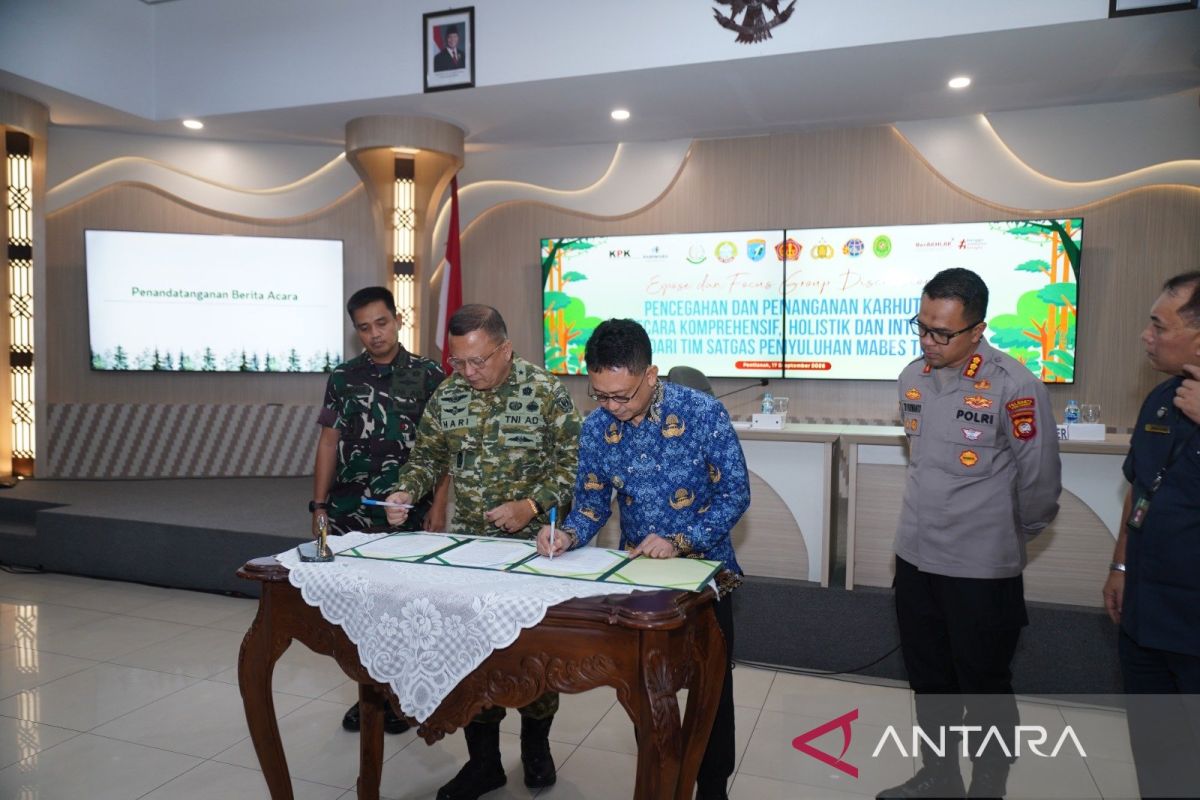
Pontianak (ANTARA) - The Chairman of the TNI Headquarters Advisory Task Force, Brigadier General TNI Hari Mulyanto, has called on the community to change their perspective on managing forests and land by prioritising environmental sustainability.
“Preventing forest and land fires is not enough when the fire has already appeared; it must begin with changes in behaviour, education, and preparedness before the dry season,” he stated during an Expose and FGD on Comprehensive, Holistic, and Integral Prevention and Handling of Forest and Land Fires at the Sultan Syarif Abdurrahman Hall, Pontianak Mayor’s Office, on Thursday.
Hari noted that land management should not be solely oriented towards economic profit, but environmental aspects must be the primary consideration to ensure that fires do not recur and their impacts are not felt by the wider community.
“Do not only focus on profit; environmental sustainability must be prioritised,” he said.
According to him, the success of preventing forest and land fires will have a direct impact on various sectors of life, namely that the city can be free from haze, teaching and learning activities can continue, the economy remains undisturbed, and health risks can be suppressed.
“If forest and land fires do not occur, Pontianking will be free from haze, children can attend school, the economy will run well, and public health will not be disrupted. All of this determines a better future,” he added.
This view aligns with the Mayor of Pontianak, Edi Rusdi Kamtono, who emphasised that prevention is far more important than firefighting. He noted that with a total area of approximately 118.2 square kilometres, about 30 per cent of which is peatland, Pontianak has areas that are quite vulnerable to fire during the dry season.
Edi explained that fire vulnerability is particularly high in several areas of South Pontianak, South Pontianak, and North Pontianak. He noted that the prolonged dry season in 2026 has been particularly challenging, having lasted since the beginning of June 2026.
“Prevention is more important than extinguishing because once a fire occurs, we require significant time, labour, and budget,” he said.
According to Edi, most land fires are triggered by human activities, with various patterns ranging from land clearing through burning, agricultural land opening, and residential area development, to negligence such as discarding cigarette butts or burning rubbish without supervision.
The practice of burning is still frequently chosen because it is considered a quick way to clear land and reduce soil acidity. However, this method poses a massive risk as fire can spread beneath the peat surface and becomes difficult to extinguish.
The Pontianak City Government has formed a Forest and Land Fire Prevention Task Force involving the Regional Disaster Management Agency (BPBD), TNI, police, Babinsa, Bhabinkamtibmas, sub-districts, villages, and volunteers.
The team is tasked with monitoring vulnerable land, conducting socialisation, installing burning prohibition notices, and monitoring areas using direct observation as well as drones.
“If there are signs of potential fire, we monitor them. If a fire does occur, we extinguish it as quickly as possible and perform cooling to ensure it does not resurface,” he concluded.