
TNI Speaks Out on Allegations of Militarisation in Food Security Programme
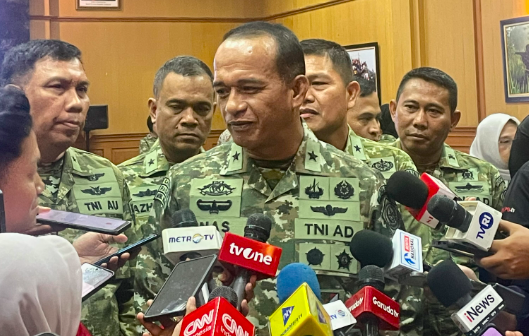
Head of the TNI Information Centre, Brigadier General Muhammad Nas, dismissed the notion that the military’s involvement in the food security programme is a form of militarisation of civilian space. According to him, the TNI’s presence in the agricultural sector is solely to assist communities and help the government accelerate national programmes. ‘I urge everyone not to rush into labelling our presence in the civilian domain as a militarisation programme. It is not militarisation at all,’ Nas stated at TNI Headquarters in Cilangkap, East Jakarta, on Tuesday. Nas explained that the TNI’s involvement in food security stems from a shortage of agricultural extension workers in the field. Consequently, village supervisory non-commissioned officers, known as Babinsa, are deployed to help communities from land management through to the distribution of harvests. ‘What is the TNI doing in food security? We are mentoring,’ he said. He stressed that the TNI is not taking over the duties of the Ministry of Agriculture but merely assisting until communities can manage the programmes independently. ‘Extension workers and field assistants are lacking. Once everything is running, it will be handed back to them, to the Ministry of Agriculture. So it is not us taking over the Ministry of Agriculture,’ he added. According to Nas, the community remains the main actor in the food security programme, with the TNI playing a role in providing mentorship and skills training. ‘The community is at the forefront, we in the TNI provide support. From the land management stage through to harvesting and the distribution of yields,’ he stated. He also noted that agricultural mentoring programmes have long been run by the TNI, including a programme to absorb unhusked rice directly from farmers in the regions. Furthermore, Nas mentioned that the total land area under the TNI’s food security mentoring currently reaches approximately 2.5 million hectares, comprising TNI land, local government land, and community land. ‘Regarding the land, there is TNI land and local government land that we are mentoring. The current recorded total is around 2.5 million hectares,’ he said. He noted that the Army is focusing on rice production, while the Navy is developing soybean commodities as part of the national food programme. Nas also affirmed that the TNI’s involvement in various social sectors, including food security and disaster management, is based on community needs and has a clear legal foundation. ‘What the community needs is aid, medicines, and handling, not ideological debate,’ he remarked. He cited the TNI’s involvement in building irrigation systems, bridges, and the ‘Tentara Manunggal Air’ programme, which assists communities in remote areas. ‘What is the army doing building bridges? Why is the army dealing with irrigation? What is clear is that we are acting for the community,’ he stated. Nas emphasised that the TNI adheres to its principle as a people’s army in every programme carried out with the community. ‘We are state apparatus educated to uphold our identity as a people’s army, a fighting army, and a professional army,’ he concluded.