
TNI Responds After Commander Criticised for Claiming Responsibility for Indonesia's Security
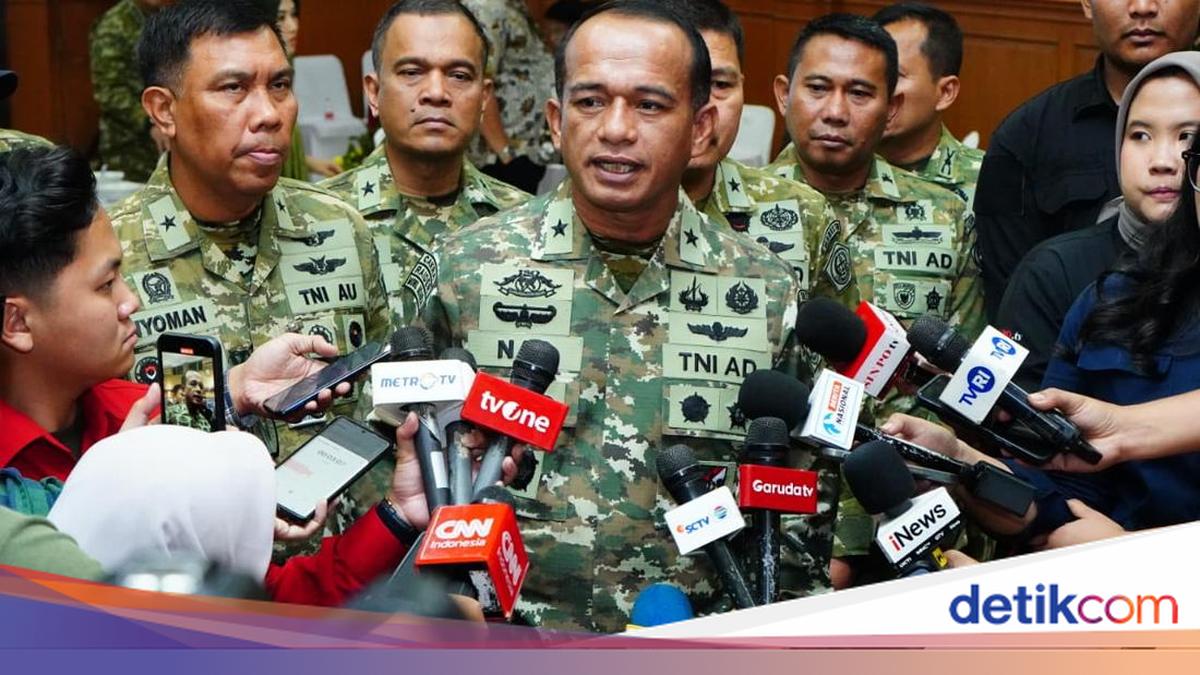
The Civil Society Coalition for Security Sector Reform has condemned a statement by TNI Commander General Agus Subiyanto in which he claimed responsibility for public security across Indonesia. The TNI has stressed that the statement was made because of a request from the National Police.
“The TNI is not taking over the domain of the police or civilian authorities. In matters of security, the TNI, in accordance with the law, assists the police on the basis of a request,” said Head of the TNI Information Centre Brigadier General Muhammad Nas to journalists on Tuesday (11/8/2026).
Nas said this was in line with existing regulations, namely those concerning the involvement of assistance to the National Police.
“This is regulated in the SOP on the technicalities of assistance involvement,” he said.
For information, this is regulated in Law Number 34 of 2004 on the TNI. In particular, Article 7 paragraph (2) letter b states that one of the TNI’s main tasks in military operations other than war is to ‘Assist the National Police of the Republic of Indonesia in the context of public security and order tasks as regulated by law’.
Previously, the Civil Society Coalition for Security Sector Reform condemned the statement by TNI Commander General Agus Subiyanto regarding his claim of responsibility for public security across Indonesia. The statement was made alongside an explanation that the TNI had been and would continue to conduct patrols in various regions, including to anticipate the possibility of demonstrations such as those that took place in August last year.
“The statement cannot be regarded as merely a poor choice of words. The claim of being responsible for public security shows that the boundary between defence and domestic security functions is increasingly being blurred. Furthermore, the statement risks legitimising the presence of the military as something normal in civilian life,” the Civil Society Coalition said in a written statement to journalists on Tuesday (11/8/2026).
The Civil Society Coalition referred to the constitution, which regulates the duties and portions of the TNI and the National Police. Article 30 of the 1945 Constitution places the TNI as a state instrument tasked with defending, protecting and maintaining the integrity and sovereignty of the state, while public security and order, protection of and service to citizens, and law enforcement are the responsibility of the National Police.
“The division is not merely an administrative matter. The separation of the TNI and the National Police is one of the important achievements of Reformasi to end the dual function of ABRI and military dominance in civilian affairs, as affirmed in MPR Decree Number VI/MPR/2000 and MPR Decree Number VII/MPR/2000. Indonesia has a long and bitter experience when the military was given too much space in public life: freedoms were silenced, violence was tolerated, human rights violations occurred, while accountability was difficult to obtain,” it said.
According to the Civil Society Coalition, past experience shows the risks when the military obtains too much space in public life. They said such conditions once contributed to the silencing of freedoms, violence, human rights violations, and weak accountability.
“Therefore, the pretext of ‘coordination’, ‘collaboration’, or implementation based on SOPs is not sufficient to justify the deployment of the military in civilian spaces. SOPs are internal rules. They cannot create authority that is not granted by the constitution and laws,” it explained.
“The most worrying thing is when patrols and the deployment of the TNI are linked to the possibility of demonstrations. Protests are not a threat to the state. They are a constitutional right of citizens to assemble, express opinions, and oversee the exercise of power,” it continued.
They assessed that confronting demonstrations with military patrols is a misguided way of thinking. Such an approach has the potential to create fear and intimidation, especially for students, workers, farmers, indigenous peoples, women, journalists, environmental defenders, human rights defenders, and other groups who are fighting for their rights.
“The involvement of the TNI also carries serious risks. Soldiers can be drawn into conducting checks, arrests, interrogations, surveillance, or other law enforcement actions that are not within their authority. If violence occurs, the public will once again face a closed military accountability system that still leaves problems of impunity,” it said.
They stressed that criticism of the TNI’s involvement does not mean condoning police violence and repressiveness. They questioned the government for deploying security forces to respond to criticism.
“The issue is not whether the public should be controlled by the TNI or the National Police. The question that must be answered is why the government continues to treat criticism, demonstrations, and public dissatisfaction as security disturbances that must be met with the deployment of security forces,” it said.