
TNI Handling of Dangerous Terrorism if Not Subordinate to Civil Courts
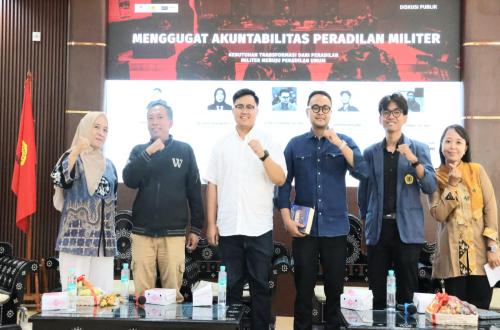
Jakarta — Deputy Director of Imparsial, Hussein Ahmad, stated that the material review of the TNI Law and the Military Justice Law, filed by Imparsial along with a Civil Society Coalition, aims to ensure that the principle of equality before the law is truly implemented.
This was conveyed during a public discussion titled “Challenging the Accountability of Military Justice: The Need for Transformation from Military Courts to General Courts”. The discussion, held on Tuesday, 28 April 2026, was a collaboration between Imparsial and Mataram University (Unram).
The discussion featured speakers from the Law Laboratory of Mataram University, academics from the Faculty of Humanities and Social Sciences at Mataram University, the Social Observers Group of the Faculty of Humanities and Social Sciences at Mataram University, as well as Imparsial as a human rights research and advocacy institution.
“Law No. 31 of 1997 was born in the context of the authoritarian New Order regime, where law functioned as an instrument of power, not as a mechanism to limit power,” said Hussein in his press release.
On the other hand, Hussein also highlighted concerns over the expansion of the TNI’s role through several draft regulations, including the draft presidential regulation on counter-terrorism. This expansion of authority is seen as potentially leading to power abuses if not accompanied by strong accountability mechanisms, especially in the context of broad interpretations of security threats.
Hussein questioned the background behind the sudden emergence of the draft presidential regulation involving the TNI in counter-terrorism. According to him, this policy needs to be carefully examined because it could transform the counter-terrorism approach, which has so far been placed within the framework of law enforcement, into a military approach (war model), which is dangerous.
Amid the military not being subject to the general judicial system, said Hussein, through the draft presidential regulation involving the TNI in addressing terrorism, the military would have broad operational authority under the elastic pretext of terrorism. This is extremely dangerous because if there are mistakes by the military in arresting suspected terrorists, they would be tried in military courts, not in general courts.
“Without the military’s subordination to general courts, the draft presidential regulation involving the TNI in addressing terrorism threatens the rule of law and democracy,” he stated.
In the criminal justice system approach, according to Hussein, terrorism perpetrators should be treated as criminal actors who must be arrested, tried, and processed through legal mechanisms, not killed as in the war paradigm. According to Hussein, the draft presidential regulation involving the TNI in counter-terrorism also raises serious formal and substantive issues.
“This is because it has the potential to shift the terrorism handling paradigm from a legal approach to a war approach,” said Hussein.
Additionally, the draft regulation is seen as potentially expanding the TNI’s authority beyond its primary function as a state defence instrument. In the draft rule, the TNI could be given very broad authority, including in arrests, enforcement, and recovery. Broad authority without clear boundaries is feared to create room for abuse of power.
Academic from the Faculty of Humanities and Social Sciences at Unram, Agung Setiawan, views the issue of military justice within a broader historical-political framework. According to him, although the New Order regime has ended, authoritarian practices and tendencies have not completely disappeared. These practices continue to transform and adapt within the new political system.