
TNBBS: Discovery of Clerodendrum ismaili enhances biodiversity
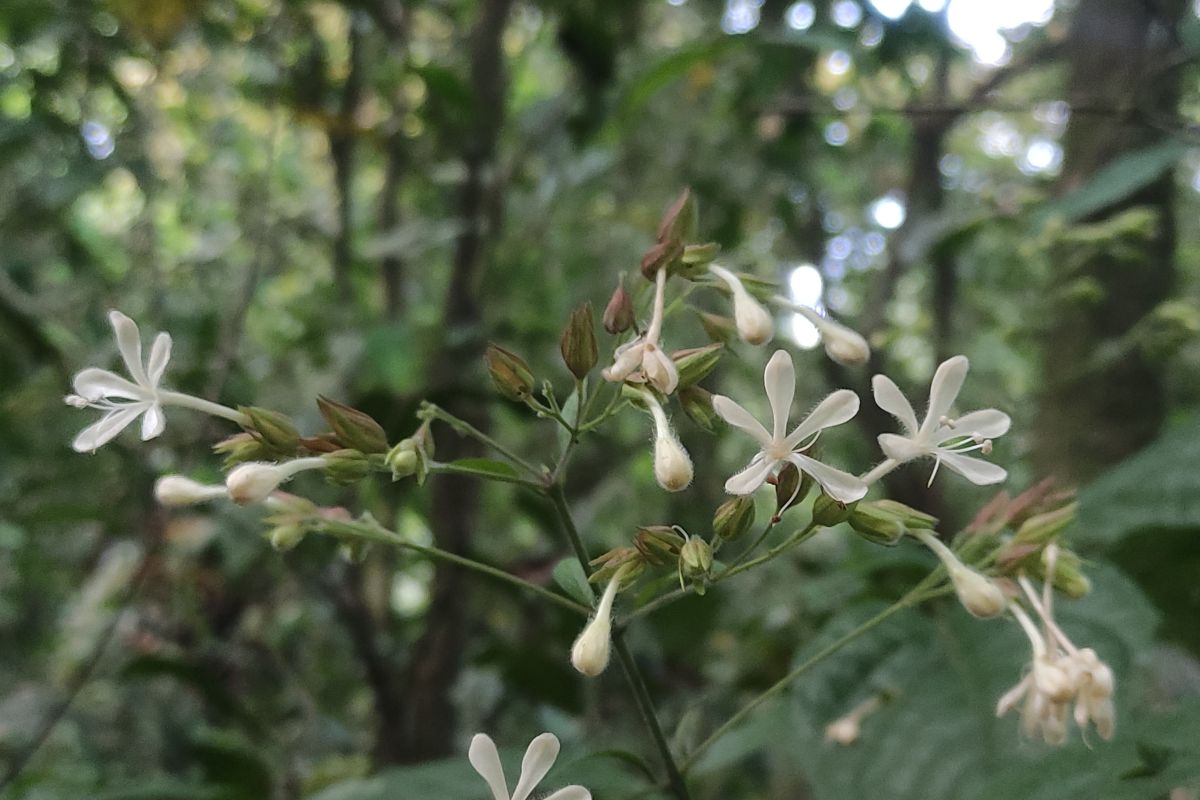
Malang, East Java (ANTARA) - The Bromo Tengger Semeru National Park (TNBBS) administration has stated that the discovery of the flora species Clerodendrum ismaili H.Sant. & Sudarmono in Ranu Darungan, on the southern slopes of Mount Semeru, adds to the biodiversity of the area.
“We have once again recorded an important biodiversity discovery, namely Clerodendram ismaili H.Sant. & Sudarmono, found within the TNBBS forest area in Ranu Darungan, on the southern slopes of Mount Semeru,” said the Head of TNBBS, Rudijanta Tjahja Nugraha, in Malang, East Java, on Wednesday.
Rudi stated that the identification and scientific publication stages, aimed at establishing Clerodendrum ismaili as a new flora finding from the TNBBS area, relied not only on field observations but also on the examination of morphological characters of specimens and living plants.
His office also compared Clerodendrum ismaili H.Sant. & Sudarmono with the Herbarium bogoriense and reviewed literature up to the taxonomic identification keys.
The results of this study were subsequently compiled into a scientific paper titled “Clerodendrum ismaili (Lamiaceae), a new species from Bromo Tengger Semeru National Park, East Java, Indonesia.”
“On 3 September 2026, the manuscript was received by the journal Phytotaxa and published on 15 September 2026. The specific epithet ‘Ismaili’ was chosen to honour Ismail, one of the TNBBS conservation cadres who, during his service, supported conservation activities in the Ranu Darungan area,” he said.
Rudi explained that the plant was first discovered during a biodiversity patrol in Ranu Darungan, on the southern slopes of Mount Semeru, within the jurisdiction of the Ranu Darungan National Park Management Resort in Lumajang Regency, East Java, on 26 February 2026.
His office subsequently followed up on the discovery by conducting observations and data collection regarding habitat, local distribution, population, and phenology from May to July 2026.
The data collection concluded that there are approximately 12 healthy adult individuals.
Due to the small population and limited distribution, the TNBBS administration is providing extra attention to the continued existence of this flora through protection and preservation efforts.
Through this series of stages, it was also found that Clerodendrum ismaili H.Sant. & Sudarmono can grow in sub-montane forest areas at altitudes between 825 and 950 metres above sea level, under dense forest canopies, and in shaded, relatively humid microhabitats.
Clerodendrum ismaili, he continued, is an upright shrub that can grow up to 2.4 metres.
This plant from the Lamiaceae family possesses several characteristics, such as white flowers, smooth or slightly serrated leaf edges, and fine or coarse hairs on the petals.
Rudi noted that morphologically, this new flora species shares similarities with Clerodendrum calamitosum Linnaeus.
“The distinguishing factor is the consistent vegetative and reproductive characters, which allow it to be recognised as a different species,” he said.
The TNBBS administration hopes that the recording of the Clerodendrum ismaili discovery will be beneficial to science and to efforts in preserving biological wealth.
Source: jawawa.id (https://jawawa.id/newsitem/tnbbs-discovery-of-clerodendrum-ismaili-enhances-biodiversity-1790766567)
Originally published by Antara (Indonesian) (https://www.antaranews.com/berita/5764915/tnbts-penemuan-clerodendrum-ismaili-tambah-keanekaragaman-hayati), translated from Indonesian