
TMMIN and Udayana University Collaborate to Deliver Industry-Based Learning
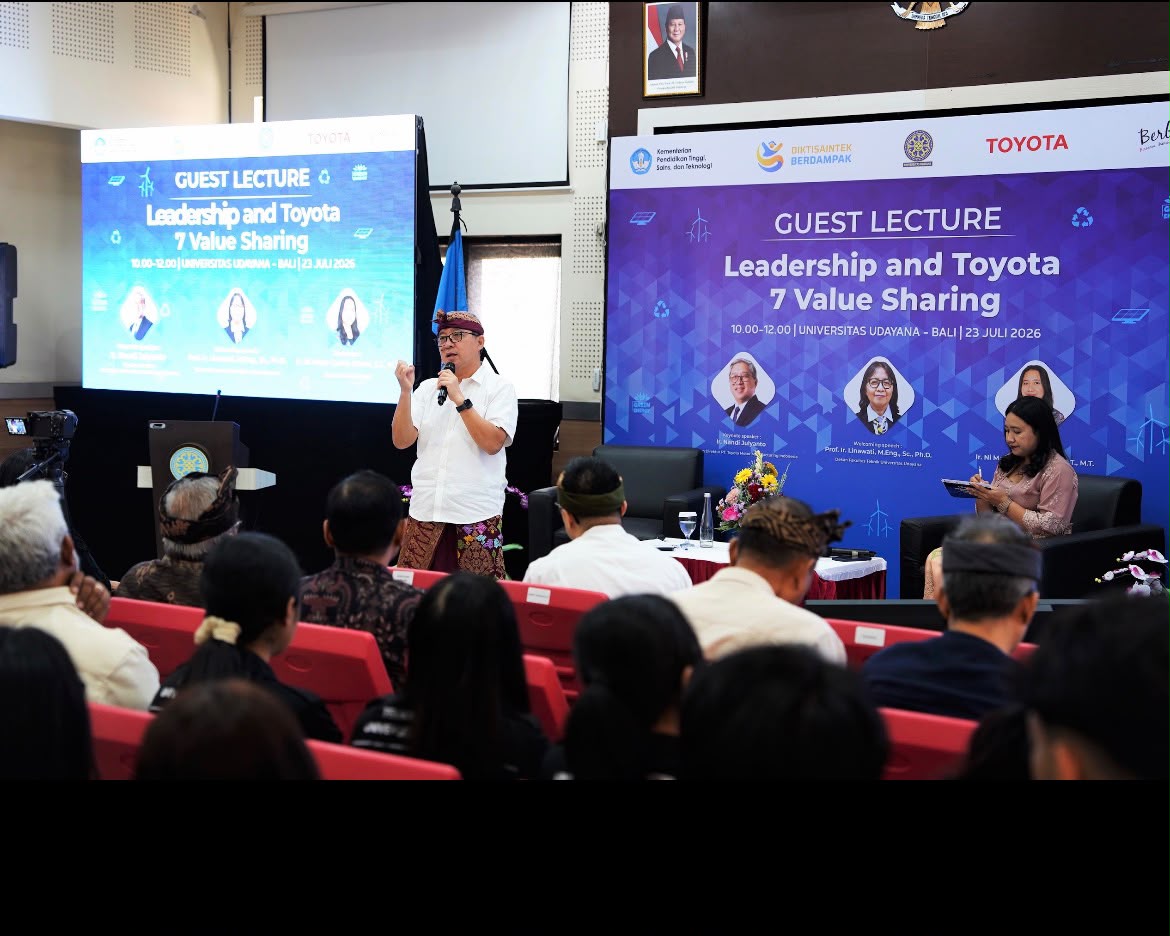
PT Toyota Motor Manufacturing Indonesia (TMMIN) is sharing industry insights with students to bridge academic theory and practical application. As part of this effort, TMMIN and Udayana University collaborated to deliver an industry-based learning experience on Thursday (23/7) at the university’s campus in Bali. The initiative featured a public lecture by TMMIN President Director Nandi Julyanto and a review of the Lean Manufacturing Laboratory at the university’s Faculty of Engineering. The activity aimed to observe the direct application of the Toyota Production System (TPS) in the learning process, representing a collaboration between industry and education to prepare competitive human resources. During the lecture, Nandi introduced Toyota’s decades-long work culture, highlighting foundational aspects from leadership to core corporate values such as integrity, being visionary, respect, ownership, innovation, and teamwork. He also stressed the importance of the ‘Bad News First’ principle, which encourages the early communication of problems to enable swift solutions. Nandi emphasised that these values are not just Toyota’s work culture but principles applicable to daily life and professional settings. A key implementation of these values is the TPS, which forms the foundation for Toyota’s culture of continuous improvement, enhancing quality, productivity, and efficiency in every process. ‘TPS is not just a production system born from Toyota. For us, TPS is a way of thinking and a way of working,’ said Nandi. ‘Through TPS, everyone is encouraged not to stop at solving surface-level problems, but to dare to find the root cause, make decisions based on facts, and continuously improve. We believe sustainable progress always starts from small, consistent steps taken every day.’ During a review of the TPS implementation at the university’s Lean Manufacturing Laboratory, Nandi discussed refinement efforts with lecturers and students. He explained the concept of ‘Genba’, meaning the actual place where a process occurs. This approach ensures problems are understood directly on-site, so solutions are based on facts rather than assumptions. Genba is also part of the Kaizen philosophy, the spirit of continuous improvement through small, consistent steps. Udayana University is one of ten universities receiving gradual TPS mentoring from TMMIN. The other institutions include Institut Teknologi Sepuluh Nopember (ITS), Universitas Diponegoro (UNDIP), Universitas Gadjah Mada (UGM), Universitas Syiah Kuala (USK), Institut Teknologi Bandung (ITB), Universitas Sebelas Maret (UNS), Universitas Hasanuddin (UNHAS), Universitas Darma Persada (UNSADA), and Universitas Indonesia (UI). The mentoring process is carried out in stages, starting from developing TPS laboratories at the universities, providing Lean Manufacturing understanding to lecturers and students, and forming applicable curricula. Universities are then encouraged to further develop the TPS implementation, with the ultimate goal of enabling students to apply it directly in the industrial world. Through this collaboration, TMMIN hopes to align higher education learning processes more closely with industry needs, equipping students with a systematic mindset, problem-solving abilities, and a spirit of continuous learning and improvement wherever they work.