
TKDN: Indonesia's Bet to Avoid Becoming a Mere Assembler
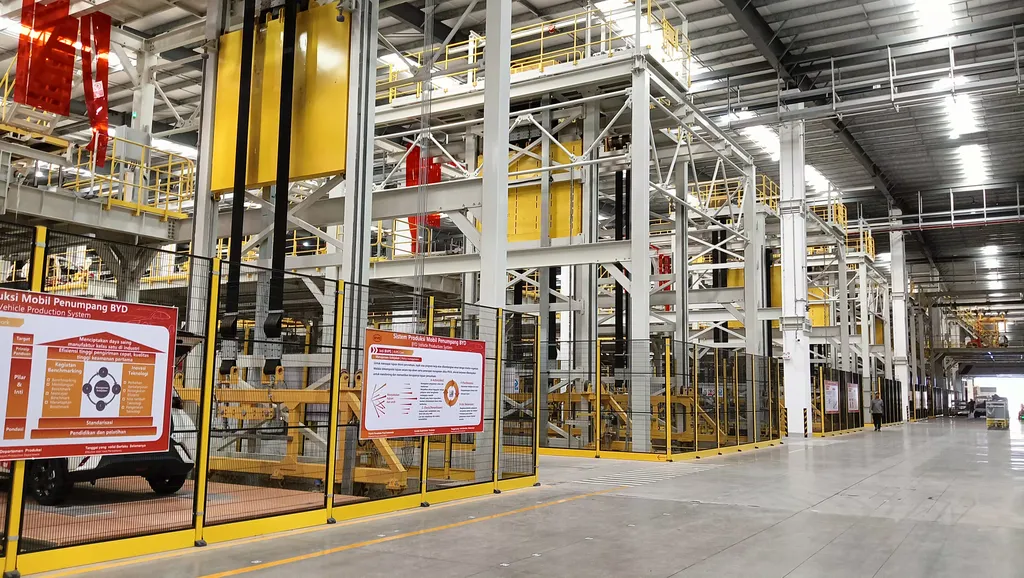
The increasing use of local components, raw materials, technology, local labour, and domestic production is essential to ensuring a greater share of economic value remains in Indonesia. The Local Content Requirement (TKDN) serves as an instrument to ensure that electric vehicle (EV) investments do not stop at factory construction and assembly activities. Through steadily increasing local content targets, manufacturers are encouraged to expand the use of domestic components while building a supply chain that connects the automotive industry with batteries, raw materials, technology, and the national component industry.
BYD, in addition to investing by establishing an automotive plant in Subang, West Java, has also pledged to increase its local content or TKDN level to 60 per cent by 2027. The increase in TKDN is a vital metric for assessing the quality of automotive investment. The more components, raw materials, technology, local workforce, and production processes that originate domestically, the greater the economic value that stays within Indonesia.
TKDN, particularly for electric vehicles, is not merely a measure of how many local components are used. The Minister of Industry, Agus Gumiwang Kartageasmita, stated during the inauguration of the BYD factory on Thursday (3/9/2029) that the government continues to encourage the use of domestic components through TKDN policies. The roadmap for the development of Battery-Based Electric Motor Vehicles (KBLBB) sets a gradual increase in minimum TKDN values: at least 40 per cent until 2026, at least 60 per cent from 2027–2029, and at least 80 per cent starting from 2030.
This roadmap is stipulated in the Ministry of Industry Regulation (Permenperin) Number 6 of 2022 regarding Specifications, Development Roadmaps, and Calculation Provisions for the Local Content Value of Battery Electric Vehicles. This policy is one of several TKDN measures intended to deepen the structure of the manufacturing industry, specifically in the automotive sector. The policy calculates the TKDN percentage covering manufacturing, assembly, and research and development (R&D) activities.
The manufacturing aspect is the primary factor in assessing the localisation of vital EV components, accounting for 58 per cent. High-value component localisation includes batteries at 35 per cent, drive systems at 12 per cent, and bodies or chassis at 11 per cent. Furthermore, the manufacturing aspect of supporting components, which assesses the use of spare parts such as steering, suspension, braking, wheels, electrical/cooling systems, and seats, accounts for 10 per cent. The R&D aspect, which assesses domestic research, design, and testing activities, accounts for 12 per cent, while the assembly aspect, assessing the use of local labour and assembly work, accounts for 12 per cent.
Through this policy, companies are compelled to invest in Indonesia through factory construction, which ultimately creates added value and strengthens the domestic industrial structure. Foreign companies are required to rely on domestic components if they wish to meet local content targets. Minister Agus has also instructed his subordinates to provide incentives based on TKDN levels.
In electric vehicles, batteries hold a strategic position in TKDN calculations. For four-wheeled, two-wheeled, and three-wheeled electric vehicles, batteries are a major component with significant weight. During the 2020-2023 period, batteries accounted for 30 per cent of the TKDN value. From 2024, this weight increased to 35 per cent. The electric motor drive system also increased from 10 per cent to 12 per cent.
Permenperin Number 6 of 2022 demonstrates that the government’s focus extends beyond vehicle production and battery assembly. The roadmap directs development to include battery cells, battery packs, battery management systems, battery materials, and even battery recycling at the end of their lifespan. As stated by the Chairman of the National Economic Council, Luhut Binsar Pandjaitan, BYD’s presence in Indonesia is a significant momentum because the company can connect with the battery industry ecosystem built through the mineral downstreaming programme.
“This is indeed an important momentum for BYD because they are building an ecosystem. It began with our nickel downstreaming to build the ecosystem. So, the battery includes precursors, cathodes, and everything,” said Luhut. Luhut also encouraged the development of the electric vehicle battery recycling industry. According to him, the ability to recycle batteries will be a vital part of the EV ecosystem, as it allows valuable materials, including nickel and lithium, to be reused.
With the development of an integrated electric vehicle industry—ranging from raw material processing and the production of components and batteries to vehicle assembly—Indonesia will not merely be a market for electric vehicle products, but will become a production base with much higher added value. Under Permenperin Number 6 of 2022, the TKDN value for batteries can be calculated based on realised investment in the battery and electric vehicle manufacturing sectors. The investment components considered include installed batteries, battery packs, battery cells, and electric vehicle facilities. The minimum realised investment must be at least IDR 5 trillion and must be realised no later than five years after the initial investment is made.
In the roadmap, from 2028 onwards, there are provisions regarding cooperation with the battery raw material industry that processes raw materials directly from the domestic industrial and/or mining sectors. An alternative is using recycled batteries as material for precursors or battery materials.