
Tito, Amran and Trenggono Meet at Zulhas’s Office: What’s the Issue?
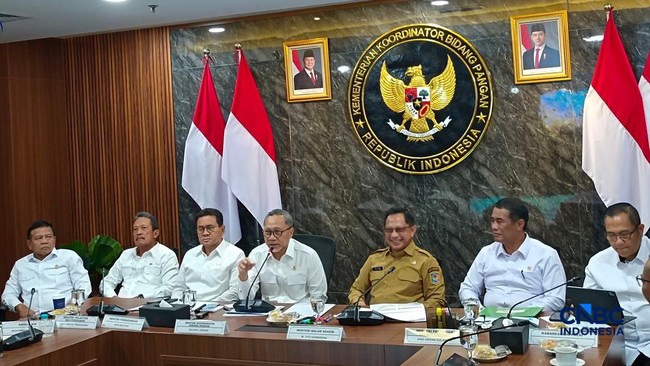
Agriculture Minister and National Food Agency (Bapanas) head Amran Sulaiman, Trade Minister Budi Santoso, Home Affairs Minister Tito Karnavian, Marine Affairs and Fisheries Minister Sakti Wahyu Trenggono, Meteorology, Climatology and Geophysics Agency (BMKG) head Teuku Faisal Fathani, and Perum Bulog president director Ahmad Rizal Ramdhani held a limited coordination meeting at the Coordinating Ministry for Food Affairs on Monday (26 October 2026).
The meeting lasted around two hours and focused on national food security and the latest movements in the prices of several commodities.
The government highlighted rising prices for red chillies and bird’s eye chillies, which have also contributed to inflation. Statistics Indonesia (BPS) data showed that price increases for both commodities had spread across various regions by the fourth week of October 2026.
The national average price of red chillies reached Rp70,849 per kilogram in the fourth week of October 2026, up 23.47% from the September 2026 average of Rp57,383 per kilogram, BPS recorded.
Bird’s eye chillies cost Rp88,642 per kilogram, an increase of 12.49% from Rp78,802 per kilogram in September.
Red chilli prices rose in 327 regencies and cities, or 90.83% of the areas monitored. Bird’s eye chilli prices increased in 269 regencies and cities, or 74.72% of monitored areas.
The government is concerned that higher chilli prices could add to inflationary pressures towards the end of the year.
Home Affairs Minister Tito Karnavian said Indonesia’s September 2026 inflation remained within the government’s target range. However, prices rose month on month, driven mainly by the food, beverages and tobacco group.
“Month on month, there was a slight increase in inflation from August to September, of 0.3%. The main contributor was the food and beverages sector. Within that sector, the main items were bird’s eye chillies and red chillies—not staple foods,” Tito said at a press conference on Monday (26 October 2026).
BPS data showed that Indonesia’s inflation in September 2026 stood at 3.28% year on year and 0.30% month on month. The food, beverages and tobacco group was the largest contributor to monthly inflation, adding 0.26 percentage points.
Bird’s eye chillies contributed 0.08 percentage points to monthly inflation, followed by red chillies at 0.06 points. Other contributors included broiler chicken, at 0.05 points; rice, 0.03 points; and chicken eggs, 0.02 points.
Tito said the rise in chilli prices was linked to production disruptions caused by drought. One measure to address the situation, he said, would be to increase chilli planting in various regions.
“It can also be addressed by stepping up chilli-planting programmes, which are already being carried out in many areas—in villages, urban wards and cities. If we can produce enough chillies, the issue can be resolved,” he said.
Tito also noted that higher prices benefited farmers who grow chillies. Even so, the government needs to maintain supplies so that price spikes do not place a burden on consumers.
The government has also begun preparing for a potential increase in food demand ahead of Christmas and New Year. Increased public mobility during the year-end holiday period could put further pressure on food prices and other commodities.
Tito therefore proposed strengthening social assistance and holding market operations in the regions to protect people’s purchasing power and keep prices under control.
“Market operations by our regional leaders. We hope these will continue in their respective areas in November and December, led by the National Food Agency, Bulog and others,” he said.