
Titiek Soeharto Questions Garlic Self-Sufficiency Plans; Amran Responds
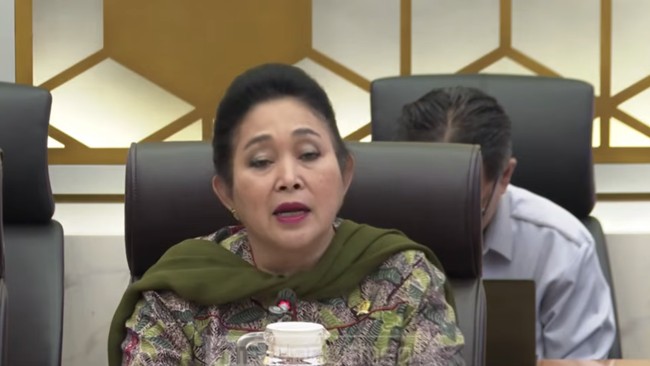
The Chairperson of Commission IV of the Indonesian House of Representatives (DPR RI), Siti Hediati Hariyadi, popularly known as Titiek Soeharto, questioned the budget readiness to achieve garlic self-sufficiency targets. The inquiry was made during a working meeting between Commission IV and the Minister of Agriculture, Amran Sulaiman.
Titiek questioned whether the additional budget of Rp5 trillion proposed by the Ministry of Agriculture (Kementan) would be sufficient to accelerate garlic self-sufficiency. “With the target of achieving garlic self-sufficiency as soon as possible, is an additional budget increase like this enough?” Titiek asked Amran during the meeting at the Parliament Complex, Jakarta, on Tuesday (1/9/2026).
Responding to the question, Amran stated that the Ministry of Agriculture actually intends to increase the budget by up to twofold. However, he emphasised that the issue of garlic self-sufficiency is not solely related to the budget. “We actually want to increase it by two times. However, it is not as easy as turning over one’s palm. We need a gestation period; that takes six months,” he explained.
According to Amran, one of the main obstacles lies in the availability of garlic seeds. To meet the seed requirements, the Ministry of Agriculture has dispatched the Director General of Horticulture to several countries. “We have sent the Director General of Horticulture to India, China, and even across the world because we want to move quickly on seeds, but it turns out that obtaining seeds is not easy,” he said.
He noted that his department has collected available seeds to be developed so that future production can increase. “We have been to China and India, and we have taken what we can. This is to maximise efforts, but we must first propagate these seeds so that by 2028, production can be larger,” he added.
Amran stated that the government remains committed to achieving garlic self-sufficiency as soon as possible. However, national garlic demand remains significantly higher than current production levels. “We are striving for self-sufficiency as soon as possible, because our need is 1.1 million tonnes, whereas production is only 8,000 tonnes,” Amran said.
Therefore, Amran emphasised that the limitation of seeds is the primary issue in pursuing self-sufficiency, rather than the budget. “It is not because of the budget; we could reallocate funds. It is not the budget, but rather the fact that seeds are extremely limited,” he clarified.
Titiek urged the expansion of local seeds. She noted that Indonesia is already capable of producing high-quality garlic seeds, citing examples from her visit to Sembalun, West Nusa Tenggara (NTB). “We are already able to produce good garlic seeds. During our visit to Sembalun, the seeds were excellent. Perhaps those could be multiplied,” Titiek suggested.
In addition to seed multiplication, Titiek requested that the government begin preparing new cultivation lands. She noted that this is necessary because garlic is grown at specific altitudes. “New lands should also be prepared because garlic is grown at certain altitudes. While searching for good seeds, the land should be identified in advance,” she explained.
This approach would ensure that land is ready once seeds become available. Titiek also encouraged the development of local seeds through research institutions. “So that once seeds are available, planting can begin immediately. Local varieties should also be multiplied; agencies like BRIN and BRMP should be tasked to produce superior garlic seeds,” she concluded.