
Tiran Nusantara Group and Chinese Giant Sign Rp10 Trillion Investment Deal
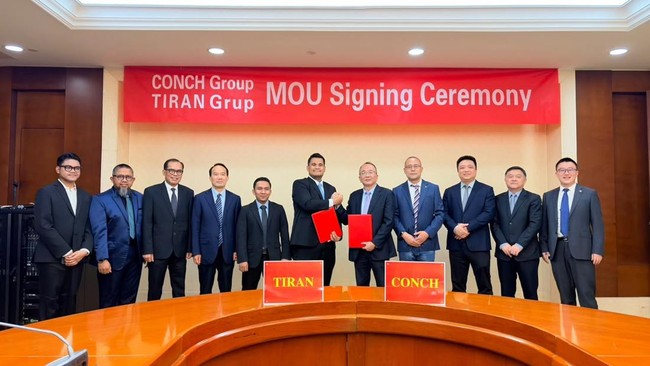
Jakarta, CNBC Indonesia — PT Tiran Nusantara Group and Chinese giant Conch Investment Holdings (Hong Kong) Ltd, a company under the Government of the People’s Republic of China, have officially signed an initial investment agreement worth Rp10 trillion in manufacturing and green energy. The signing took place on Friday, 9 October 2026, in Anhui, China.
The agreement was signed by Tiran Nusantara Group operations director Andi Karyadi and Conch director Li Xin, and was witnessed by Tiran Nusantara Group president commissioner Andi Amar Mar’uf Sulaiman.
The co-operation covers the construction of a lithium battery anode-materials plant, a plastic packaging factory, a wind power plant and a waste-to-energy plant. Conch is one of China’s largest companies and has diversified into new energy, waste processing, and high-technology industrial and construction materials.
Conch is not a newcomer to Indonesia. Its investments already operating in the country have reached Rp30 trillion, making the deal with Tiran Nusantara Group a continuation of its long-term commitment to Indonesia. The value of the co-operation is expected to grow gradually.
“This co-operation affirms international partners’ confidence in Indonesia’s investment climate and national industrial capacity. We are committed to building downstream industries that can employ 5,000 people and strengthen economic self-reliance,” said Rezki Mulyadi, public relations officer for PT Tiran Nusantara Group, in a press release on Sunday (11 October 2026).
Ownership arrangements in the partnership with Conch are structured according to the nature of each project. In some joint ventures, Tiran Nusantara Group will hold a 49 per cent stake and Conch 51 per cent; in others, the proportions will be reversed, with Tiran Nusantara Group holding 51 per cent and Conch 49 per cent. Tiran Nusantara Group was established by Agriculture Minister Amran.
The company’s origins lie in Amran’s research into rat infestations, which led to a rat-control innovation called Tiran, short for “Tikus Diracun Amran” (“Rats Poisoned by Amran”). In 1995, Amran applied for patents for his innovations, including Tiran 58PS and Alpostran. He now holds seven patents in agricultural innovation, particularly pest control, and his products have been used by millions of farmers in Indonesia and marketed in Japan, Malaysia, Vietnam, Thailand and several other countries.
In 2004, the business developed into the beginnings of Tiran Nusantara Group. Starting with a loan of Rp500,000, the group now encompasses dozens of companies employing thousands of people across mining, energy, trade, logistics and industrial estates.
In logistics, Tiran Nusantara Group operates dozens of cargo vessels, hundreds of dump trucks and heavy machinery. The fleet is a mainstay for distributing raw materials and products across regions. The group has been actively investing in these sectors since 2007.
“All the companies in Tiran Nusantara Group are owned by Agriculture Minister Amran. Thankfully, the group’s other business lines have grown, although its core rat-poison business was closed when Amran was first appointed Agriculture Minister in 2014, to preserve his professionalism,” Rezki added.
Outside business, Andi Amran Sulaiman is known for his involvement in social activities. He has provided thousands of scholarships to orphans, people with disabilities and university students, including students from Palestine; the latest cohort comprised 112 recipients. He has also provided humanitarian aid to people affected by natural disasters in Indonesia and as far afield as Turkey.
Most recently, Andi Amran Sulaiman built a mosque costing Rp1 trillion, with capacity for up to 20,000 people, as a centre for worship, civilisation, education and community empowerment. He has also invested in a 17-storey hospital to help more people who have difficulty accessing healthcare.
The investment co-operation is expected to accelerate the transformation of national industry towards clean energy, waste management and downstream processing of natural resources.