
Tirakatan as the Red and White Greets Grief
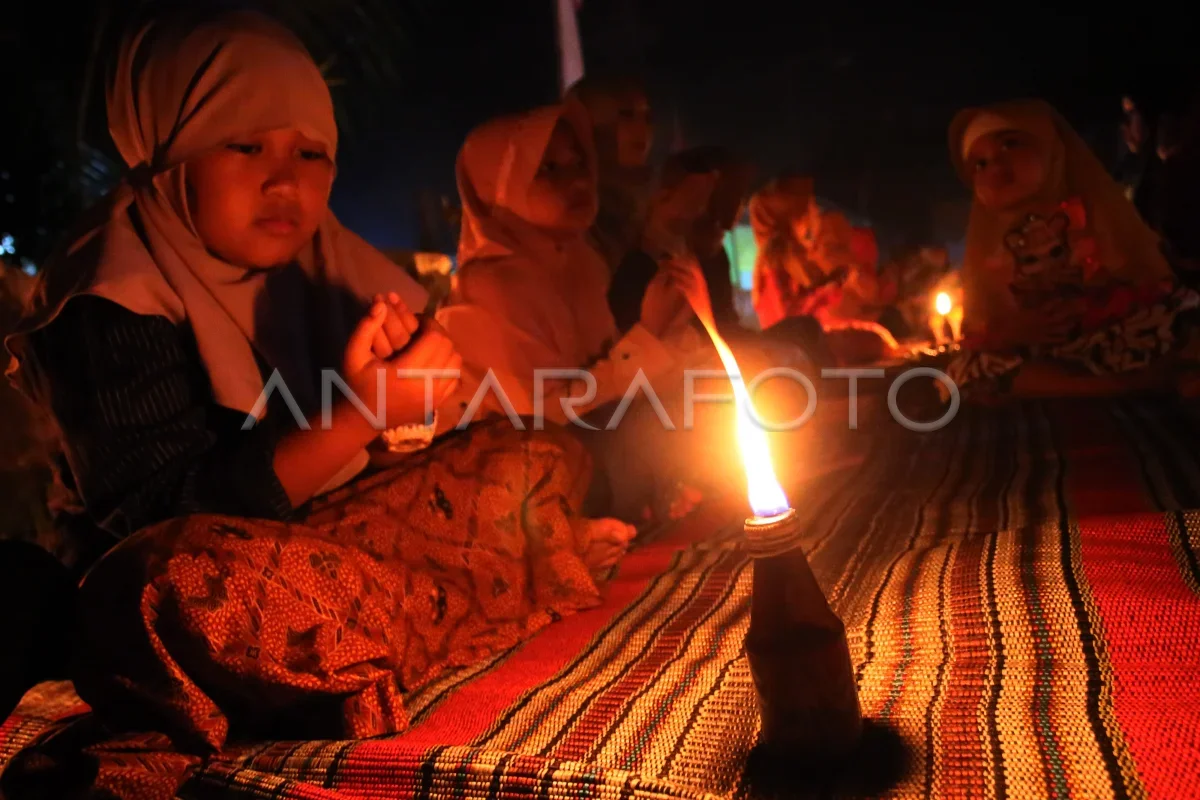
Surabaya (ANTARA) - Independence does not always arrive in festivity. In many villages, it finds its simplest form when residents sit close together, prayers are offered, stories of struggle are remembered, and food is shared without asking who brought more.
That is malam tirakatan, a tradition generally held on 16 August ahead of independence commemorations. In various regions, especially Java, tirakatan is filled with communal prayer, a moment of silence, readings of the history of the struggle, the cutting of tumpeng, shared meals, and social activities.
The tradition appears simple, yet it holds a profound question about how this nation interprets independence. After 81 years of Indonesian independence, is independence enough to be celebrated, or must it be continually brought to life through care for others?
Tirakatan derives its strength from bringing residents together in an equal space. There is no grand stage, no distance between community figures and ordinary citizens. Everyone sits together as neighbours.
In this tradition, independence is not only remembered as a historical event. Residents pause briefly from their routines to recall the sacrifices of previous generations, while also expressing gratitude for a life that can be lived in an independent country.
However, Indonesia’s challenges today have changed. Physical colonisation has passed, but the nation’s problems are not finished. Inequality, poverty, corruption, disinformation, social violence, vulnerability to disasters, and issues with public services remain shared work.
Therefore, gratitude for independence cannot stop at honouring heroes. Gratitude must be translated into social responsibility. Positions are carried out with trustworthiness, knowledge is used for the public interest, businesses create jobs, and the younger generation safeguards digital spaces so they do not become breeding grounds for hatred and false information.
At this point, tirakatan becomes relevant. The tradition can serve as a bridge between the past and today’s problems. History teaches that independence was born of sacrifice and unity. The present demands the same values to face more complex issues.
It would be ironic if malam tirakatan ended only with a shared meal, while afterwards residents again became easily provoked, suspicious of one another, or indifferent when a neighbour faced hardship.
Independence should broaden a sense of shared fate. One resident’s problem should be seen as the neighbourhood’s problem, and one region’s problem should become the concern of other regions.
This meaning is felt more deeply when this year’s independence commemoration coincides with sorrowful news from East Nusa Tenggara (NTT). A 7.7 magnitude earthquake in the Flores region had, by Saturday evening, reportedly killed at least 47 people. Homes and various public facilities were also damaged.
In one place, residents were preparing to hold prayers, preparing tumpeng, and gathering in an atmosphere of gratitude. In another, families were still searching for safe places, waiting for news of relatives, or enduring amid the destruction caused by the disaster.
This contrast should not cause the independence celebration to lose its meaning. It is precisely there that unity is tested. Independence is not only the ability to celebrate, but the ability of the state and society to be present when citizens are in their most vulnerable condition.
The government must ensure aid reaches the victims. Officials must work quickly. Communities in other regions can show solidarity through verified assistance, logistical support, and concern that does not stop at sympathy in digital spaces.
The response to the disaster also serves as a reminder that an independent state has an obligation to protect all its people. Evacuation efforts, search for victims, health services, data collection, and aid distribution are not merely technical work, but a concrete manifestation of the state’s presence.
Therefore, prayers during tirakatan should not stop within one’s own neighbourhood. When residents pray for the heroes, they can also remember their fellow citizens who are facing disaster in Flores.
The grief in NTT is Indonesia’s grief. The hardship of a family in Flores remains within the same national space as the residents who that night sat in tirakatan circles in Surabaya, Malang, Kediri, Madiun, or other cities.
This empathy is increasingly important amid the rapid flow of information. A disaster can become a space for solidarity, but it can also turn into a space for spreading unverified news, panic, and even the exploitation of suffering.
One form of tirakatan in the present era is therefore discipline regarding information. Restraining oneself from spreading unconfirmed casualty figures, not circulating photos without context, and not turning a calamity into material for political quarrels are forms of national responsibility.
Independence also means being free from the habit of treating other people’s suffering as a spectacle.
Tirakatan should not end when the village lights come back on after the event is over. That night should become a starting point for renewing social commitment after 16 August has passed.
The younger generation needs to be positioned not merely as participants, but as drivers. They can be invited to understand the nation’s problems through concrete experiences, such as learning to verify disaster information, understanding aid governance, recognising the impact of corruption, or using technology to solve community problems.
The tradition can also be developed into a space for intergenerational dialogue. Parents bring experience, youth bring ideas, and children bring curiosity. All three can be brought together to answer a simple question: how can independence truly be felt in daily life?
The answer does not always require grand projects. Mutual cooperation, helping families affected by disasters, and accompanying children.