
Tiny Profits from Vast Palm Oil Estates: Agrinas Palma Nusantara's Rp27.9 Billion Net Income Questioned
PT Agrinas Palma Nusantara (Persero) recorded a net profit of Rp27.9 billion in the 2025 financial year. That year, the state company booked a surplus of Rp2.86 trillion and a net profit of Rp27.9 billion from managing oil palm plantations spanning 1.7 million hectares.
The profit, deemed very low, has been questioned by oil palm farmers in Riau. Katimin, a farmer from Siak Regency in Riau Province, said the profit figure announced by Agrinas does not reflect the true potential of the area of plantation under its management.
According to him, a simple calculation at the farmer level shows that plantation productivity should still be capable of generating far greater income, even under very low production assumptions.
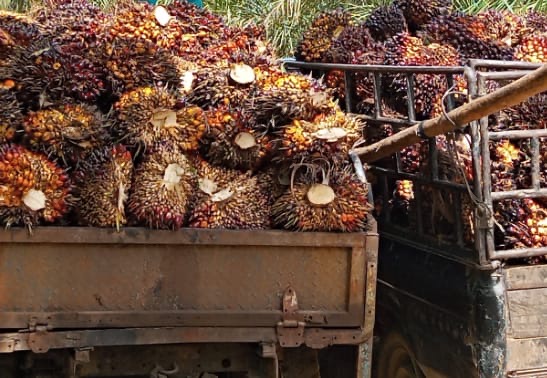
He explained that even a single hectare of entirely untended oil palm plantation can still produce around 500 kilogrammes of fresh fruit bunches (TBS) per harvest.
Assuming three harvests a month, production reaches around 1.5 tonnes of TBS per hectare. “If we use the lowest TBS price of around Rp2,000 per kilogramme, then one hectare already generates about Rp3 million per month. That is the most minimal calculation,” said Katimin on Friday (10/7).
Based on that assumption, he continued, land covering 1.7 million hectares is estimated to have the potential to generate around Rp5.1 trillion every month.
“If calculated over six months of management in 2025, the potential income could be around Rp30 trillion. That’s why I’m puzzled that Agrinas’ profit is only Rp27 billion,” said a suspicious Katimin.
IT MAKES NO SENSE
Meanwhile, another oil palm farmer, Abdul Aziz, responded that what was conveyed by the President Director of PT Agrinas Palma Nusantara, Mohammad Abdul Ghani, made no sense.
“The statement delivered by Agrinas Palma Nusantara’s President Director, Abdul Ghani, during a hearing with Commission VI of the House of Representatives, saying that APN’s net profit for 2025 was only Rp2.7 billion, makes no sense. That statement was later corrected by Abdul Ghani to Rp27 billion the following day,” said Aziz.
Even a profit of Rp27 billion, said Aziz, remains implausible, given the sheer size of the plantations managed by Agrinas. “Let me just follow Abdul Ghani’s own words, that of the 1.7 million hectares under management, only 730,000 hectares are covered in palm. Assume the yield per hectare is only Rp1 million per month,” said Aziz, who is also Deputy Chairman of the Sawitku Masa Depanku (Samade) association.
“That is already a very low yield — no fertiliser, nothing done, just harvested. Even that alone is Rp730 billion a month. Multiplied by six months (the period Agrinas managed the plantations in 2025), the result is already Rp4.38 trillion. And that is only from the palm yield. What about the proceeds from managing the 23 palm oil mills (PKS)? There were also 23 Palm Oil Mills handed over by the Forest Area Security Task Force (Satgas PKH) to Agrinas,” he said.
UNUSUAL
Therefore, he continued, there is something highly unusual and implausible within Agrinas. According to him, this situation severely undermines President Prabowo Subianto’s intentions, namely that the main mission of the takeover was to secure revenue for the state, to be used as much as possible for the people’s welfare.
“If this is how it is, what welfare is to be gained? The seized lands bring no benefit to local communities. Then if the profit is only Rp2.7 billion or Rp27 billion, how much is being deposited to the state?” he said.
If this is how things stand, said Aziz, the government need not have seized the land, which subsequently caused an uproar. In his view, the owners should have been left to manage it, with the government simply requesting Rp1,000 per kilogramme.
“If that had been done, from 1.7 million hectares alone, the government would receive Rp1.7 trillion every month. That calculation assumes each hectare yields one tonne,” he said.
Beyond avoiding the ensuing furore and polemics, the government would have respected the rights of others by facilitating permits, and workers would have been better off.
“After all, once seized, those plantations were not turned into forest. Instead, they were managed, and the forest land was then reclassified as Other Use Area (APL). Why could it become APL for Agrinas, but not for private parties? The status would eventually be the same anyway — a Right to Cultivate (HGU),” he said.
UNWORTHY
He revealed that Agrinas is unworthy of continuing to manage the oil palm plantations seized by the Forest Area Security Task Force (Satgas PKH). “In my view, it would be better to simply dissolve it. The palm plantation land that is to be retained should just be handed over to PalmCo, which is already professional. Look at PalmCo — its plantation area is nowhere near as large as what Agrinas manages, yet its profit for 2025 reached Rp7 trillion. I hope the President is firm on this matter. Don’t let the President’s programme be damaged because of this issue,” he said.
He also called on the Corruption Eradication Commission (KPK) to examine the company. “We ask the KPK to conduct an intensive examination and an investigative audit of Agrinas, which for almost two years now has managed the oil palm plantations seized by Satgas PKH,” he concluded.
Source: jawawa.id (https://jawawa.id/newsitem/tiny-profits-from-vast-palm-oil-estates-agrinas-palma-nusantaras-rp27-9-billion-net-income-questioned-1783705826)
Originally published by Media Indonesia (https://mediaindonesia.com/nusantara/909734/kelola-kebun-sawit--sangat-luas-laba-bersih-agrinas-palma-nusantara-hanya-rp279-miliar-dipertanyakan), translated from Indonesian