
Time for Finance Minister to Make Sharia Economy a Pillar of Indonesia's Economic Growth
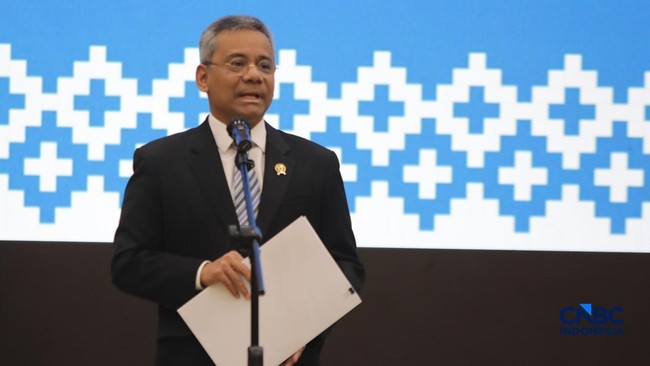
President Prabowo Subianto inaugurated Suahasil Nazara as Finance Minister on 14 September 2026, replacing Purbaya Yudhi Sadewa. In a statement following the inauguration, Suahasil emphasised that the State Budget (APBN) must serve as an instrument to drive growth, maintain stability, and provide maximum benefits to the public.
This message is highly relevant to Indonesia’s future economic challenges. The current growth rate of approximately 5 per cent needs to improve in quality to effectively create jobs, strengthen the middle class, increase productivity, and reduce inequality.
The change in Finance Minister should be more than just a change in personnel. This momentum presents an opportunity to expand the perspective of fiscal policy, specifically by establishing Islamic economy and finance as a new wave of economic growth. Islamic economy and finance ought to be positioned as a main pillar of national economic development.
In the State of the Global Islamic Economy (SGIE) 2025/2026 report, Indonesia ranked fourth in the world on the Global Islamic Economy Indicator. Our Islamic economic ecosystem is already globally recognised.
This is further supported by Bank Indonesia data, which shows an impressive performance in the Halal Value Chain (HVC) sector. The HVC’s contribution to GDP surged to 27 per cent in 2025 from 25.45 per cent the previous year, alongside sectoral growth of 6.2 per cent.
According to KNEKS data, Indonesia’s halal product exports reached USD 52.4 billion as of October 2025, representing an annual growth of 26.15 per cent. Furthermore, halal certification realisation reached 10.99 million products by December 2025. This series of achievements demonstrates that the Sharia economy is not a peripheral economy, but is already part of the national economic mainstream.
The halal industry should not stop at certification or domestic consumption. The next challenge is transforming Indonesia from a market for halal products into a global producer and exporter of halal goods. This industry encompasses a long value chain, including halal food and beverages, Muslim fashion, halal pharmaceuticals and cosmetics, Muslim-friendly tourism, and the creative economy.
Developing this sector requires investment, financing, technology, standardisation, logistics, human resources, and access to export markets. This means the state’s role is not merely to ensure products meet halal standards; the state needs to build a halal industrial policy. This is where the Ministry of Finance plays a vital role in developing the national halal industry.
The Ministry of Finance holds a strategic position for this purpose. Tax incentives, export financing, government spending, guarantee schemes, SME financing, and regional fiscal policies can be directed to strengthen the halal industry value chain. The State Budget must begin to view the halal industry not just as an object of expenditure or a recipient of incentives, but as a basis for expanding the tax base, creating jobs, and generating new foreign exchange.
Transformation of Islamic Economy and Finance
Transforming the Sharia economy certainly requires a financial system capable of financing it. OJK data shows that total assets in the national Islamic financial industry reached IDR 3,131.0 trillion in 2025, growing by 8.56 per cent. Of this amount, Islamic banking contributed assets of IDR 1,067.73 trillion after recording growth of 8.92 per cent.
In terms of intermediation, Islamic banking financing reached IDR 705.22 trillion, with growth of 9.58 per cent. Nevertheless, the market share of Islamic banking within the national banking industry only reached 7.69 per cent by the end of 2025, indicating significant room for market penetration that can still be optimised.
Therefore, Islamic economy and finance policies should not merely focus on the target of growing Islamic bank assets. It is far more important to direct Sharia financing towards increasing national production capacity, SMEs, agriculture, food security, the halal industry, housing, renewable energy, the digital economy, and exports. Islamic banks must be encouraged to become financing engines for productive sectors, rather than just an alternative banking service.
Another vital instrument is Waqf (endowment). The Indonesian Waqf Board (BWI) stated that the potential for cash waqf in Indonesia could reach approximately IDR 181 trillion per year, while the accumulated cash waqf stands at around IDR 3.5 trillion. BWI also noted that the total potential value of waqf assets reaches approximately IDR 2,000 trillion.
The gap between potential and realisation suggests that the issue is not a lack of resources, but rather institutional frameworks, literacy, governance, instrument innovation, and trust. KNEKS data recorded accumulated cash waqf assets of approximately IDR 3.54 trillion as of November 2025, while waqf land reached 57,263 hectares across 440,412 locations.
Imagine if a portion of these funds could be professionally mobilised to finance hospitals, education, Islamic boarding schools (pesantren), SMEs, agriculture, food security, or productive social projects. Waqf does not have to be positioned in opposition to the State Budget. On the contrary, waqf can serve as a complement to the State Budget.
The state can build a blended finance framework that brings together the State Budget, waqf, zakat, philanthropy, Islamic banking, and private investment to fund projects with high socio-economic impact. This is what is known as social finance for development.
Time for the Ministry of Finance to take a strategic position
To date, the Islamic economy and finance agenda has been scattered across various institutions, including Bank Indonesia, OJK, KNEKS, the Ministry of Religious Affairs, the Ministry of Industry, the Ministry of Trade, Bappenas, and other ministries. The Ministry of Finance holds a unique position because it controls fiscal instruments.
Source: jawawa.id (https://jawawa.id/newsitem/time-for-finance-minister-to-make-sharia-economy-a-pillar-of-indonesias-economic-growth-1789628151)
Originally published by CNBC Indonesia (https://www.cnbcindonesia.com/opini/20260917112627-14-768667/saatnya-menkeu-jadikan-ekonomi-syariah-pilar-pertumbuhan-ekonomi-ri), translated from Indonesian