
Through Trade and Education, Next Step Helps Expand Indonesia-China Connectivity
For most micro, small and medium enterprises (MSMEs) in Indonesia, breaking into international markets often feels like an unattainable dream. Their efforts are frequently hampered by complex bureaucracy, language barriers and limited understanding of the global competitive landscape.
Amid these challenges, Assed Lussak, an alumnus of International Relations at Universitas Gadjah Mada (UGM), sought to bring new hope to local MSMEs by founding the consulting firm Next Step.
For him, there is vast untapped potential among domestic businesses seeking to enter export markets, particularly China. He therefore dreams of mobilising local MSMEs to launch a “counter-attack” on that country’s market.
“I see enormous potential that has not been optimally explored by local business players, due to a lack of courage and limited access to information for stepping outside the comfort zone of the domestic market,” he said.
This is where Next Step plays its role. Beyond helping Indonesian traders source goods from China, the former Tanoto Foundation scholarship recipient also acts as a facilitator for Indonesian MSMEs wishing to explore the Chinese market, which holds great potential given its population of 1.4 billion people.
To realise this, Next Step has adopted several strategies. In the initial stage, the consulting firm provides mentoring, followed by business matching through the provision of market information that Indonesian MSMEs can pursue.
At the same time, Assed is actively involved in curating promising Indonesian products to compete in China, including commodities, furniture and local creative industries.
“We provide mentoring from the market introduction stage, product potential analysis, through to reviewing legal cooperation documents such as Letters of Agreement (LOA) and Letters of Intent (LOI),” Assed continued.
Although the number of local MSMEs mobilised is not yet massive, these small steps have gradually opened the eyes of local business players to the market in the Middle Kingdom.
To date, no fewer than ten medium-sized Indonesian businesses have been successfully facilitated, with each facilitated business generating transactions of more than Rp 1 billion per month.
Through these steps, Assed wants to prove that Indonesian MSMEs can also export to the very country whose products have long flooded the domestic market.
To accomplish this mission, Next Step has even established an official representative office in Shanghai. This bold move was taken to ensure Indonesian MSMEs have a strong anchor and representation in the heart of China’s economy.
For Assed, Indonesia-China connectivity is not solely about goods or trade transactions. In his journey assisting businesses, he also saw that access to global experience needs to be opened up more widely, especially for Indonesia’s younger generation. From this, Next Step developed its education services.
Next Step therefore expanded its wings as an end-to-end education consultant, specifically introducing and facilitating Indonesian students to continue their studies at leading universities in China, at undergraduate, master’s and doctoral levels, including Beijing Institute of Technology, Tianjin University and Beijing Language and Cultural University, among others.
Here, Next Step serves business owners and students, most of them young. For business owners, Next Step’s clients usually bring along the second generation, or prospective business successors, to join business trips.
“We provide comprehensive services, from course selection consultation, scholarship searches, through to the registration process. We saw that many prospective students and families need a more directed and easily understood process,” he explained.
Assed’s concern about access to education is also close to his personal experience. Before helping Indonesian students find study opportunities abroad, he himself experienced how educational support can open doors for young people to develop. While studying International Relations at Fisipol UGM in 2009, he received the National Champion Scholarship from the Tanoto Foundation.
He acknowledged this was an important milestone, as it freed him from the need to take part-time work, giving him ample time to be active in student and inter-campus activities.
Upon entering the workforce, Assed built his career at companies in the consulting field, both business and communications consultants.
Between 2011 and 2014, he assisted clients in the port sector and frequently travelled outside Java. There, he witnessed first-hand the disparities in the lives of people in the Frontier, Outermost and Disadvantaged (3T) regions.
“It was a stark contrast compared to life in the big cities of Java,” he said.
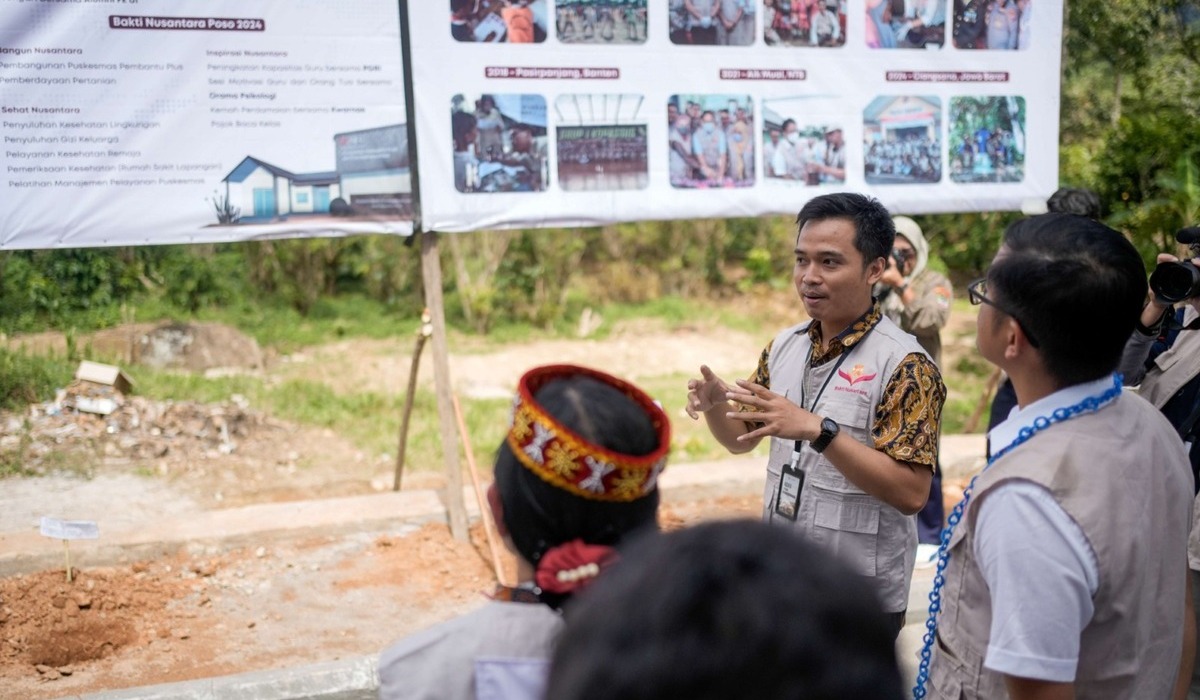
This prompted Assed to pursue a social mission by joining the Tunas Bakti Nusantara Foundation in 2017. The foundation was established by alumni of SMA Taruna Nusantara and works in social and economic empowerment across various regions of Indonesia.
The foundation’s activities embrace many young Indonesians from across the regions, including those overseas. Its main aim is for children and young people to have the optimism to dream high and to grow and make an impact on their surrounding communities (although its various education and health programmes target all levels of society).
At the foundation, Assed dedicates part of his time to carrying out social missions in various regions.
One area of focus for his social projects is Poso in Central Sulawesi, which was previously struck by social conflict. In this region, Assed and his colleagues built various social facilities and other programmes tailored to the needs of the local community.
“There was also a unique experience when we ran a programme in West Nusa Tenggara. Our main programme was actually establishing health service facilities in collaboration with the Health Ministry. Along the way, however, we were also asked to reconcile two villages that had been feuding for years,” he said.
From his career in consulting firms, founding and running Next Step, to his active involvement in various social activities, Assed believes the role of young people is crucial if Indonesia’s potential is to be properly harnessed.
For him, creative and innovative young people have great potential to become the driving force towards more inclusive and equitable change.